Getting your bearings in Qatar’s capital
Doha is the capital of Qatar, a small, independent, oil- and gas-rich state on a peninsula that juts north into the Persian Gulf from the Arabian mainland. It is worth saying plainly, because the two get mixed up constantly: Qatar is not part of the United Arab Emirates, and Doha is not a district of Dubai or Abu Dhabi. Qatar is its own state, ruled by its own Emir, with its own currency, laws and single land border, which it shares with Saudi Arabia to the south. Doha holds the large majority of the country’s population, and almost everything a visitor does — sightseeing, eating, shopping, day trips into the desert or the north — is organised around it.
The city itself is not one dense old town but a string of distinct districts strung along and around Doha Bay, each with a different character and a different reason to visit. This page is the map: what each district is for, how much time the city as a whole deserves, when to come, and how to move between the pieces.
The districts themselves — West Bay, the Corniche, Souq Waqif, the Museum of Islamic Art, the National Museum of Qatar, Katara, The Pearl-Qatar, Msheireb, Lusail and Al Rayyan — each have their own guides with practical detail; this page deliberately does not repeat what they cover.
How the city is organised
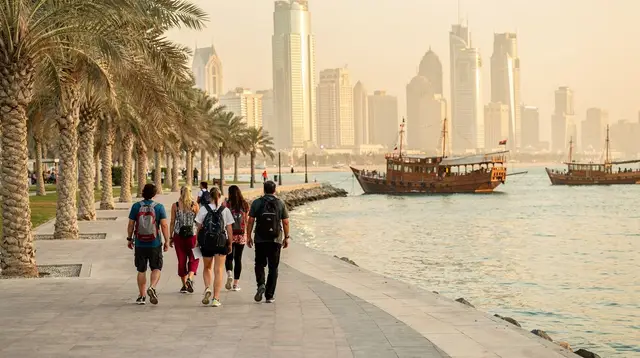
Doha wraps around Doha Bay in a rough crescent. On the eastern arm of that crescent sit the glass towers of West Bay, the city’s financial and hotel district, facing across the water toward the older heart of town. Running along the shoreline below West Bay is the Corniche, a roughly 7 km waterfront promenade where traditional wooden dhows moor and where the classic postcard view of the West Bay skyline is taken from, especially around sunset.
A short distance inland from the southern end of the Corniche is Souq Waqif, a restored traditional market that is the closest thing Doha has to an old town centre, and next to it the rebuilt heritage quarter of Msheireb Downtown, low-rise, walkable and deliberately built in a style that references old Doha rather than preserving an original one. Out on its own island just off the Corniche sits the Museum of Islamic Art, and a short drive south along the bay is the National Museum of Qatar, built around the old palace of Sheikh Abdullah bin Jassim.
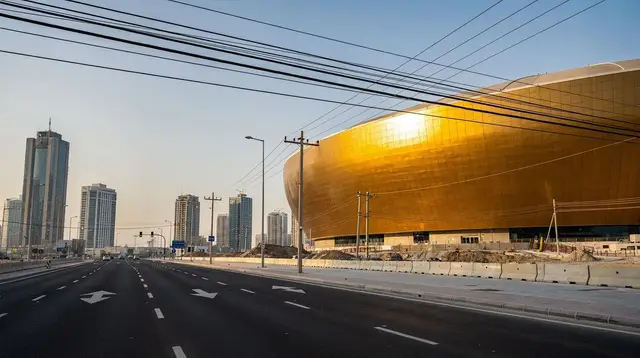
Further out, three newer or separate districts round out the picture: Katara Cultural Village, a purpose-built arts and beach precinct between West Bay and The Pearl; The Pearl-Qatar, an artificial island of marinas and apartment towers; and Lusail, an entirely new city to the north of West Bay, home to Lusail Stadium — the venue of the 2022 World Cup final — along with the Lusail Marina and Place Vendôme. To the west of the centre, Al Rayyan holds Education City, the Aspire Zone sports precinct and the 3-2-1 Qatar Olympic and Sports Museum.
None of these districts are within easy walking distance of each other; each is really its own destination with its own parking, metro stop or taxi drop-off, which is why planning a Doha trip is mostly a question of sequencing districts rather than covering one continuous downtown on foot.
How many days Doha deserves
Three to five days is the realistic range for the city itself, before adding any day trips into the desert, the north or the west of Qatar. Three days covers the essentials at a reasonable pace: a day around West Bay, the Corniche and a sunset dhow cruise; a day for Souq Waqif, Msheireb and one of the two big museums; and a day for Katara, The Pearl or Lusail depending on interest. Five days allows both museums properly, a slower pace through the souq in the evening rather than rushed, and room for Al Rayyan or a first day trip.
Travellers who are not on a dedicated Doha trip but stopping over on a Qatar Airways connection face a narrower version of the same question: whether it is even possible to leave Hamad International Airport depends on nationality and the entry rules in force at the time of travel, so that has to be checked before planning any city time at all. For those who can leave, a single evening is enough for a compressed loop of the Corniche and Souq Waqif; a full day adds a museum or Katara.
| Time available | Realistic priorities |
|---|---|
| A few hours (stopover) | Corniche viewpoint, Souq Waqif in the evening |
| 1 day | Add one museum or a sunset dhow cruise |
| 2–3 days | West Bay, Souq Waqif, Msheireb, one museum, Katara or The Pearl |
| 4–5 days | All of the above plus Al Rayyan, the second museum, a slower souq evening |
| 5+ days | Add a desert, north-Qatar or west-Qatar day trip |
For a structured plan rather than a district-by-district list, see the two-day first-timer itinerary or the three-day essentials itinerary; a one-day West Bay and Katara route and a one-day Lusail and The Pearl route work well as single-day add-ons for longer stays.
When to visit
Qatar has a hot desert climate, and the difference between seasons in Doha is large enough to shape an itinerary. Summer, running roughly from May to September, is extremely hot and humid, with daytime temperatures routinely above 40°C; walking the Corniche or Souq Waqif in the middle of a summer afternoon is a genuine discomfort and, for some visitors, a health risk rather than just an inconvenience. The best season for outdoor sightseeing is roughly November to March, when days are warm and evenings on the water are genuinely pleasant. Rain is rare across the year and falls mainly in winter, when it does fall at all.
Visitors travelling in the hot months are not shut out of Doha; the city’s museums, malls and Msheireb’s covered areas are all air-conditioned, and outdoor plans simply shift to early morning or after sunset, which is when Souq Waqif comes alive anyway. See the guides on Doha in summer indoor activities and Qatar’s cool season outdoor activities for season-specific planning.
One more calendar note worth flagging on a page like this: Ramadan follows the Islamic lunar calendar and shifts roughly eleven days earlier every year, so it can fall in any season depending on the year of travel. It changes opening hours and daytime public eating and drinking rules across the city; check the dates for the year of travel rather than assuming a fixed month.
Getting around the city
Doha’s public transport has improved sharply since the Doha Metro opened in 2019. It runs three lines — Red, Green and Gold — and is clean, air-conditioned, inexpensive and a genuinely practical way to move between West Bay, Msheireb and the airport, with the Red Line serving Hamad International Airport directly. Standard class, a paid Gold Club class and family carriages are all available on the same trains. Beyond the metro, the free Msheireb tram loop and the separate Lusail Tram and Education City tram cover their own local areas rather than connecting the whole city.
The metro’s limitation is coverage: it does not reach Souq Waqif’s immediate doorstep as conveniently as it reaches West Bay, and it does not serve The Pearl, Katara or any of the districts beyond the city at all. For those, taxis (run by Karwa) and ride-hailing apps such as Uber and Careem are the normal choice, and they are also how the great majority of visitors reach the desert, the north and the west of Qatar, none of which the metro touches. Traffic in Qatar drives on the right.
A rental car is an option for the city itself but is not recommended for off-road areas such as the Inland Sea, which require an experienced driver in a proper 4x4. The Doha Metro and tram guide and the taxis and ride-hailing guide cover fares and routes in more detail; airport-specific transfer options are in the Hamad Airport to city centre guide.
For visitors who would rather not plan the logistics themselves, a half- or full-day guided loop is a straightforward way to see West Bay, the Corniche, Souq Waqif and Msheireb in one sitting. The City Tour Doha option covers the daytime landmarks in a single booking, while the Doha by Night tour is built specifically around the illuminated West Bay skyline and the Corniche after dark, which is when both are at their best.
Doha on the water
The Corniche is also where Doha’s harbour life happens: traditional wooden dhows moor along it and run short cruises around Doha Bay, usually timed for sunset or the evening, when the point of the trip — the lit-up West Bay skyline seen from the water — is at its clearest. This is a low-effort, high-payoff addition to almost any Doha stay, and it pairs naturally with an evening in Souq Waqif afterward since both are within a short taxi ride of each other.
The Sunset Dhow Boat Cruise covers the classic version of this outing, and travellers who want to combine the boat trip with a wider city loop can look at the combined city tour and dhow cruise instead of booking the two separately. The dhow cruise guide and practical tips for the Corniche departure points go into scheduling and pricing.
Museums, souqs and heritage in one city
Doha’s two landmark museums are easy to conflate but distinct in every respect. The Museum of Islamic Art, designed by the architect I. M. Pei, sits on its own purpose-built island off the Corniche, with the MIA Park green space beside it. The National Museum of Qatar, designed by Jean Nouvel and shaped like a desert rose, is built around the historic palace of Sheikh Abdullah bin Jassim, further south along the bay.
Both are run by Qatar Museums, both require tickets, and both close one day a week, so current hours are worth checking before planning a museum day around them. The Museum of Islamic Art visit guide and National Museum of Qatar visit guide cover tickets and layout; a straight comparison of the two is in Museum of Islamic Art vs National Museum.
Souq Waqif, despite its old-town feel, was substantially rebuilt in the 2000s on the footprint of the historic market rather than preserved intact; it is a working, contemporary souq rather than a museum piece. It comes alive in the late afternoon and evening, and many stalls close during the early afternoon, so timing a visit for the right part of the day matters more here than almost anywhere else in the city.
The adjoining Falcon Souq and falcon hospital are a distinctive Doha sight in their own right. Msheireb Downtown, the rebuilt heritage quarter near the souq, holds the four Msheireb Museums in restored historic houses and rewards an unhurried walk rather than a rushed pass-through; the Msheireb Downtown walking guide and Msheireb Museums guide lay out a route.
Beyond the historic centre
Katara Cultural Village, between West Bay and The Pearl, combines an arts and amphitheatre precinct with its own beach, and is at its best in the evening when performance spaces and restaurants are active; see the Katara evening guide. The Pearl-Qatar, the artificial island nearby, is built around marinas, high-end shopping and waterfront dining rather than sightseeing landmarks as such, and pairs naturally with Katara on the same outing, covered together in The Pearl and Katara tour guide.
Lusail, north of West Bay, is Doha’s newest district and the most different in feel: a planned city built around Lusail Stadium, the venue of the 2022 FIFA World Cup final, along with the Lusail Marina and the Place Vendôme shopping and entertainment complex. The Lusail city tour guide and Lusail Marina and Place Vendôme guide cover what is worth the trip out. West of the centre, Al Rayyan holds Education City’s university campuses, the Aspire Zone sports district and the 3-2-1 Qatar Olympic and Sports Museum, detailed in the Education City and Aspire Zone guide and the 3-2-1 museum guide.
Where to base yourself
West Bay suits travellers who want hotel towers, easy metro access and proximity to Lusail and the airport line. Souq Waqif and Msheireb suit those who want to walk out into restaurants, the souq and the museums’ general area on foot in the evening. The Pearl suits a quieter, marina-facing stay with its own dining scene, at the cost of being further from the historic centre. A dedicated comparison is in West Bay vs Souq Waqif vs The Pearl: where to base, and a fuller district-by-district breakdown is in the Doha neighborhoods guide.
Doha as a base for day trips
Once the city itself is covered, Doha is also the natural base for everything else in Qatar: the desert dunes and the Inland Sea to the south, the mangroves and Al Zubarah’s UNESCO-listed pearling town to the north, and Zekreet’s abandoned film set and sculpture in the west. None of these are reachable by metro, and the Inland Sea specifically can only be reached by 4x4 across sand. The day trips from Doha guide and the things to do in Doha hub index the full range of options by category, from desert safaris to museums to kayaking.
Doha, Qatar: frequently asked questions
Is Doha in the UAE or Dubai?
No. Doha is the capital of Qatar, an independent country with its own Emir, currency and border with Saudi Arabia. It is not part of the United Arab Emirates and is not close to Dubai or Abu Dhabi; the two are separate Gulf states with separate airline hubs and separate skylines.
How many days should I spend in Doha?
Three to five days covers the city’s main districts — West Bay, the Corniche, Souq Waqif, Msheireb and one or two of Katara, The Pearl and Lusail — at a comfortable pace. Stopover travellers with only a few hours typically manage the Corniche and Souq Waqif; longer stays leave room for both major museums and a day trip beyond the city.
What is the best time of year to visit Doha?
Roughly November to March, when daytime temperatures are warm rather than extreme and evenings outdoors are comfortable. Summer, roughly May to September, is extremely hot and humid, and outdoor sightseeing in the middle of the day during those months carries real health risk.
How do I get around Doha without a car?
The Doha Metro’s Red, Green and Gold lines cover West Bay, Msheireb and the airport cheaply and comfortably, supplemented by the free Msheireb tram loop and the separate Lusail and Education City trams. For The Pearl, Katara and anywhere outside the metro’s reach, taxis and ride-hailing apps such as Uber and Careem are the standard option.
Which of Doha’s two big museums should I visit first?
There is no fixed order; they cover different subjects and are in different parts of the city. The Museum of Islamic Art, on its own island off the Corniche, focuses on Islamic art and design; the National Museum of Qatar, built around the historic Amiri palace further south, focuses on Qatar’s own history and landscape. Visitors with limited time often pick one rather than rush both in a single day.
Is Souq Waqif an old original market?
Not physically. The souq was substantially rebuilt in the 2000s on the footprint of the historic market, so what visitors walk through today is a restored, modern version of an old trading site rather than an unaltered original. It is busiest and most atmospheric in the late afternoon and evening, since many stalls close for part of the early afternoon.
Can I see Doha on a Qatar Airways stopover?
It depends on nationality and the entry rules in force at the time of travel, which determine whether a transit passenger can leave Hamad International Airport at all. Travellers who can leave typically have enough time for the Corniche and an evening in Souq Waqif on a short layover, or add a museum or desert visit on a longer one.
Do I need a rental car to see Doha’s districts?
Not for the city itself, where the metro and taxis cover West Bay, Msheireb, Souq Waqif, The Pearl, Katara and Lusail without difficulty. A rental car is not recommended for off-road destinations such as the Inland Sea, which require an experienced driver in a proper 4x4 rather than an ordinary saloon.