A building shaped like a desert rose
Few museum buildings anywhere try to explain a country before a single object is on display, but the National Museum of Qatar does exactly that. Approach it from the Corniche and the building reads less like a conventional museum than a low, pale outcrop that has grown out of the shoreline: hundreds of interlocking discs of different sizes, curving and tilting against each other, catching the light differently through the day.
The reference is the desert rose, a mineral formation of gypsum and sand crystals that forms naturally in Qatar’s arid terrain, and the architect, Jean Nouvel, used it deliberately as a way of rooting a very modern building in the country’s own desert landscape rather than importing a foreign museum typology wholesale.
The museum opened in 2019, more than a decade after the older Museum of Islamic Art established Doha’s first major cultural landmark on its own island further along the bay. The two buildings are frequently confused by first-time visitors because both sit on the Corniche and both are architectural set pieces, but they are the work of different architects with entirely different briefs: the Museum of Islamic Art, by I.
M. Pei, houses a collection of Islamic art assembled from across the Muslim world, while the National Museum of Qatar, by Jean Nouvel, is a history museum built specifically to tell the story of Qatar itself. Getting the two swapped is one of the most common mix-ups in Doha trip planning, and it is worth fixing before you go, since it changes what you should expect to see inside.
What makes the building more than a striking shell is what it is built around. At the centre of the disc structure stands the restored palace of Sheikh Abdullah bin Jassim Al Thani, who ruled Qatar in the early 20th century and used this waterfront residence as his seat of government for around 25 years. Rather than demolish the palace to build something new, the museum was designed to enclose and preserve it, so that the old structure now sits inside the new one as both an artefact and a starting point for the exhibition itself.
Walking through the museum, you move from the palace outward into galleries that trace Qatar’s history forward from it, which gives the whole visit a sense of chronological and physical logic that is unusual among history museums: the building is not simply a container for the story, it is staged around the actual place where part of that story happened.
What the museum tells you about Qatar’s history
The National Museum of Qatar organises its permanent galleries as a continuous chronological journey, usually described as beginning with the geological formation of the Qatari peninsula itself, before moving through the archaeology of early settlement, the centuries of Bedouin and coastal life, the pearling economy that sustained Qatar before oil, the difficult mid-20th-century collapse of that pearling trade after the arrival of Japanese cultured pearls, and finally the discovery of oil and gas and the rapid transformation of the country into its present form. It is, in effect, a single narrative arc from desert and sea to skyscraper, and it is designed to be legible to visitors who arrive with no prior background in Gulf history.
A few threads run through the galleries that are worth knowing before you go, because they explain a lot of what you will see elsewhere on a Qatar trip. Pearling is one of them: for generations before oil, Qatar’s coastal towns, including Al Wakrah and the settlements further south, depended on pearl diving fleets that spent months at sea each summer, and the collapse of that industry in the 1930s was a genuine economic shock that the museum treats with some care rather than skipping past.
The Bedouin desert way of life is another thread, and it gives useful context if you are also planning a desert safari out toward Sealine or the Inland Sea later in your trip: the museum’s account of tribal and nomadic life in the peninsula’s interior is a good primer for understanding why that landscape still matters culturally, not just scenically. And the emergence of the modern state under the Al Thani family, culminating in the palace at the museum’s core, gives a direct thread from a 20th-century ruler’s residence to the Qatar of Lusail towers and the 2022 World Cup stadiums you may already have seen from the plane.
Because the museum is run by Qatar Museums, the same body responsible for the Museum of Islamic Art and several of the country’s other major cultural institutions, its galleries are updated periodically and its temporary exhibition spaces host rotating shows, so what is on display beyond the permanent chronology can change between visits.
Visiting: what to check before you go
This is a page about the museum as a destination, not a ticketing desk, and the two things visitors most often get wrong are opening hours and admission prices. Both change, both are set by Qatar Museums directly, and quoting a specific number here would go stale quickly and could easily send you to the wrong entrance at the wrong time. What is worth stating plainly: the museum, like the Museum of Islamic Art, closes one day a week, and rather than name a day that may no longer be accurate by the time you read this, check the current schedule directly with Qatar Museums or the museum’s own listing before you plan your visit around it.
The same applies to ticket prices, which have varied by visitor category over the years the museum has been open. For the current information you need to actually plan your visit, use our dedicated National Museum of Qatar visit guide, which is kept up to date with hours, admission and practical tips, rather than relying on a fixed figure printed once and left to age here.
A few practical notes that don’t tend to change as quickly as prices. The museum sits directly on the Corniche waterfront, close enough to West Bay and the old town that it is easy to combine with a longer Corniche walk, and it is a short taxi or rideshare ride from most Doha city hotels; the Doha Metro does not stop at the museum door, so a taxi, rideshare app, or a walk from the nearest station is the practical way in.
Bring a printed or digital ticket confirmation if you book ahead, dress modestly as you would for any museum or public building in Qatar (shoulders and knees covered), and allow at least two and a half hours if you intend to see the permanent galleries properly rather than skim them, since the chronological layout genuinely rewards moving through it in order.
The park, the shop and the setting
The museum’s grounds are as much a reason to come as the galleries. MIA Park, the landscaped waterfront green space that runs along the Corniche near the Museum of Islamic Art, sits close enough that many visitors combine both stops in a single outing, and the National Museum of Qatar has its own surrounding public realm, with the disc structure visible from multiple angles as you approach from the water side.
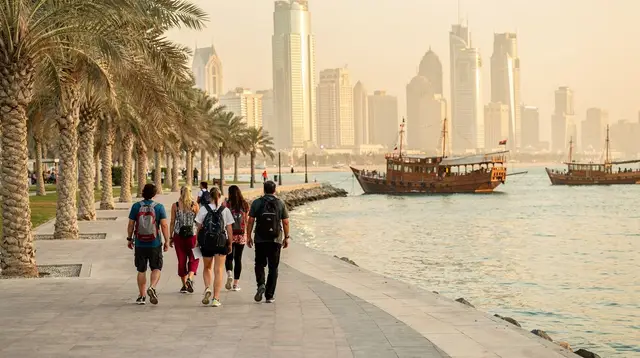
In the evening, when the discs are lit and the tide is calm, the exterior alone draws photographers who never buy a ticket to go inside. There is a museum shop and a café inside, and the traditional wooden dhow moored beside the museum, once part of the pre-oil pearling and fishing economy the galleries describe, is a deliberate physical echo of the exhibition inside: a single boat sitting outside a museum explaining the trade that boats like it once carried out.
Pairing the museum with the rest of the city
Most visitors treat the National Museum of Qatar as one stop on a longer day rather than a destination in isolation, and the geography makes that easy. It sits close enough to Souq Waqif that a museum morning and a souq evening fit naturally into the same day, with the souq only really coming alive in the late afternoon in any case.
It is also a reasonable pairing with Msheireb Downtown and its own cluster of heritage museums a short drive away, since both sites deal with different chapters of the same national story: Msheireb through restored early-20th-century houses and the Msheireb Museums, the National Museum through the broader sweep from geology to gas. If your schedule is tight, our half-day Doha city tour guide and one-day Doha highlights itinerary both show how to fit the museum in alongside the Corniche, the souq and West Bay without feeling rushed.
Travellers on a Qatar Airways stopover ask about this museum more than almost any other single sight, because it photographs well, sits close to the airport road, and can be done properly in half a day. If that describes your trip, our Doha stopover guide and Doha layover museums and souq guide go into more detail on timing a museum visit around a transit window, including how long to allow to and from Hamad International Airport.
For visitors weighing the two big Corniche museums against each other before committing an afternoon to one or both, our Museum of Islamic Art vs National Museum of Qatar comparison sets out how the two collections and buildings differ, since they are genuinely complementary rather than duplicates of each other.
A tour rather than a self-guided visit
Some visitors prefer a guided introduction to Doha that includes the museum’s exterior and the wider West Bay and Corniche area as part of a broader city overview, especially on a first visit or a short stopover. A half-day tour such as a guided highlights tour covering Doha’s landmark sights typically passes the museum along the Corniche and can be a useful orientation before or after a self-guided visit inside.
If your interest runs more toward Qatar’s newer architectural and educational landmarks, a full-day city tour that also takes in Education City pairs the museum’s story of the country’s past with a look at where its universities and research institutions sit today, and a guided visit to the Education City Mosque, Qatar National Library and Quranic Botanic Garden extends that theme further west into Al Rayyan.
The museum’s own account of Qatar’s modern transformation connects naturally to the country’s recent sporting history, and travellers curious about the 2022 World Cup infrastructure built partly on the wealth the museum’s later galleries describe may enjoy a guided visit to the 3-2-1 Qatar Olympic and Sports Museum in Al Rayyan as a follow-on stop. For a different, more nostalgic angle on Qatar’s mid-20th-century past, a classic car tour through Doha with an expert driver is a distinctive way to see the city’s older and newer districts side by side.
Where the museum fits in a longer trip
If you are building out a fuller Doha itinerary, the National Museum of Qatar sits comfortably within any first visit of two days or more. Our two-days-in-Doha-first-time itinerary and the more detailed three-days Doha essentials itinerary both place the museum on day one alongside the Corniche and Souq Waqif, leaving desert or northern day trips for day two.
For the wider question of how long to spend in the country as a whole, our how many days in Doha guide and best time to visit Doha article cover seasonal planning beyond this single stop, including why the cooler months from November to March make the Corniche walk to and from the museum far more comfortable than the height of summer.
Frequently asked questions about the National Museum of Qatar
Who designed the National Museum of Qatar?
The National Museum of Qatar was designed by French architect Jean Nouvel, opening in 2019. It should not be confused with the Museum of Islamic Art, a separate building on its own island along the Corniche designed by I. M. Pei.
Why is the museum shaped like interlocking discs?
The design is inspired by the desert rose, a mineral formation of gypsum and sand crystals found naturally in Qatar’s desert terrain. Jean Nouvel used the form to root a contemporary museum building in the country’s own landscape rather than following a conventional museum shape.
What is inside the museum besides the exhibits?
The museum is built around and incorporates the restored palace of Sheikh Abdullah bin Jassim Al Thani, a former ruler of Qatar who used the site as his seat of government in the early 20th century. The permanent galleries trace Qatari history chronologically from geological formation through pearling, Bedouin life and the oil and gas era.
How long should I plan to spend at the museum?
Most visitors need two and a half to four hours to see the permanent galleries properly, given the chronological layout. Add extra time if you also want to walk the surrounding grounds, see the moored dhow outside, or visit the museum shop and café.
What are the current opening hours and ticket prices?
Hours and admission are set directly by Qatar Museums and do change, so this page does not quote a fixed price or a specific closing day. Check current details before you go in our dedicated National Museum of Qatar visit guide.
Does the museum close on a specific day of the week?
Like several major Qatar Museums sites, it does close one day a week, but the exact day is not fixed here since it is best confirmed against the current official schedule rather than an aging guide. Verify it shortly before your visit.
Is the National Museum of Qatar the same as the Museum of Islamic Art?
No. They are separate buildings by separate architects with separate collections: the National Museum of Qatar, by Jean Nouvel, tells the story of the country’s history, while the Museum of Islamic Art, by I. M. Pei, houses a collection of Islamic art from across the Muslim world. Many visitors see both on the same trip.
How do I get to the museum from central Doha?
The museum sits directly on the Corniche and is a short taxi or rideshare ride from West Bay, Souq Waqif and most city-centre hotels. The Doha Metro does not stop at the museum entrance, so a taxi, rideshare app or a walk from the nearest station is the practical route.