A museum built on its own island
Few buildings sum up modern Doha as neatly as the Museum of Islamic Art. It does not sit inside an older neighborhood or share a block with anything else: the Qatari government built it a small artificial island of its own, just off the Corniche, so that the building could be seen from every angle, surrounded by water on three sides.
The architect was I. M. Pei, best known internationally for the glass pyramid at the Louvre in Paris, and the Museum of Islamic Art, completed in 2008, was one of his last major projects. It is a separate building, by a separate architect, from the National Museum of Qatar further along the waterfront — a distinction worth holding onto, because the two are easy to mix up on a first visit and are, in fact, entirely different structures with different designers and different collections.
Pei was in his eighties when he took on the commission, and reportedly spent time studying early Islamic architecture across the Middle East and North Africa before settling on a design that draws on geometric forms rather than quoting any single historical building. The result is a stack of cubes and octagons in pale limestone, stepped back as they rise, crowned by a central dome-lit atrium that floods the entrance hall with daylight. It reads as modern from a distance and unmistakably rooted in Islamic geometric tradition up close, which is precisely the balance the design was aiming for.
Setting: the Corniche, the bay and the West Bay skyline
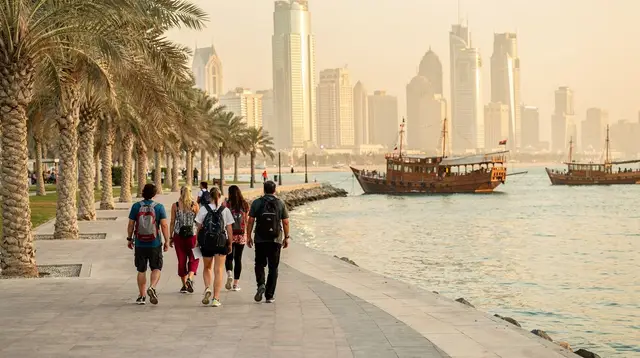
The site is the point almost as much as the building. From the museum’s island, the sweep of West Bay fills the horizon across Doha Bay: a dense cluster of towers that has gone up mostly since the 2000s, glass and steel catching the light differently through the day and lit up after dark. Photographers gather along the museum’s waterline in the late afternoon for exactly this view, and it is one of the more reliable places in the city to get an uncluttered shot of the skyline without fighting traffic on the Corniche itself.
The museum sits at the southern end of the Corniche’s long waterfront promenade, the same curve of reclaimed shoreline that runs roughly seven kilometers around the bay and where the city’s traditional wooden dhows still moor, available for short evening cruises. Walking the Corniche from Souq Waqif to the museum, or the other way, is one of the simplest and most rewarding things to do in central Doha on a cool evening: flat, well-lit, mostly shaded by late afternoon, and bookended by two of the city’s most photographed landmarks.
MIA Park: the museum’s own public space
Around the base of the building is MIA Park, a landscaped strip of lawns, palm-lined paths and shaded benches that wraps the island and extends along a stretch of adjoining shoreline. It functions as a public park in its own right, used by joggers in the cooler months, by families in the evening, and by anyone who wants to sit somewhere green and look back at the water without paying for entry anywhere. Food trucks and small kiosks appear along the park’s edges at various times, and it is a reasonable spot to let children run around after a stretch of gallery-going, since the museum’s interior — impressive as it is — is not built for long stays by younger visitors.
Because the park is open space rather than a ticketed area, it is also one of the easier places in Doha to combine a free activity with a paid one: walk the park and the waterfront for nothing, then decide separately whether to go into the galleries.
What is inside
The museum’s collection spans roughly 1,400 years of Islamic art gathered from three continents — manuscripts, ceramics, glasswork, textiles, jewelry, and metalwork among the holdings — arranged around Pei’s central atrium, where a monumental chandelier-like fixture hangs beneath the dome. The building itself, with its interplay of light, geometric pattern and stone, is often described by visitors as being as much a part of the experience as the objects on display.
Because gallery layouts, current exhibitions, opening hours, the weekly closing day and ticket prices are all set and updated by Qatar Museums, the public institution that runs the site, none of those specifics are repeated here — they change, and quoting a fixed number risks being wrong within a season. Our Museum of Islamic Art, Doha: A Visitor’s Guide covers how to check current details and how to plan a visit around them.
Getting there
The museum sits close enough to central Doha that most visitors reach it on foot or by a short taxi ride. From Souq Waqif it is a comfortable walk along the Corniche; from the West Bay towers it is a slightly longer walk or a five-to-ten-minute taxi or ride-hailing trip around the bay.
Visitors staying near The Pearl-Qatar or Lusail, further north, will generally find a taxi more practical than the Doha Metro, since the museum’s location on the Corniche is not directly on a metro line; a taxi from either area typically takes fifteen to twenty-five minutes depending on traffic. For anyone arriving straight from Hamad International Airport, the museum is a manageable stop on the way into the city, which is part of why it appears so often on layover itineraries.
Pairing the museum with the rest of Doha city
The Museum of Islamic Art belongs to the dense cluster of sights that make up central Doha, and almost nobody visits it in isolation. The most common pairing is with Souq Waqif, the restored traditional market a short walk up the Corniche, best visited in the late afternoon or evening once its stalls and cafés come alive. A second common pairing is with the National Museum of Qatar, further round the bay near the old palace site — a different building by a different architect, worth treating as a separate stop rather than an extension of the same visit.
Travelers with a full day can also work in Msheireb, the rebuilt heritage quarter a short ride inland, or continue north to Lusail and The Pearl-Qatar for a look at the newer side of the city, or west to Al Rayyan for the museums and stadiums of Education City and the Aspire Zone.
Guided options bundle several of these stops into a single half-day or full-day city tour, which suits anyone short on time or unfamiliar with the layout of central Doha. A city tour such as a half-day highlights tour covering the Corniche, the museum area and the old town is a straightforward way to see the museum’s setting alongside Souq Waqif without arranging transport between each stop.
Visitors who prefer the water can instead combine the museum’s waterfront view with a short cruise: a traditional dhow ride paired with a stop near Souq Waqif gives a sense of the bay from the water before or after seeing the museum from land.
Those staying longer, or based further north near Lusail, sometimes prefer a single day that mixes the old city with newer districts, in which case a combined tour taking in the souq, the museum area and Lusail’s waterfront covers more ground in one booking. Travelers with a specific interest in Education City’s architecture and museums can extend the day further west with a full-day city tour that continues out to Education City.
When to visit
The building and the park work at any time of year, but the outdoor half of the visit — walking the island’s waterline, sitting in MIA Park, photographing the West Bay skyline — is far more comfortable during Qatar’s cooler months, roughly November to March, when daytime temperatures are mild and the evenings are pleasant enough to linger.
Summer, from around May to September, brings extreme heat and humidity that make anything more than a quick dash between air-conditioned spaces uncomfortable; the museum’s interior remains a valid indoor option in summer, but the park and the waterfront walk are best saved for the cooler season, or for the couple of hours after sunset when temperatures ease. Late afternoon and early evening, in any season, tend to give the best light for photographs across the bay toward West Bay’s towers.
Museum of Islamic Art vs. National Museum of Qatar
Because visitors regularly confuse the two, a short side-by-side is useful before planning a day around either one.
| Museum of Islamic Art | National Museum of Qatar | |
|---|---|---|
| Architect | I. M. Pei | Jean Nouvel |
| Opened | 2008 | 2019 |
| Location | Its own island off the Corniche | Site of the old palace of Sheikh Abdullah bin Jassim |
| Form | Stacked cubes and octagons, central atrium | Interlocking discs inspired by a desert rose |
| Setting | MIA Park, facing the West Bay skyline | Waterfront gardens along the Corniche |
For a fuller comparison of what each museum covers and how to plan a visit to both in one trip, see Museum of Islamic Art vs. National Museum and the practical National Museum of Qatar: A Visitor’s Guide.
Nearby in central Doha
Beyond the two big museums, the same stretch of the city rewards a slower look. Msheireb Downtown has its own cluster of heritage buildings and small museums a short taxi ride inland; a walking route through the district is covered in Msheireb Downtown Walking Guide.
Anyone spending a full day around the museum and the old town can plan the sequence in advance with One Day in Doha: National Museum, Msheireb and Souq Waqif or, for a broader introduction to the city’s landmarks in a single day, One Day in Doha: Museum of Islamic Art, Corniche and Souq Waqif. Travelers planning further ahead may also want Best Time to Visit Doha to weigh the museum’s outdoor park against the rest of the year’s heat.
Visiting the Museum of Islamic Art: what to know
Who is the architect of the Museum of Islamic Art in Doha?
The Museum of Islamic Art was designed by I. M. Pei, the architect also known for the Louvre Pyramid in Paris. It should never be confused with the National Museum of Qatar, which is a separate building designed by Jean Nouvel.
Is the Museum of Islamic Art the same building as the National Museum of Qatar?
No. They are two different museums in two different parts of the city. The Museum of Islamic Art sits on its own island off the Corniche, designed by I. M. Pei, while the National Museum of Qatar occupies the site of the old palace of Sheikh Abdullah bin Jassim, further along the waterfront, designed by Jean Nouvel.
What are the opening hours and ticket prices for the Museum of Islamic Art?
Opening hours, the weekly closing day and ticket prices are set and updated by Qatar Museums, the institution that runs the museum, so they are not repeated here to avoid quoting anything out of date. Check the official Qatar Museums channels or our practical visit guide before you go.
Can I walk to the Museum of Islamic Art from Souq Waqif or West Bay?
Yes. It sits on the Corniche within easy walking distance of Souq Waqif, and a pleasant walk or a short taxi ride from the West Bay towers. Many visitors combine it with a stroll along the promenade in either direction.
What is MIA Park and is it free to visit?
MIA Park is the landscaped public park that surrounds the museum building on its island, with lawns, shaded paths and views back across the bay. The park itself is open public space; only the museum galleries require a ticket, set by Qatar Museums.
Is the Museum of Islamic Art suitable for a Doha stopover?
Yes, it is one of the most efficient stops for a short layover: it sits close to Hamad International Airport by road, close to the Corniche and Souq Waqif, and can be combined with a walk or a short guided tour in a few hours.
What should I see inside the Museum of Islamic Art?
The museum holds a collection spanning roughly 1,400 years of Islamic art from three continents, including manuscripts, ceramics, glass, textiles and metalwork, arranged around a soaring central atrium. Specific current exhibitions and gallery layouts are best checked on the official Qatar Museums site before a visit.