Doha in Summer: The Best Indoor Activities When It's Too Hot Outside
What can you actually do in Doha during the hot months?
Base your day around air-conditioned museums, malls and indoor attractions, save any outdoor time for early morning or after sunset, and book desert trips as sunrise safaris rather than afternoon ones. Doha's metro, malls and cultural sites are fully air-conditioned, so the heat mostly affects walking tours and midday sightseeing outdoors.
Planning around the heat, not against it
Doha’s hot season runs roughly from May to September, and it changes how a trip should be built far more than it changes whether the trip is worth taking. Flights and hotel rates tend to be noticeably lower in these months, the city’s museums and malls are exactly as good as they are in winter, and the crowds at the major sights thin out considerably. The trade-off is straightforward: outdoor walking in the middle of the day stops being a reasonable option, and a schedule built around strolling the Corniche or wandering Souq Waqif at noon needs to be rebuilt around air-conditioned interiors and shifted daylight hours instead.
This is not a minor comfort issue. Midday heat during the hot months is a real health risk, not an inconvenience to push through, and it catches out visitors who assume a desert country is simply “very warm” the way a Mediterranean summer is very warm. The practical answer is not to cancel outdoor plans altogether, it is to move them: early morning before the sun is high, or evening once it has dropped, with the hours in between spent somewhere with reliable air conditioning.
For exact monthly conditions rather than a single blanket description, the best time to visit Doha guide and the month-specific pages such as Doha in June, Doha in July and Doha in August are the more precise references — this page deliberately does not attach a number to how hot it gets, because that number changes year to year and a wrong one is worse than none.
The other window: early morning
Evenings get most of the attention, but the hour or so around sunrise is the other genuinely comfortable stretch of a summer day in Doha, and it’s easy to waste it sleeping in. The Corniche and the waterfront around Al Bidda Park are at their quietest and coolest right at first light, well before the malls and museums open, which makes this the natural slot for a walk along the water rather than a drive-by glance from an air-conditioned car later in the day.
a guided walk covering Al Bidda Park and the Corniche uses exactly this window, finishing well before the heat builds. For visitors who prefer to structure their own route rather than join a guided one, the Doha walking tours guide lays out which stretches of the city are worth covering on foot and at what time of day, summer included.
Museums: the backbone of a summer itinerary
The two landmark museums in Doha are built for exactly this kind of day. The Museum of Islamic Art, designed by I. M. Pei and set on its own island off the Corniche, and the National Museum of Qatar, designed by Jean Nouvel around the old palace of Sheikh Abdullah bin Jassim and shaped like a desert rose, are both large enough to fill a half day each, and both are fully air-conditioned throughout.
Visiting them back to back, with a break for lunch somewhere indoors in between, easily covers a full day without any meaningful time spent outside. Full visit planning, including current hours (both close one day a week), sits in the dedicated Museum of Islamic Art visit guide and National Museum of Qatar visit guide.
Beyond the two headline museums, the restored heritage quarter of Msheireb Downtown holds four indoor Msheireb Museums built inside restored historic houses, all air-conditioned and all walkable between via short, sheltered stretches rather than long open ones — details in the Msheireb Museums guide. Out at Education City and the Aspire Zone in Al Rayyan, the 3-2-1 Qatar Olympic and Sports Museum adds a third major indoor option, useful for spreading a multi-day summer visit across different neighborhoods rather than repeating the same drive each day.
Pairing a museum morning with an air-conditioned lunch keeps the whole block heat-free: both the Museum of Islamic Art and the National Museum of Qatar have on-site cafés, so there’s no need to step outside between the galleries and the meal. Photographers should note that both buildings are as much a subject as their collections — Pei’s building catches strong light through its central atrium, and Nouvel’s desert-rose form is easiest to appreciate from MIA Park across the water in the late afternoon, once the worst of the heat has passed but before the light fades.
Malls and indoor entertainment
Doha’s shopping malls do double duty in summer as genuine attractions rather than just places to buy things. Several combine retail with substantial indoor entertainment — aquariums, ice rinks, cinemas and, in one case, one of the region’s largest indoor theme parks — which makes an afternoon inside a mall a legitimate use of a hot day rather than a fallback. The full rundown of which malls offer what is in the Doha water parks guide and the indoor theme parks in Doha guide.
a full day at Doha’s largest indoor theme park is the single most heat-proof full-day plan available in the city: rides, attractions and food courts are all under one climate-controlled roof, which makes it a natural pick for families or anyone travelling with kids during the hottest stretch of the year. It pairs well with a museum visit the following day, so the two indoor anchors of a trip don’t feel repetitive.
Beyond the headline theme park, most of the larger malls also carry an ice rink, a cinema multiplex or an aquarium as a secondary draw, which is enough to fill a second indoor afternoon without repeating the same mall twice on a longer trip. None of this requires advance planning the way the museums or desert trips do — mall hours are long and consistent throughout the week, which makes them the easiest item to slot into a day that has run long or a plan that fell through elsewhere.
Culture and heritage sites that stay indoors
Not every cultural experience in Doha requires standing outside. Katara Cultural Village has indoor galleries and performance spaces alongside its beach, and The Pearl-Qatar and Lusail both have extensive indoor retail and dining that work as a shaded alternative to walking their marinas at midday — better saved for evening.
Moving between these areas is easiest by metro or tram rather than on foot: the Doha Metro and tram guide covers the fully air-conditioned Red, Green and Gold lines plus the Lusail Tram, the free Msheireb tram loop and the Education City tram, all of which let a visitor hop between indoor attractions without a car and without more than a few minutes of outdoor exposure at each end.
Ticketing for the major sights is worth sorting out before arrival rather than at the door, particularly in the lower-crowd summer months when advance booking can also mean shorter queues once inside; the Doha attraction tickets guide lays out what needs booking ahead and what doesn’t.
Traveling with kids in summer
Families face the heat constraint more acutely, since children tolerate midday sun even less well than adults, and the indoor-first approach above works particularly well for them. The indoor theme park, the aquariums and ice rinks inside several malls, and the hands-on galleries at the National Museum of Qatar all give kids something to do without any outdoor exposure, and the dedicated Doha with kids guide goes through which attractions hold a child’s attention longest.
Not everything worth doing costs money either: several of the indoor cultural spaces have free or low-cost entry, and the free things to do in Doha guide flags which of them work well as an air-conditioned break between paid attractions.
Evenings: where the outdoor experience moves to
Almost everything that would normally happen outdoors in Doha simply moves to the evening in summer. Souq Waqif is a good example: it is a restored traditional market, rebuilt in the 2000s on the footprint of the old souq, and it was never really a midday destination even in winter, since many stalls close in the early afternoon and the market comes alive from late afternoon into the night regardless of season. In summer that pattern just becomes non-negotiable rather than optional.
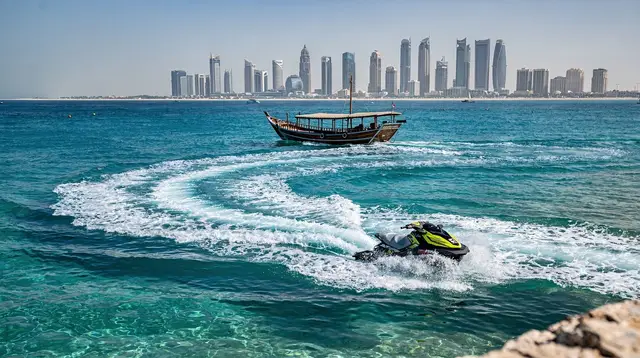
an evening tour through Doha’s illuminated skyline and waterfront is built for exactly this shifted schedule, covering the Corniche, West Bay and the souq after the temperature has dropped, when the same streets that are impractical at noon become genuinely pleasant to walk. A dhow cruise from the Corniche works the same way: these traditional wooden boats moor along the waterfront and the sunset or evening sailings, taking in the view back onto the West Bay skyline, are the standard way to experience Doha Bay in any season, and doubly so when the alternative is standing on an open deck at midday.
For a broader look at how to structure an evening-heavy day, a half-day city tour timed for the cooler parts of the day covers West Bay, the Corniche and Souq Waqif in a single guided loop, with transport between stops handled by air-conditioned vehicle rather than on foot.
Desert safaris: shift to sunrise
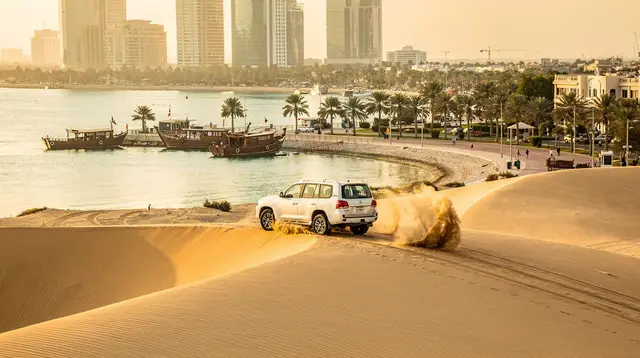
A desert safari does not have to be crossed off a summer itinerary, but the timing matters more than at any other time of year. Nearly all desert safaris are based at Sealine, south of the industrial port of Mesaieed and roughly an hour’s drive from Doha, and they typically combine dune bashing in a 4x4, sandboarding and often a run out to Khor Al Adaid, the Inland Sea, a tidal inlet among high dunes on the Saudi border reachable only by 4x4 across the sand.
In the hot months, a sunrise safari is the version worth booking. Doing the dune bashing and sandboarding in the first couple of hours after sunrise, before the sand and air have fully heated up, keeps the experience comfortable rather than punishing, and still delivers the full activity list.
a sunrise desert safari covering dune bashing, sandboarding and the Inland Sea is the practical way to keep this on the itinerary without scheduling it for the hottest part of the day. For more detail on how sunrise timing changes the experience, see the sunrise desert safari guide; an ordinary rental saloon car should never attempt this route regardless of the season, since the terrain requires an experienced driver in a proper 4x4.
Heat safety matters more on a summer desert trip than on any other outing in this guide, since the dunes offer no shade and temperatures there run higher than in the city itself. Sticking to a sunrise departure, carrying more water than feels necessary, and following the operator’s guidance on when to end the activity are not optional precautions in the hot months; the desert safari safety tips guide covers this in more detail than fits here.
Building a realistic summer day
A workable structure for a hot-season day in Doha looks less like a walking tour and more like a series of indoor blocks connected by short, air-conditioned transfers. The table below is a starting point rather than a fixed schedule — a later flight, an earlier check-in, or simply a preference for museums over malls will shift the blocks around, but the underlying logic, outdoors only at the edges of the day and everything else indoors, holds regardless of which specific attractions fill each slot.
| Time of day | What works well | What to avoid |
|---|---|---|
| Early morning (before sunrise to mid-morning) | Sunrise desert safari, hotel pool, early breakfast | Any walking tour of the souq or Corniche |
| Late morning to mid-afternoon | Museum of Islamic Art, National Museum of Qatar, Msheireb Museums, malls, indoor theme park | Outdoor sightseeing, walking between distant sights |
| Late afternoon | Indoor attractions continue, transition toward the waterfront | Long outdoor stops before the heat has dropped |
| Evening after sunset | Souq Waqif, Corniche walk, dhow cruise, Doha by Night tour, Katara beachfront | Nothing in particular — this is when outdoor Doha is at its best |
This pattern holds for most of the hot season, though the exact edges of “early” and “late” shift somewhat between May and September; the monthly blog pages such as Doha in July and Doha in August go into the specifics for travellers planning around a particular month, and the Doha summer survival guide covers hydration, clothing and general precautions in more depth than fits here.
The bottom line
Visiting Doha in summer means accepting one simple rule: nothing extended happens outdoors between mid-morning and early evening. Everything else about the city — its museums, its malls, its indoor entertainment, its metro network, and even its desert safaris in a sunrise slot — works exactly as well as it does the rest of the year. Built around that one constraint, a summer trip to Doha is not a compromised version of a winter one; it simply moves the outdoor half of the day to the hours on either side of it.
None of this requires giving up on Qatar’s outdoor identity either — the dunes, the mangroves and the coastline are still there, just accessible on a different clock than a winter visit would use. A trip planned this way often ends up more efficient than a cooler-season one, since the heat forces a clearer choice between indoor and outdoor time slots rather than the more meandering pace that mild winter weather tends to encourage.
Seasonal Guide
Verified deep-linked GetYourGuide tours. Book through these links and we earn a small commission at no cost to you.
GetYourGuide does not provide a product photo for this activity — the image shows the meeting point, photographed by us.