Katara Cultural Village in the Evening: Beach, Culture and Dinner
What is there to do at Katara Cultural Village in the evening?
Katara's beach, amphitheatre area and promenade are pleasant from the late afternoon into the night, once the heat has eased, with a range of restaurants and cafes overlooking the water. Cultural venues and galleries operate on their own schedules, so check what is actually open on the day rather than assuming a fixed evening programme.
Why the evening is the right time for Katara
Katara Cultural Village sits on the coast between West Bay and The Pearl-Qatar, and it is built for open-air movement: a beach, a wide promenade, an amphitheatre area, galleries and a scatter of restaurants, all facing the Gulf. During the middle of the day, especially in the hotter months, that open layout works against it — there is little shade and the heat off the pavement is real.
From the late afternoon onward, once the sun has dropped and the temperature has eased, the same layout becomes the village’s biggest strength. This guide is not about what Katara is, in the abstract; the Katara destination page covers that. It is about how to actually spend an evening there: the beach window, the cultural buildings, the restaurants along the water, and the walk itself.
Katara rewards an unhurried pace more than a checklist. There is no single “must-see” building that dominates the village the way the Museum of Islamic Art dominates its own island, or the way Souq Waqif’s lanes pull you through a set route. Instead, Katara is a place you drift through: sea air, a changing skyline view toward West Bay, and a choice of where to sit down for dinner.
Timing an evening at Katara
There is no fixed opening or closing time worth printing here, because Katara is a mixed-use precinct — beach, restaurants, galleries, event spaces — and each part runs on its own schedule that can also shift with the season and with Ramadan, which moves earlier every year on the Islamic calendar. The practical approach is simpler than chasing a timetable:
- Arrive in the last hour or two before sunset if you want beach time with tolerable heat and good light.
- Plan dinner for after sunset, when outdoor seating along the promenade is at its most comfortable.
- Treat any cultural building, gallery or event listing you see on site as the actual schedule for that day — not this guide, and not a general assumption carried over from another city.
If you are trying to fit Katara into a single evening alongside other coastal stops, the Pearl-Qatar and Katara tour groups them logically, and a broader Doha night tour can bookend Katara with the Corniche or West Bay skyline.
The beach
Katara’s beach is a public-facing stretch of sand on the Gulf, distinct from the fully private beach clubs found in some Pearl-Qatar developments. It suits a late-afternoon swim or a walk along the shoreline once the day’s heat has broken. As with any beach in Doha, swimwear is appropriate on the sand and around the immediate pool or beach-club areas, but it does not travel with you once you step back onto the promenade — more on that below. For a broader comparison of where to swim around the city, the Doha beaches guide sets Katara alongside the Pearl’s beach clubs and other coastal spots.
Do not expect posted lifeguard hours or facility details here: those change and should be checked on site rather than assumed from a guide written months earlier.
Watersports and beach activities
Katara Beach is not only a place to lay out a towel. Jet ski operators run out of the beach area, and an evening or late-afternoon session on the water gives a different view of the coastline than the promenade does — the towers of West Bay catching the last light from the water rather than from the shore.
The jet ski adventure with a Katara beach view and the adrenaline-filled jet ski tour at Katara Beach both run from this stretch of coast, and either works as a way to open an evening before moving on to dinner. For visitors comparing water activities across the city more broadly, the jet ski in Doha guide and the parasailing and flyboard guide cover the other options along the Corniche and Pearl-Qatar coastline.
As with the beach itself, operating hours, weather conditions and safety briefings are set by the operator on the day, not by this guide — check current timing when booking rather than assuming a session runs right up to sunset.
Cultural venues — what to expect, and what not to expect
Katara houses a number of galleries, exhibition spaces and cultural buildings, along with an amphitheatre used for events. This is genuinely a cultural village, not just a beach with restaurants attached. What this guide will not do is invent a nightly programme, list specific opening hours for specific galleries, or promise that a particular building will be running an exhibition on the evening you visit. Cultural programming in Katara varies by week and by season, and some spaces close for setup between events. The reliable approach:
- Walk the village and see what is actually open and signposted that evening.
- If a specific gallery or venue matters to your trip, check its own current information before you go, rather than relying on a static description.
- Treat any event you stumble across as a bonus, not the reason to plan the whole evening around Katara.
This is also where Katara differs most clearly from Souq Waqif: Souq Waqif’s rhythm (quiet by day, busy from late afternoon into the night, described in the Souq Waqif shopping guide) is fairly predictable across the year, while Katara’s cultural calendar is more variable.
The promenade and the amphitheatre area
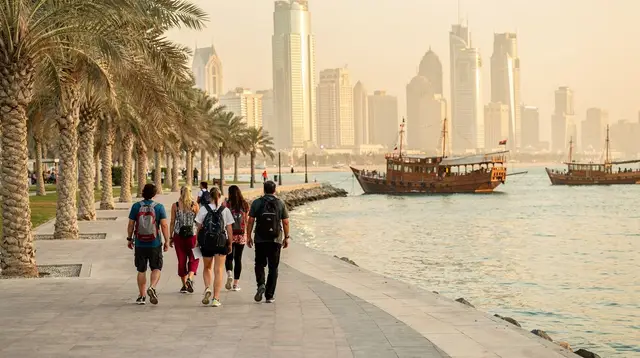
The waterfront promenade is Katara’s connective tissue — it links the beach, the restaurant cluster, the amphitheatre and the cultural buildings into one walkable loop, with views out toward the Gulf and, depending on where you stand, back toward the towers of West Bay. This is where an evening at Katara actually happens for most visitors: a slow walk, a stop to look at the water, another stop for food, rather than a tour of a single sight.
The amphitheatre area is used for performances and larger events at various points in the year; whether anything is scheduled on your evening is, again, something to check on site rather than assume. Even with nothing running, the space itself — an open amphitheatre facing the sea — is worth walking through as part of the loop.
Light, skyline views and photography
Katara’s evening light is one of its quieter draws. Because the village faces the Gulf and sits at a slight remove from West Bay’s towers, sunset and the half hour after it put the skyline in silhouette across the water — a different angle on the same towers that dominate views from the Corniche closer in.
The amphitheatre steps, the walkway near the twin towers that frame Katara’s entrance, and the beach itself all give a clear line of sight, with none of the crowding that can make similar shots harder to get along the busier stretches of the Corniche at the same hour. None of this needs a plan or a guide — it is simply worth timing your walk so that you are on the promenade, rather than at a restaurant table, when the light is at its best, and moving to dinner once it has faded.
Dress code — what changes once you leave the beach
This is one point worth being explicit about, because it trips visitors up more than almost anything else at Katara: the beach and pool areas are where swimwear belongs, and nowhere else in the village. Step off the sand and onto the promenade, into a restaurant, or into any of the cultural buildings, and the general Doha standard applies — shoulders and knees covered, nothing beach-specific.
This is not a Katara-specific rule invented for this guide; it follows the same modest-dress expectation that applies across malls, souqs and cultural sites in the city, covered in more depth in what to wear in Doha. Bring a cover-up or a change of clothes if your evening plan runs from a swim straight into dinner.
Where to eat
Katara’s restaurant cluster runs along the waterfront and around the village core, with a genuine range: casual cafes with outdoor seating and sea views, mid-range restaurants covering a mix of cuisines, and a few more upscale options. The common thread is the setting — outdoor or semi-outdoor tables facing the water, which is exactly what makes the evening slot work better than a midday visit. For a broader view of dining options across the city, including how Katara compares to West Bay and Souq Waqif for an evening meal, see Doha dinner experiences and the wider Doha food tour guide.
Two practical notes, both consistent with how dining works elsewhere in Doha: casual restaurants generally do not need advance booking, but the more popular sit-down spots can fill up on Thursday and Friday evenings, since the weekend in Qatar runs Friday and Saturday. Alcohol, where served at all in this part of the city, is limited to licensed hotel restaurants and bars rather than standalone venues — the same rule that applies across the country.
Getting to and from Katara
Katara sits on the coast between West Bay and The Pearl-Qatar, close enough to both that a short taxi or ride-hailing trip connects them. The Doha Metro does not run directly into the village, so most visitors arrive by taxi, ride-hailing app or their own car; parking is available on site. If your evening plan includes stops at more than one coastal neighbourhood, the Doha metro and tram guide and the taxis and ride-hailing guide both cover how the pieces fit together, and Lusail Marina and Place Vendôme is a reasonable add-on further north if your evening is not finished after Katara.
Combining Katara with a guided visit
If you would rather have the logistics — transport, orientation, a guide who can point out what is actually open that day — handled for you, a few guided options cover Katara alongside nearby sights. The Katara Cultural Village and coast guided tour is built specifically around this stretch of coastline.
For visitors who want Katara folded into a wider look at the city’s markets and heritage sites, the guided city tour that pairs Souq Waqif with Katara Village covers both in one outing, and the similarly structured city tour combining Souq Waqif and Katara Cultural Village is a close alternative worth comparing on timing and inclusions.
Travellers who prefer their own pace and their own vehicle can look at the private cultural guided tour with transfer, which builds the schedule around you rather than a fixed group departure.
A guided introduction to Katara’s culture
For visitors who want the village’s cultural side explained rather than just walked through, the Katara culture tour focuses specifically on this neighbourhood, and the stories of Katara culture, art and seaside heritage walking tour takes a similar walking-led approach, pairing the amphitheatre, galleries and seafront into a single narrated route.
Either is a reasonable way to get context on what you are looking at before setting off on your own for dinner, and both work as a shorter alternative to the wider city tours listed above if Katara itself, rather than Doha as a whole, is the point of the evening.
Building Katara into a wider Doha stay
Katara rarely needs to be the only stop of the evening, and it fits naturally into several of the itinerary patterns covered elsewhere on this site. The one-day West Bay and Katara itinerary pairs it with the skyline neighbourhood immediately to its south, while a first Doha trip built around the two-days Doha first-time itinerary can slot a Katara evening in alongside a daytime visit to the Museum of Islamic Art or Souq Waqif.
If you are still deciding how to structure your visit at all, the Doha city tour guide and the broader Doha for first-timers guide are useful starting points, and the Doha walking tours guide covers Katara’s promenade loop alongside comparable walks in Msheireb and along the Corniche. Anyone still weighing where to stay relative to Katara, West Bay, Souq Waqif and The Pearl should see the Doha neighborhoods guide for how the city’s areas relate to one another.
Katara in context: where it fits in a Doha evening
Katara is one of several coastal neighbourhoods that work well after dark, alongside the Corniche, West Bay and The Pearl-Qatar. It does not have the density of Souq Waqif or the single dominant landmark of the Museum of Islamic Art; its appeal is the combination of beach, open cultural space and waterfront dining in one walkable loop. For first-time visitors trying to decide how to split limited evenings across the city, West Bay vs Souq Waqif vs The Pearl is a useful companion piece, since Katara sits geographically and in character between those three.
For families, the open layout and beach access make Katara an easier evening than a dense souq crawl — the Doha with kids guide covers this in more detail. And if your main goal for the evening is simply a scenic walk with dinner at the end, Katara’s promenade does that job as well as anywhere in the city, without needing an event or a specific exhibition to be running.
The short version
Come to Katara in the late afternoon or evening, once the heat has eased. Use the beach if you want it, cover up again once you leave the sand, walk the promenade at your own pace, treat any cultural programming you find as a bonus rather than a guarantee, and pick a waterfront restaurant for dinner. It is a village built around a slow evening, not a single sight to tick off — plan the time accordingly rather than the itinerary.
Doha by Neighborhood
Verified deep-linked GetYourGuide tours. Book through these links and we earn a small commission at no cost to you.
GetYourGuide does not provide a product photo for this activity — the image shows the meeting point, photographed by us.