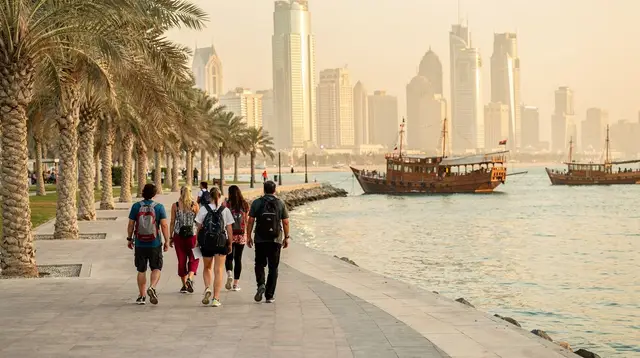
Msheireb Downtown Walking Guide
Is Msheireb Downtown an old part of Doha?
No. Msheireb Downtown is a newly built district finished in the 2010s, on the footprint of one of Doha's oldest neighbourhoods, next to Souq Waqif. Its low, sand-toned buildings and the four heritage houses it kept are designed to read as traditional, but almost everything visitors walk past was constructed in the last decade.
What Msheireb Downtown actually is
It is tempting, walking through Msheireb Downtown’s low sand-coloured buildings, wind-tower silhouettes and shaded arcades, to assume this is a preserved slice of old Doha that somehow survived the city’s rapid growth. It is not. This is one of the largest heritage-led redevelopment projects in the region, built almost entirely from the ground up and completed in the 2010s, on the exact site where Doha’s original town centre once stood.
The area had grown dense and run-down over decades; rather than demolish it for glass towers, the project’s architects and planners chose to rebuild it low-rise, walkable and deliberately traditional in style, while keeping four of the original houses standing as anchors for its museums.
The result is a district that functions like an open-air, air-conditioned-adjacent old town: narrow shaded streets, wind towers referencing older Gulf architecture, public squares, retail at street level, and a free internal tram loop connecting its main points. It sits immediately next to Souq Waqif, which is itself a rebuilt market rather than an untouched ancient one, so the two make a natural, walkable pairing rather than a contrast between “old” and “new” Doha.
This guide treats Msheireb Downtown as a self-guided walk: what to look for as you move through it, where the four Msheireb Museums sit, how the tram loop works in general terms, and how to link the walk to the Corniche and Souq Waqif on either side.
Correcting the “old quarter” idea
Because Msheireb sits on genuinely historic ground and reuses a handful of real historic buildings, many visitors describe it online as Doha’s preserved old town. It is more accurate to call it a reconstruction with authentic anchors. The four heritage houses that now form the Msheireb Museums are original structures, restored rather than rebuilt from scratch, and they carry real historical weight. Almost everything surrounding them, however, including most of the streets, squares, retail buildings and residential blocks, is new construction designed to evoke a traditional Qatari urban fabric rather than to preserve one.
This distinction matters for how you look at the district. The architecture is contemporary engineering, cooling technology and materials dressed in a traditional visual language, inspired by Gulf vernacular building rather than copying any single historic building. Wind towers, for instance, appear throughout Msheireb as a design reference to older passive-cooling structures, but they sit on buildings finished within the last ten to fifteen years.
Where to start the walk
Most visitors begin either from the Souq Waqif side, walking the short distance across into Msheireb, or from the district’s own main square near the museums. Because Msheireb and Souq Waqif are only a few minutes apart on foot, a natural route is to spend the cooler part of the late afternoon in Msheireb before crossing into the souq as it comes alive in the early evening. This guide will not give a fixed number of minutes for that walk beyond “a few,” since exact routing depends on where in each district you start.
If you are arriving by public transport, the Doha Metro and tram network connects into this part of the city, and Msheireb itself sits at a metro interchange point. Confirm current station names and connections before you travel, since this guide is not the place to state platform-level detail that can change.
The Msheireb tram loop
One of the more distinctive features of the district is its own short tram, which loops within Msheireb Downtown and does not charge a fare. It is entirely separate from the Lusail Tram and from the Doha Metro’s Red, Green and Gold lines; think of it as an internal circulator for the district rather than a way to get to or from it.
This guide will not state a frequency, first or last departure time, or a fixed number of stops for the tram, because these details are the kind that change without much notice and would be easy to get quietly wrong here. Check current tram information locally, on site, or through Qatar Museums or Msheireb Properties channels before building a tight schedule around it. In practice, most visitors treat the tram as a pleasant, free way to move between the museums and the main squares rather than as a strict timetable to catch.
What to look for as you walk
Street-level architecture. Look at how buildings step back and overlap to create continuous shade at street level, a deliberate response to Doha’s climate rather than a decorative choice. Wind towers, perforated screens (a nod to traditional mashrabiya lattice work) and sand-toned facades recur throughout, tying the district visually to older Gulf towns without literally reproducing one.
The public squares. Msheireb is organised around a series of connected open squares rather than a single main street, each shaded and each typically hosting a mix of retail, cafés and public seating. These squares are where the district’s public life happens in the cooler hours.
The four heritage houses. These are the genuine historic anchors: restored houses, each now home to one of the Msheireb Museums, covering distinct threads of Doha’s twentieth-century story, from family life to the early oil economy to darker chapters of regional history. Because each museum is compact, visiting all four in one afternoon is realistic for anyone who enjoys museums, though a single house alone is enough for a shorter visit.
Msheireb and Doha’s newer skyline. From several points in the district you get sightlines toward West Bay’s towers, a useful visual reminder that this low, traditional-looking quarter and Doha’s glass skyline are contemporaries, built within a similar recent period, rather than representing different historical eras of the city.
Visiting the Msheireb Museums
The four museums sit within walking distance of each other inside the district. Because they are ticketed and typically close one day a week, this guide will not state specific hours or a specific closing day; check current information before visiting, particularly if you are planning around a single free afternoon in Doha.
| Museum | What it covers | Typical visit length |
|---|---|---|
| Bin Jelmood House | History of the slave trade in the region | Under an hour |
| Company House | Qatar’s early oil-era administration | Under an hour |
| Mohammed Bin Jassim House | Family history tied to Qatar’s ruling family | Under an hour |
| Radwani House | Everyday family life in old Doha | Under an hour |
A guided option that bundles entry with context and commentary can be a good match for visitors who want the history explained rather than self-paced; see the tour options below.
Combining Msheireb with the rest of central Doha
Msheireb works well as one stop within a broader half-day or full-day loop through central Doha rather than as a destination on its own. A common combination is Msheireb in the afternoon, Souq Waqif as the evening picks up, and a Corniche walk or a dhow cruise at sunset to close the day. If you are short on time, treat Msheireb as the quieter, architecture-and-history half of that loop and the souq as the livelier, market-and-food half.
For visitors building a longer stay, Msheireb also pairs naturally with Msheireb Downtown itself as a base, or with a look at The Pearl-Qatar and Katara on a different day, since those newer districts show a different, more contemporary side of the city’s recent building boom.
Getting there and moving on
Msheireb sits centrally enough that most visitors reach it on foot from Souq Waqif or the Corniche, or via the metro and tram network described in our Doha Metro and tram guide. Taxis and ride-hailing apps are a straightforward alternative if you are coming from West Bay, Lusail or further out. Because the district was built with pedestrians and shade in mind, it remains one of the more comfortable parts of central Doha to explore on foot outside the height of summer.
If your time in Doha is limited to a stopover, Msheireb is compact enough to fit into a short window; see our Doha stopover guide for how it can slot alongside the airport, the souq and the Corniche.
Booking a guided visit
Walking Msheireb independently costs nothing beyond museum tickets, but a guided tour can help if you want the history and architecture explained as you go, or if you want to combine it efficiently with Souq Waqif and West Bay in a single outing. A short city tour such as the two-hour walk through Souq Waqif and Msheireb covers both districts back to back with a guide.
For a deeper look specifically at the heritage houses, a guided option focused on the Msheireb Museums and Qatar’s history adds context that is easy to miss walking through alone.
If Souq Waqif is your main interest and Msheireb is a bonus stop, a guided walk through Souq Waqif often extends naturally into the neighbouring district. Visitors who prefer going off the obvious path can also look at a guided walk through Doha’s hidden corners, which typically covers quieter streets around the historic centre.
Practical notes
- Heat: shaded streets help, but the extreme heat of the Doha summer (roughly May to September) still makes early morning or evening the more comfortable time to walk here; see our guide to Doha in summer for indoor alternatives during the hottest hours.
- Dress: as with the rest of central Doha, modest dress covering shoulders and knees is expected in the museums and public squares.
- Timing with the souq: Souq Waqif itself is quieter in the early afternoon and busiest in the late afternoon and evening, so pairing an afternoon Msheireb walk with an evening souq visit tends to work better than the reverse.
- Photography: the district’s squares and facades are popular for photos; be considerate around the entrances of the heritage houses, which remain functioning museums rather than photo backdrops.
Frequently asked questions about Msheireb Downtown
Is Msheireb Downtown an old quarter of Doha?
No, it only looks that way. It is a purpose-built redevelopment completed in the 2010s on the site of Doha’s original downtown, which had fallen into disrepair. Four historic houses were restored as the Msheireb Museums; nearly everything else around them is new construction in a deliberately traditional style.
Is the Msheireb tram free?
Yes, the short tram loop that circulates within Msheireb Downtown does not charge a fare. It is separate from the metro-linked Doha Metro and from the Lusail Tram, which serve different parts of the city.
How long does the tram loop take and how often does it run?
This guide will not state a fixed frequency or journey time for the tram, because both can change. Check the current schedule and route on site or with Qatar Museums or Msheireb Properties before planning your visit around it.
What are the Msheireb Museums?
They are four separate small museums, each set in a restored historic house, covering different threads of Doha’s story: the Al Mana family life, the Company (Qatar’s early oil administration), a slave-trade history, and the Mohammed bin Jassim house connected to the ruling family’s history. Each is compact and can be visited in well under an hour.
Can I walk from Msheireb Downtown to Souq Waqif?
Yes. The two sit next to each other, and the walk between them takes only a few minutes on foot, making it easy to combine a Msheireb walk with an afternoon or evening at the souq.
Is Msheireb Downtown walkable, and is it hot?
The district was designed with pedestrians in mind, with shaded streets and cooling measures built into the architecture, which helps in the heat. Even so, the extreme heat of the Doha summer (roughly May to September) makes an early morning or evening visit far more comfortable than the middle of the day.
Is there a charge to enter Msheireb Downtown or the Msheireb Museums?
Walking through the district’s streets and squares is free. The Msheireb Museums are ticketed; check current opening days and prices before you go, since museums in Doha typically close one day a week.
Doha by Neighborhood
Verified deep-linked GetYourGuide tours. Book through these links and we earn a small commission at no cost to you.
GetYourGuide does not provide a product photo for this activity — the image shows the meeting point, photographed by us.