Doha’s waterfront arc, and why it anchors a first visit
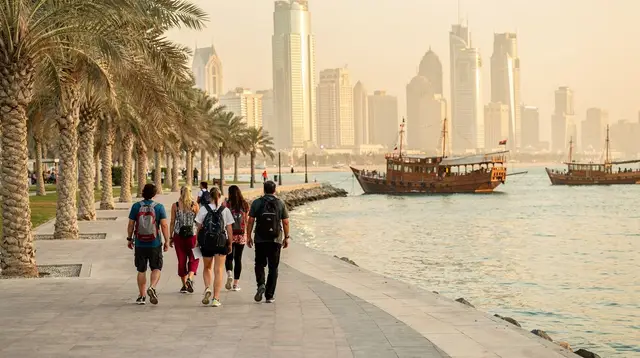
The Corniche is the curved promenade that traces Doha Bay for roughly 7 km, from the dhow harbour near Souq Waqif around to the museum park at the tip of the peninsula. It is not a single attraction so much as the spine that holds the old and new city together: walk it, and you get the wooden dhows moored below you on one side and the glass towers of West Bay rising across the water on the other. Most visitors end up on some stretch of it more than once, because it links several of the places already on their list rather than requiring a special trip of its own.
Unlike The Pearl-Qatar or Katara, which sit apart from the centre, the Corniche runs directly through it. That makes it less a destination to plan around and more a route to fold into whatever else is happening that day — a walk after visiting the Museum of Islamic Art, a sunset stop before dinner in Msheireb, or the first thing a stopover traveller sees on the way in from Hamad International Airport.
What sits along the bay
The promenade is best understood in three stretches.
The southern end, near the dhow harbour, is where the traditional wooden boats moor in clusters, sails furled, waiting for passengers. This is also the starting point for most sunset cruises on the bay — covered in full in our Doha dhow cruise guide, which is the right place to look if the boats themselves, not just the view of them, are the goal. Behind this stretch, a short walk inland leads into Souq Waqif, so it’s an easy pairing: souq in the late afternoon, harbour and boats as the light turns gold.
The central stretch curves past MIA Park and the island that holds the Museum of Islamic Art, designed by I. M. Pei and opened in 2008. The museum sits on its own promontory just off the Corniche, so the walk out to it — and the view back from its steps — is part of the experience, not a detour from it. This is consistently the most photographed section of the whole waterfront, mainly because it frames the West Bay skyline across open water rather than through traffic or trees.
The northern stretch, past the museum, runs on toward the National Museum of Qatar and eventually toward Lusail further up the coast. It is quieter, with fewer food stalls and more open lawn, and tends to draw joggers and cyclists rather than photographers.
In practical terms, the promenade’s southern end starts right at the dhow harbour behind Souq Waqif, and its northern end tails off near the National Museum of Qatar, beyond which the coastline becomes more road-driven and less built for walking. If you only have time for one stretch, the southern-to-central section — harbour to MIA Park — is the one that rewards a short visit, since it’s flat, well used, and puts both the moored boats and the skyline in the same short walk. The northern stretch beyond the museum suits a longer walk or a run rather than a first orientation, since the landmarks thin out and the appeal is more the open space than any single view.
Across the water for the entire length sits West Bay, Doha’s skyscraper district. It is the view, not a place you can walk to directly from the Corniche — reaching it means going around by road or metro.
When to walk the Corniche
Timing matters here more than on almost any other stretch of the city, because the Corniche is entirely outdoors and entirely exposed to the sun.
Season. The best time to walk it is roughly November to March, when daytime temperatures are warm rather than punishing and the evenings are genuinely pleasant. From around May to September, Doha’s hot desert climate pushes temperatures well above 40°C with high humidity, and a midday walk along an unshaded seafront is a real health risk, not just an uncomfortable one. In summer, the Corniche still works — but only at night, after the heat has broken.
Time of day. Even in the cool season, the late afternoon into the evening is when the Corniche comes alive: the light softens, the temperature drops, and the waterfront fills with families, joggers, and people setting up for a dhow trip at sunset. Midday visits work for photography of the skyline in hard light, but most people find an hour before sunset through to after dark the most rewarding window — it’s also when the dhow harbour is busiest and when cafés along the route do their best trade.
Weekends. Friday and Saturday form the weekend in Qatar, and Friday mornings are quiet everywhere, including here, since it’s the main day of prayer. The Corniche tends to fill up from Friday afternoon onward and stays lively into Saturday evening.
Comfort on the walk: shade, water and toilets
The Corniche has matured into a well-maintained public promenade, with benches spaced along most of its length and stretches of landscaped lawn to sit on rather than just paving. Shade is the one thing it doesn’t have much of: young trees line parts of the route, but for most of the 7 km you’re walking in open sun, which is exactly why timing matters as much as it does.
Drinking water points and public toilets exist at intervals, more reliably near the busier southern and central stretches than out toward the quieter northern end, so it’s worth carrying your own water rather than counting on finding a fountain exactly when you need one. The cafés and kiosks mentioned above double as informal rest stops and the easiest place to find a toilet if you’d rather use a paying business than search for a public one.
Jogging, cycling and closures
Alongside the strolling crowd, the Corniche is Doha’s default outdoor running and cycling route, and a marked path separates wheels from feet in places — keep to your side of it and expect a steady stream of both, especially on cool-season evenings. On Qatar National Day (18 December) and around some other national celebrations, stretches of the Corniche close to vehicle traffic and host processions, stages, or fireworks viewing, which makes the waterfront busier and more festive than usual but can also disrupt road access and parking nearby for the day. If a visit coincides with a national holiday, it’s worth checking local news or asking at the hotel before planning a drive to the water.
Dress and conduct
As with most public places in Qatar, modest dress is the norm on the Corniche — shoulders and knees covered is a safe default for both men and women, even though enforcement here is relaxed compared with religious sites or government buildings. Public displays of affection are best kept low-key, and photographing families or women without asking is not appreciated, even in a spot as photogenic as the waterfront. None of this makes the Corniche formal — joggers in shorts and t-shirts are a normal sight — but it sets the general tone for how the space is used.
Getting there by metro
The Corniche runs close enough to the Doha Metro’s Red Line that several stations feed directly into it, which makes it one of the easiest parts of the city to reach without a car or taxi. Stations near the southern end put you a short walk from the dhow harbour and Souq Waqif; stations further along serve the museum stretch and the areas nearer West Bay. Because the promenade itself has no metro line running along it — you get off at a station and walk in from there — it helps to know roughly which section you want before choosing a stop, since the walk from harbour to museum park, doing the whole 7 km, is a genuine outing rather than a quick stroll.
For visitors without a rental car, this metro access is one of the Corniche’s real advantages over destinations further out, such as Al Zubarah or Sealine, which the metro doesn’t reach at all and which depend on taxis, ride-hailing apps, or organised tours.
| Getting there | Approx. time from centre | Notes |
|---|---|---|
| Doha Metro (Red Line) | 0–10 minutes | Several stations feed directly into different stretches |
| Taxi / ride-hailing | 5–15 minutes | Easiest if starting from West Bay or the airport |
| On foot from Souq Waqif | 5 minutes | Southern end only |
| Rental car | Not recommended | Parking along the waterfront is limited at peak times |
What it costs
Walking the Corniche itself costs nothing — it’s open, public, and free at any hour. Costs only appear once you add something to the walk:
| Activity | Typical cost (QAR) | Notes |
|---|---|---|
| Walking the promenade | Free | No ticket, no gate |
| Café or juice stop | 15–40 | Several kiosks and cafés along the route |
| Museum of Islamic Art entry | Check current pricing | Ticketed; closes one day a week |
| Sunset dhow cruise | Varies by operator | See our dhow cruise guide |
| Guided city tour including the Corniche | Varies by tour | Several combine it with West Bay and Msheireb |
Combining the Corniche with a guided tour
Because the Corniche threads through so much of central Doha, it appears on nearly every city-tour itinerary rather than standing as a booking of its own. A guided option can be worth it if you’d rather have the museums, the old town, and the new skyline explained together in one outing instead of piecing the route together yourself.
a half-day city tour that takes in the Corniche alongside Souq Waqif and the museum district is the simplest way to see the waterfront as part of a wider first look at Doha, with commentary on what you’re looking at across the bay.
For a broader sweep that pushes further along the coast, a tour covering Msheireb, West Bay, Lusail and The Pearl uses the Corniche as its connecting thread between the old restored quarter and the newer districts to the north.
Travellers with a full day to give the city, including its education and sport landmarks inland, might prefer a full-day city tour that also takes in Education City, which typically opens or closes with time along the water.
What not to expect
The Corniche is a promenade, not a beach — there’s no swimming along most of it, and the water’s edge is a stone or grass embankment rather than sand. It’s also not where the dhow cruises themselves are covered in detail: for departure points, durations, and what a sunset or dinner cruise actually involves, see the dedicated Doha dhow cruise guide rather than expecting that detail here. And while it looks walkable end to end on a map, the full 7 km is a real commitment in the heat — most visitors do one stretch at a time rather than the whole arc in one go.
The Corniche also has no beach clubs, no swimming access, and nowhere to rent a car or scooter on the spot — anything beyond walking, jogging, or a dhow ride, such as watersports, golf, or the malls and indoor attractions around West Bay, sits off the promenade and needs a taxi or a short metro ride to reach.
Nearby, if you have more time
A stop at the Corniche pairs naturally with a wider look at the city. The Doha city tour guide sets out how to sequence it with Souq Waqif, Msheireb, and West Bay across a half or full day. Travellers building a longer stay can also look at the one-day Doha highlights itinerary or the three-day Doha essentials itinerary, both of which place the Corniche early in the plan as an easy, free orientation to the bay before venturing further out to the desert or north Qatar.
Corniche FAQ: timing, distance and access
How long is the Corniche in Doha?
The Corniche runs roughly 7 km along Doha Bay, from the dhow harbour near Souq Waqif to the museum park at the tip of the peninsula. Few visitors walk the entire length in one outing; most cover one stretch at a time.
What is the best time of day to walk the Corniche?
Late afternoon into the evening is best, when temperatures drop and the light softens for photos of the West Bay skyline. Midday works for photography in the cool season but is uncomfortable, and can be risky, in summer.
What is the best season to visit the Corniche?
Roughly November to March, when Doha’s climate is warm rather than extreme. From around May to September, daytime heat routinely passes 40°C with high humidity, making a long outdoor walk unsafe at midday.
Can I reach the Corniche by metro?
Yes. Several Doha Metro Red Line stations sit close to different stretches of the promenade, making it one of the easiest parts of the city to reach without a taxi or rental car.
Is walking the Corniche free?
Yes, the promenade itself is free and open at all hours. Costs only apply if you add a café stop, a museum ticket, or a dhow cruise.
Where do the dhow cruises leave from?
Dhow cruises depart from the harbour at the southern end of the Corniche, near Souq Waqif. For durations, timings, and what to expect on board, see the Doha dhow cruise guide.
Is the Corniche a beach?
No. It’s a paved and landscaped waterfront promenade, not a swimming beach. Doha’s beaches are separate destinations along the coast and at venues like The Pearl-Qatar and Katara.