Two Days in Doha: A First-Timer's City Itinerary
What can you realistically see in Doha in two days?
Two days is enough to cover Doha's core sights on foot and by metro without a car: the Museum of Islamic Art and the Corniche, a dhow ride and Souq Waqif on day one, then the National Museum of Qatar, the Msheireb Downtown quarter and Katara Cultural Village on day two. It leaves the desert, the Pearl and Lusail for a longer trip.
Why two days works for a first visit to Doha
Doha’s landmark sights sit close together along or near the Corniche, which makes a compact two-day, no-car itinerary realistic for a first-timer or for anyone stretching a longer Gulf trip. This plan keeps both days inside the city: it does not touch the desert safaris around Sealine or the Inland Sea, and it does not push out to Lusail, the Pearl or the north and west of the country. If you only have a single day rather than two, start instead from our one-day Doha highlights guide, which compresses the same area into a tighter loop; this itinerary simply gives that plan room to breathe and adds the National Museum and Katara on a second day.
The two days are organised around geography rather than themes: day one covers the museum-and-souq axis along the eastern Corniche, and day two moves through the rebuilt heritage quarter of Msheireb out to Katara on the coast near West Bay. Both days are walkable in sections and connect well by the Doha Metro and tram network, so a rental car is not necessary for this itinerary — see our notes on renting a car in Qatar if you plan to extend the trip into the desert or north Qatar afterwards, where the metro does not reach.
We deliberately avoid inventing opening hours, ticket prices or exact timings here, since museum hours and closing days change and are best checked close to your travel dates on the official Qatar Museums channels. What follows is a sequence and a sense of pacing, not a printed timetable.
Day 1: Museum of Islamic Art, the Corniche, a dhow and Souq Waqif
Start the day at the Museum of Islamic Art, the I. M. Pei-designed building set on its own island just off the Corniche. Its galleries move through more than a thousand years of Islamic art from Spain to China, and the building itself, with MIA Park spreading behind it toward the water, is worth the visit on its own. Our full visit guide to the Museum of Islamic Art covers what the museum contains and how to plan your time inside without needing to check current hours here.
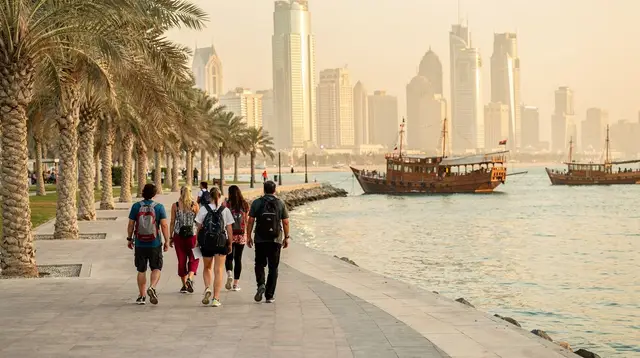
From the museum, walk or take a short taxi along the Corniche, Doha’s 7-kilometre waterfront promenade. This is where the city’s traditional wooden dhows moor, with the West Bay skyline as a backdrop across the bay. A stroll here in the late morning or an early-evening return for the sunset light are both worthwhile; the Corniche is also the departure point for the dhow cruises that are the natural next stop on this day.
In the afternoon or evening, take a dhow cruise around Doha Bay. These trips typically run for about an hour, looping past the West Bay towers and back toward the museum island, and they are one of the more relaxed ways to see the city from the water rather than the street.
a dhow ride around the bay paired with the Museum of Illusions and a stop at the souq bundles this cruise with two more stops if you would rather combine several short activities into one afternoon instead of doing each separately. For more detail on how these cruises are run and what to expect on board, see our dhow cruise guide and, if you prefer the golden-hour version specifically, our sunset dhow cruise page.
Close day one at Souq Waqif. This is a restored traditional market rather than an untouched ancient bazaar — it was rebuilt on the footprint of the old souq in the 2000s — and it comes alive in the late afternoon and evening rather than at midday, when many stalls are closed. Wander the alleys of spice, textile and souvenir stalls, visit the Falcon Souq next door, and plan on dinner here: the souq’s restaurants and shisha cafés are busiest and most atmospheric after dark.
Our Souq Waqif shopping guide and Falcon Souq page go into more depth on both, and the Souq Waqif food and karak walk is a good reference if street food and karak tea are part of your evening plan.
Day 2: National Museum of Qatar, Msheireb Downtown and Katara
Begin the second day at the National Museum of Qatar, Jean Nouvel’s desert-rose-shaped building constructed around the old palace of Sheikh Abdullah bin Jassim. The museum tells Qatar’s national story from the natural history of the peninsula through to the present day, and the palace building at its centre is itself part of the exhibit. Give this museum a proper morning rather than a rushed hour; our National Museum of Qatar visit guide explains how the galleries are laid out so you can prioritise if your time is tight.
From the National Museum, head into Msheireb Downtown, the rebuilt heritage quarter just west of Souq Waqif. This is Doha’s regeneration project on the site of the city’s original commercial core, and it houses the four Msheireb Museums in restored historic houses, alongside contemporary architecture, public art and pedestrian streets that are pleasant to walk in the cooler parts of the day. The Msheireb Museums guide and the Msheireb Downtown walking guide both cover this area in more detail than fits here, including which of the four house-museums tend to interest first-time visitors most.
In the afternoon, move on to Katara Cultural Village on the coast between West Bay and the Pearl-Qatar. Katara combines an amphitheatre, galleries, mosques, a public beach and a cluster of restaurants, and like Souq Waqif it is generally more atmospheric in the late afternoon and evening than at midday. Our Katara Cultural Village evening guide covers the area’s layout and what tends to be open when the light is best for photos.
If you have energy left for a last outing, an evening pass along the West Bay skyline or a short look at the Pearl-Qatar’s marina rounds out the trip without adding a third day. a guided icons tour that links Msheireb, West Bay, Lusail and the Pearl in one outing is a practical way to see all four in a single guided run if you would rather not string the stops together yourself, and a short express city tour covering Katara, the Corniche and West Bay works well as a compressed version of this same day if your afternoon has shrunk.
For a broader single-outing option that adds the Pearl and Lusail beyond what this two-day plan covers, a combined tour taking in the souq, the Pearl, Katara and Lusail is worth comparing against doing the sights independently.
Making the most of two days without a car
Both days in this itinerary are designed around the Doha Metro and tram network plus walking and short taxi hops, so a rental car adds cost and parking hassle without adding much. The free Msheireb tram loop in particular is useful for day two, since it links the museums quarter directly. If you decide to extend your trip into the desert, the north coast or west Qatar afterwards, none of those areas are served by the metro, and renting a car in Qatar or booking a driver becomes the more relevant question — that is outside the scope of this city-only plan.
Where to base yourself matters more than which car you rent: our comparison of West Bay versus Souq Waqif versus the Pearl as a base can help you pick a hotel area that keeps both of these days short on transit time. For everyday costs across the two days — museum tickets, meals, metro fares and the odd taxi — see our page on Doha budget and currency, and if this is your first Gulf city trip, our first-trip mistakes in Doha page and Doha dress code guide are worth a quick read before you go, since both museums and Katara expect shoulders and knees covered.
If two days turns into more, our two-days-and-desert itinerary shows how a desert day slots in immediately after this city-only plan, and the one-day West Bay and Katara and one-day Msheireb and National Museum itineraries show how each half of this plan works as a standalone single day if you end up splitting the trip differently.
FAQ: planning two days in Doha
Is two days enough to see Doha’s main sights?
Two days covers Doha’s core landmarks well: the Museum of Islamic Art, the Corniche, a dhow cruise and Souq Waqif on one day, and the National Museum of Qatar, Msheireb Downtown and Katara on the other. It does not include the desert, the Pearl-Qatar, Lusail or day trips north or west of the city, which need additional days.
Do I need a car for this two-day Doha itinerary?
No. Both days are built around the Doha Metro, the Msheireb tram loop, walking and short taxi rides between the Corniche-area sights and the Msheireb–Katara axis. A car becomes more relevant only if you extend the trip toward the desert, north Qatar or west Qatar, none of which are covered by the metro.
What is the difference between the Museum of Islamic Art and the National Museum of Qatar?
The Museum of Islamic Art, designed by I. M. Pei, focuses on Islamic art and design from across the historic Islamic world. The National Museum of Qatar, designed by Jean Nouvel and built around the old palace of Sheikh Abdullah bin Jassim, tells the specific story of Qatar’s natural and national history. They sit on opposite ends of this two-day plan rather than being interchangeable stops.
Should Souq Waqif and Katara be visited in the morning or evening?
Both are generally better in the late afternoon and evening. Souq Waqif’s stalls thin out in the early afternoon and its cafés and restaurants come alive after dark, and Katara follows a similar pattern, with its beach, galleries and dining areas busiest once the day cools off.
Can this itinerary be combined with a desert safari?
Yes, but not on these two days. This plan is deliberately city-only; a desert day at Sealine and the Inland Sea, or a north or west Qatar day trip, works best as a separate day added on afterwards. See the two-days-and-desert itinerary for how that combination is typically structured.
What should I wear for the Museum of Islamic Art, the National Museum and Katara?
Modest dress is expected at all three: shoulders and knees covered is the general standard for museums and cultural sites in Doha. Swimwear is fine only at Katara’s own beach area, not inside the cultural buildings.
Is one day in Doha enough instead of two?
A single day is workable if your time is limited, but it means compressing the museum, Corniche, souq, Msheireb and Katara elements into one tighter loop and likely dropping one or two stops. Our one-day Doha highlights guide sets out how that shorter version is put together.
Trip Planning
Verified deep-linked GetYourGuide tours. Book through these links and we earn a small commission at no cost to you.
GetYourGuide does not provide a product photo for this activity — the image shows the meeting point, photographed by us.