Where Katara sits, and why it looks the way it does
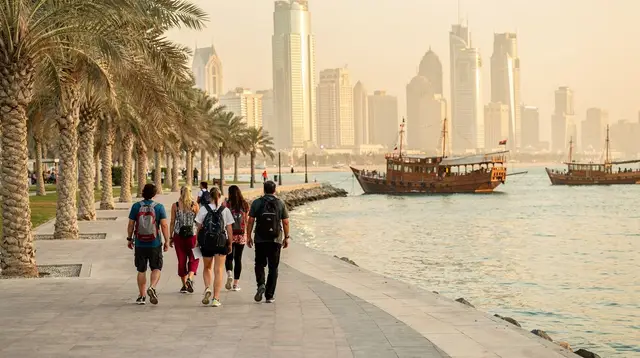
Katara Cultural Village occupies a stretch of coastline roughly halfway between the towers of West Bay and the artificial island of The Pearl-Qatar, a short drive north of the Corniche. It’s one of the easiest stops to fold into a first day in Doha, and one of the most photographed corners of the city — wind towers, amphitheatre steps and a beach all within a few minutes’ walk of each other.
The name and the setting can give a false impression. Katara is not a preserved fishing village or an old quarter that survived Doha’s modern building boom. It’s the opposite: a purpose-built cultural district, developed by the Qatari government from the mid-2000s and opened in stages from around 2010, on land that had been largely undeveloped coast.
Its Arabian Gulf-style buildings — the wind-tower forms, the carved wooden doors, the sand-toned facades — were designed and built new, in a style that references old Gulf architecture without being a restoration of it. It’s closer in spirit to a cultural park than to Souq Waqif, which was rebuilt on the footprint of a genuinely old market. Katara’s site had no equivalent market to rebuild; the whole village is a recent creation, and there’s no need to hunt for “original” buildings within it — there aren’t any.
That doesn’t make it a lesser stop. It makes it a different kind of stop: a deliberately designed cultural and leisure district, built at a scale and with a level of finish that took real investment, and it functions today much as it was meant to — as a public beach, a venue for galleries and performances, and a dining strip that comes alive after sunset.
What’s actually there
Katara is walkable and low-key to explore without a plan, which suits a first visit. A few landmarks orient the site:
The amphitheatre. The village’s best-known structure is a Greek-style open-air amphitheatre, built into the slope facing the sea, with tiered stone seating for a few thousand people. It hosts concerts, festivals and cultural events through the year; whether anything is scheduled during a given visit is worth checking directly with Katara or Qatar Tourism, since programming and timings are not fixed and change season to season. Outside of events, the amphitheatre itself is open to walk through and is one of the better photo spots in the village, especially with the sea as a backdrop.
The mosques. Katara has two notable mosques open to visitors outside prayer times, at the discretion of staff and with modest dress required: a gold-domed mosque built in an Ottoman style, and the smaller, more angular Katara Mosque. Both are recent constructions, built as part of the same development as the rest of the village, and both are popular for photography because of their distinctive silhouettes against the water.
The beach. Katara Beach is a public stretch of sand facing the Gulf, with sun loungers and parasols available to rent, calm shallow water, and cafés a short walk back from the shore. It’s more sheltered and family-oriented than the open sea beyond The Pearl, and it’s one of the few central Doha beaches that doesn’t require a hotel booking to use. For a fuller rundown of Doha’s beach options and how they compare, see the Doha beaches guide.
Cultural venues. The village houses galleries, small museums and exhibition spaces that rotate through art shows, and an outdoor amphitheatre for film screenings on some evenings. There’s also a stretch dedicated to traditional dhow building — full-size wooden boats, built and maintained on site using traditional methods, that visitors can see up close near the waterfront.
Katara Hills Park. Behind the main village, a landscaped park with walking paths, gardens and viewpoints has been added in recent years, giving Katara a green, elevated counterpart to its waterfront side; a short guided walk through it pairs naturally with a stroll through the amphitheatre and beach areas.
Restaurants and cafés. Katara has one of the denser restaurant clusters outside West Bay and Souq Waqif, spanning Middle Eastern, Asian and international cuisine, with waterfront seating at several venues. It’s a popular dinner destination in its own right, not just an add-on to sightseeing; see the Doha food tour guide for how it fits into a wider food itinerary.
The Pigeon Towers. A cluster of tall, decorative towers built to house pigeons is one of Katara’s more distinctive architectural features, referencing a historic Gulf building type reinterpreted at a larger, more ornamental scale for the village.
Getting there and getting around
Katara sits off the Corniche road, roughly ten to fifteen minutes by car from West Bay or central Doha in normal traffic, and a similar distance from The Pearl in the other direction. It’s not currently served directly by a Doha Metro station, so most visitors arrive by taxi, ride-hailing app, or their own car; free parking is available within the village, though it fills up on event evenings and weekends. Walking between Katara and The Pearl is possible along the waterfront path for those who don’t mind a longer stroll, but it’s not a short walk, and the heat for much of the year makes a taxi the more practical choice.
A guided option covers Katara alongside two of Doha’s other headline sights in a single outing:
a short guided loop taking in Katara, the Corniche and West Bay in about two hours, which suits travellers with limited time, including those on a stopover between flights.
For a closer look at the park behind the village, a walking tour through Katara Hills Park with hotel pickup included adds the green, elevated side of Katara to the more familiar waterfront view.
Katara in context: how it compares to nearby areas
Katara’s position between two very different neighbours — the high-rise skyline of West Bay and the reclaimed-island glamour of The Pearl-Qatar — makes it a useful midpoint for orientation, and a natural stop on the way between the two. It’s quieter and more low-rise than either, built at human scale rather than tower scale, and it leans further into public cultural space than either of its neighbours.
| Area | Character | Typical visit |
|---|---|---|
| Katara | Cultural village, beach, amphitheatre, dining | Half a day, or an evening |
| West Bay | Skyscrapers, business district, malls | Half a day, city views |
| The Pearl-Qatar | Marina, shopping, residential island | Half a day to a full day |
| Souq Waqif | Restored traditional market | Evening, 2–3 hours |
Compared with Souq Waqif, Katara is quieter, more spread out and less transactional — there’s little of the market haggling and shopfront density that defines the souq. Compared with The Pearl, it’s more clearly a public cultural space than a retail and residential development, even though both share the same era of construction and a similar architectural vocabulary in places.
For visitors weighing up where to spend limited time or where to base themselves, the comparison between Katara’s surrounding areas is covered directly in West Bay vs Souq Waqif vs The Pearl: where to base.
Museums and landmarks within easy reach
Katara’s location puts several of Doha’s major cultural sights within a short drive, which is why it works well as part of a longer cultural day rather than as an isolated stop:
- The Museum of Islamic Art, on its own island off the Corniche, is roughly ten minutes away by car.
- The National Museum of Qatar, shaped like a desert rose around the old palace of Sheikh Abdullah bin Jassim, sits a little further along the Corniche.
- Msheireb Downtown, the rebuilt heritage quarter with its four Msheireb Museums, is a further short drive inland.
- Lusail, the newer city to the north with its marina and Place Vendôme, and Al Rayyan, home to Education City and the Aspire Zone, both make sense as a continuation of a day that starts at Katara.
Travellers who prefer a single guided sweep of the city’s landmark sights, rather than piecing the day together themselves, can take a guided tour covering Doha’s best-known sights in one outing, which typically threads together the Corniche, Katara-area landmarks and the older and newer parts of the city.
Planning a visit
Katara works at almost any time of day, but the experience changes considerably with the hour. In the middle of the day, especially from May to September, the beach and open plazas are exposed to full sun and extreme heat, and a visit is better limited to shaded galleries, the mosques, or a quick photo stop from an air-conditioned car. In the cooler months, roughly November to March, the beach becomes genuinely usable for swimming and sunbathing during the day, and the outdoor spaces are comfortable well into the afternoon.
The real character of Katara, though, comes out after sunset, whatever the season: restaurant terraces fill up, the amphitheatre and waterfront are lit, and the temperature drops to something pleasant even in summer. Because programming, opening hours for individual venues and specific evening activities change through the year and aren’t fixed, this guide won’t attempt to lay out an evening schedule — for a proper walk-through of how to plan an evening at Katara, including which areas are busiest and when restaurants tend to fill up, see the Katara Cultural Village evening guide.
For a first Doha itinerary that places Katara alongside West Bay on the same day, see one day: West Bay and Katara; for a broader two-day introduction to the city that fits Katara in among the other headline sights, see two days in Doha for first-timers. Anyone weighing up how the city’s neighbourhoods relate to each other more generally can also read the Doha neighborhoods guide.
Dress for Katara as for any public area in Doha: shoulders and knees covered is the safe default, and full covering of arms and legs (plus a headscarf for women) is expected inside the mosques. Beachwear is fine on the beach itself but not elsewhere in the village.
Katara Cultural Village: frequently asked questions
Is Katara Cultural Village an old or historic site?
No. Katara is a modern development, built from the mid-2000s and opened in stages from around 2010. Its buildings are constructed in a traditional Gulf architectural style, but nothing on the site is an original historic structure — it’s a purpose-built cultural district, not a restored or preserved village.
Is Katara Beach free to use?
Access to the beach area is free; sun loungers and parasols are typically available to rent, and prices vary by season and vendor. It’s one of the few central Doha beach options that doesn’t require a hotel stay or club membership.
How long should I plan for a visit to Katara?
A couple of hours covers the amphitheatre, mosques and a walk along the waterfront. A half day allows time for the beach, a gallery or two, and lunch. An evening visit for dinner and a stroll is a separate, equally popular way to experience the village, and tends to run longer as restaurants and the waterfront fill up after dark.
Can I combine Katara with The Pearl or West Bay in one day?
Yes, easily — both are a short drive away in opposite directions, and many guided city tours already combine Katara with the Corniche and West Bay in a single outing. The Pearl typically needs its own dedicated time given its size, so pairing Katara with West Bay is the more common half-day combination.
Are the mosques at Katara open to non-Muslim visitors?
The two mosques at Katara are generally open to visitors outside prayer times, subject to modest dress (arms and legs covered, and a headscarf for women) and staff discretion on the day. As with any mosque in Qatar, it’s worth checking current access on arrival rather than assuming a fixed policy.
Is there a specific evening schedule or set of performances at Katara?
Programming at Katara — concerts, festivals, film screenings and gallery openings — changes through the year and isn’t fixed, so this guide doesn’t list set times or events. For guidance on what to expect on an evening visit and how to plan around it, see the dedicated Katara Cultural Village evening guide.
Is Katara suitable for families with children?
Yes. The beach is sheltered and family-friendly, the walkways are flat and easy for strollers, and the open plazas and amphitheatre steps give children space to move around outside of restaurant hours. Shade is limited in the middle of the day, so families visiting in the hotter months are better off timing a visit for the morning or evening.
Do I need a car to get to Katara?
A car, taxi or ride-hailing app is the practical way to reach Katara, since it isn’t currently served directly by a Doha Metro station. Free on-site parking is available for those driving themselves, though it can fill up during events and on weekend evenings.