Taxis and Ride-Hailing in Doha: Karwa, Uber and Careem Explained
Should I use a taxi or a ride-hailing app in Doha?
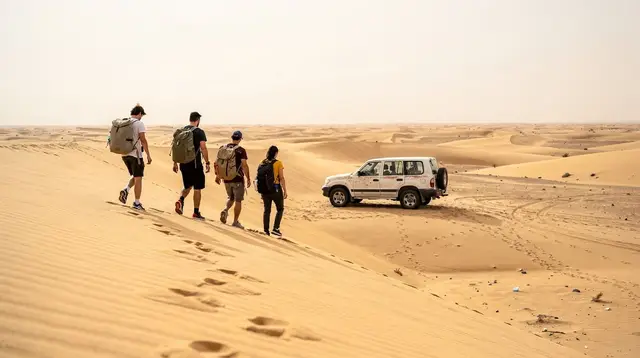
Both work well for point-to-point trips inside the city and for reaching places the Doha Metro does not serve, such as Souq Waqif in the evening, Katara or the airport. Karwa taxis can be hailed on the street or booked by app, while Uber and Careem run on the same paved roads. None of them can drive onto the dunes at Sealine or the Inland Sea, where an organised 4x4 tour is the only way in.
Getting around what the metro does not reach
The Doha Metro is fast, cheap and air-conditioned, but its three lines cover a fairly compact core: West Bay, Msheireb, Lusail, Al Rayyan and the airport.
Everything past that ring — the evening crowds at Souq Waqif, a late dinner in Katara, a villa in The Pearl, or any trip toward Al Wakrah, Al Khor or the desert — falls to taxis, ride-hailing apps or an organised tour. This page covers how Karwa taxis and the Uber and Careem apps actually work in Doha, what they cost to use in practical terms, and where their usefulness stops and a proper desert or north Qatar tour needs to take over.
Karwa: the local taxi network
Karwa is the state-linked transport operator behind Doha’s metered taxi fleet, its city buses and several intercity coach routes, so the same name appears on a saloon car and on a bus without it being a coincidence. Karwa taxis can be hailed on the street, picked up from ranks outside hotels, malls and the airport, or booked ahead through the Karwa taxi app, which gives an estimated fare and a driver’s plate number before the car arrives.
Cars are metered, which means the fare accrues on distance and waiting time rather than being agreed upfront. It is worth confirming the meter is switched on at the start of a ride rather than negotiating a flat sum, especially outside the airport or major hotels where flat-fee offers are more common. This guide will not print a per-kilometre rate, since Karwa’s tariff is set and revised independently of any travel site and the only figure worth trusting is the one ticking over on the meter, or the fare quoted inside the app before you confirm a ride.
Payment is usually cash in Qatari riyals, and many cars also carry a card terminal or accept payment through the app for a booked ride. Keeping a little cash on hand remains sensible, particularly late at night or for older vehicles where a card terminal may not be working.
Uber and Careem: how they compare
Uber and Careem both operate in Doha in a form that will feel familiar from other Gulf or international cities: an in-app fare estimate before booking, cashless payment by card or linked wallet, and live tracking of the driver’s approach. Both apps generally offer a choice of car sizes, from a standard sedan up to larger vehicles for groups or extra luggage.
In practice, the choice between Karwa, Uber and Careem in Doha comes down to convenience rather than any one option being clearly cheaper. A street-hailed Karwa taxi can be quicker for a short unplanned trip from the Corniche or Souq Waqif, while an app gives a fare estimate upfront and a fixed pickup point, which some visitors find more reassuring in a city they do not know. Car availability on either app can thin out around 1am to 4am or during major events at Lusail Stadium and similar venues, so building in extra waiting time late at night is worth doing.
| Option | Booking | Payment | Best for |
|---|---|---|---|
| Karwa taxi (street) | Hail on the street or at a rank | Cash or in-car card terminal | Short, spontaneous trips |
| Karwa taxi (app) | Karwa taxi app | Cash, card or in-app | Booking ahead, airport pickups |
| Uber | Uber app | Card or linked wallet | Fixed pickup point, fare shown upfront |
| Careem | Careem app | Card or linked wallet | Same as Uber, often used interchangeably |
| Organised tour | Tour operator, in advance | Card at booking | Desert, north Qatar, anywhere off-road |
What a taxi or ride-hailing app genuinely cannot do
This is the point worth being blunt about: neither a Karwa taxi nor an Uber or Careem car can take you onto the dunes. The desert experiences based around Sealine, south of the industrial port of Mesaieed, and the tidal inlet at Khor Al Adaid, the Inland Sea, require dune bashing across loose sand in a proper 4x4 with an experienced driver.
An ordinary saloon car, whether it is a metered taxi or a ride-hailing sedan, has no business on that terrain and would simply get stuck. A ride-hailing app can drop you at a desert tour operator’s meeting point in Doha or at a hotel pickup location, but the sand itself belongs to an organised desert safari, never to a private car booked on an app.
The same logic, in a milder form, applies to day trips north and west of Doha. Al Zubarah, Al Khor and Al Thakira in the north, and Zekreet and Al Shahaniya in the west, all sit on paved roads, so a taxi or ride-hailing car can technically reach them. In practice, a one-way ride-hailing fare to Al Zubarah, roughly 100 kilometres from Doha, has to be paid again for the return leg, with no guide, no planned stops at the fort or the mangroves, and no vehicle waiting while you look around.
A north Qatar tour covering Al Zubarah and Al Khor or a west Qatar tour to Zekreet bundles the driving, the stops and the return trip into one price, which is usually the more practical choice once the full round trip is counted rather than just the outbound fare.
When a taxi or app makes the most sense
Within the city itself, taxis and ride-hailing apps are genuinely the easiest option for a lot of ordinary trips: an evening out at Souq Waqif once the stalls come alive in the late afternoon, a dinner reservation in Katara Cultural Village, a night at Lusail Marina or a return from The Pearl-Qatar after the metro has stopped running for the night. They are also the standard way to reach Hamad International Airport outside metro hours, or when travelling with luggage that makes the metro’s turnstiles and platform changes less convenient.
For a short evening on the water, a dhow cruise around Doha Bay is an easy add-on to reach by taxi or app from most parts of the city; anyone weighing up the Corniche’s boat options can compare a straightforward sunset outing on a dhow cruise paired with a speedboat ride against a livelier evening built around a city tour that finishes with a gondola ride at Villaggio Mall.
Booking a driver for a full day, versus booking a tour
Some visitors ask about hiring a taxi or ride-hailing driver by the hour or the day to cover several stops. This is possible informally with some Karwa drivers, but it is not a standard, fixed product the way an organised tour is, and it leaves the itinerary, pacing and commentary entirely up to you to arrange. A private desert or cultural tour, by contrast, is built around a known route with a driver experienced on that terrain, entry arrangements where needed, and a set return time.
For a half day built around traditional activities rather than sightseeing alone, a private desert outing with a camel ride and tea or an evening version with a night desert safari combining stargazing and a camel ride both cover the transport, the guide and the desert access in one booking, which a taxi or app simply is not set up to do.
Matching the vehicle to the trip you actually need
Once it is clear that a taxi or ride-hailing app stops at the edge of the pavement, the more useful question is which organised option to book instead, since the desert and north Qatar catalogue is not a single product. Several tours build the dune-bashing leg into a longer day rather than treating it as the whole trip: a desert safari with camel ride and dune bashing that continues on to the Inland Sea covers both the sand crossing and the tidal inlet in one booking, which is exactly the combination a taxi cannot piece together on its own.
Others add a second activity on top of the standard camel ride and dune bashing, such as a desert safari that pairs the camel ride with paragliding or a desert safari built around ATV or quad riding, a camel ride and sandboarding for a more active half day.
For visitors trying to cover more ground than the desert alone, a full day itinerary can bundle the dunes with the north of the country: a full-day desert safari and north Qatar tour that includes the Inland Sea or a 3-in-1 tour combining a city tour with the desert safari and the north both replace what would otherwise be three separate ride-hailing bookings — one to the desert, one back into the city, and one long round trip north — with a single vehicle and driver for the whole day.
For travellers who specifically want the desert leg paired with the paved roads north toward Al Zubarah and Al Khor, a desert safari and north of Qatar tour with transfers included removes the need to negotiate a long one-way ride-hailing fare each way, since pickup and return are already part of the price.
Ride-hailing and taxis at Hamad International Airport
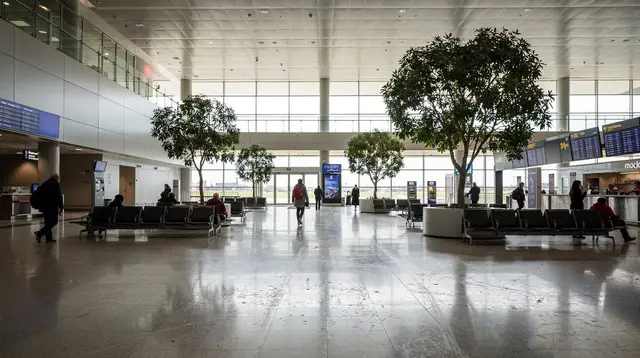
Hamad International Airport sits within reach of the metro during its operating hours, but many arrivals and late departures fall outside that window, which is when Karwa taxis and the Uber and Careem apps do most of their airport work. Taxi ranks and designated ride-hailing pickup areas are part of the normal terminal layout, and drivers on both the metered taxi side and the app side are used to the flow of international arrivals, including groups with luggage trolleys.
Because a fare from the airport into central Doha or out to a hotel on The Pearl or in West Bay is the first ride many visitors take in Qatar, it is worth applying the same rule as anywhere else in the city: confirm the meter is running in a street-hailed Karwa taxi, or rely on the fare shown in the Uber or Careem app before confirming the booking, rather than agreeing a flat price at the kerb.
Practical tips for using taxis and apps in Doha
A few habits make taxis and ride-hailing apps easier to use well in Doha. Keep a saved pin or written address in both English and Arabic on your phone, since not every driver will read English signage easily, particularly for a specific building inside Msheireb Downtown or a villa complex on The Pearl. Confirm the meter is running in a street-hailed Karwa taxi rather than accepting a flat quote from the driver.
During Friday prayers around midday, traffic and driver availability both tighten for a while, so building in extra time on a Friday trip is worth doing. And in the height of summer, from roughly May to September, waiting outside for a car in the open midday heat is genuinely uncomfortable and best avoided; waiting in an air-conditioned lobby or mall entrance until the car is close is the more sensible habit most residents keep to.
Ride-hailing apps and Karwa taxis together cover the great majority of point-to-point movement around Doha, and they do it cheaply and reliably by regional standards. Where they stop being useful is exactly where the road stops being paved: the dunes at Sealine, the Inland Sea, and the more remote stretches north toward Al Zubarah or west toward Zekreet and Al Shahaniya are all better handled by an organised tour built for that terrain, not by a car that was never meant to leave the asphalt.
Frequently asked questions about taxis and ride-hailing in Doha
Can I take an Uber or Careem to the desert safari or the Inland Sea?
You can take one to the meeting point or the operator’s office in Doha, but not onto the sand itself. Sealine’s dunes and Khor Al Adaid, the Inland Sea, are only reachable by 4x4, so the desert leg of the trip has to be an organised safari, not a ride-hailing booking.
Is Karwa a taxi company or the public transport operator?
Both names sit under the same brand. Karwa runs the metered taxi fleet as well as the city bus network, and it also operates some longer intercity coach routes, so seeing Karwa on a taxi and on a bus in Doha is not a mix-up.
Do Uber and Careem work well in Doha?
Yes, both apps operate normally in Doha with in-app fare estimates, cashless payment and driver tracking, much as in other Gulf cities. Availability of cars can thin out late at night or during major events, so building in a little extra time is sensible.
How do I pay for a Karwa taxi?
Karwa taxis are metered and accept cash in Qatari riyals; many also take cards through an in-car terminal or through the Karwa app when a ride is booked that way. Confirm the meter is running rather than agreeing a flat price with the driver.
Can a taxi or ride-hailing car take me to Al Zubarah or Al Khor in the north?
It can, since these are on paved roads, but it means a long one-way fare each way with no guide, no stops arranged and no return transport waiting. Most visitors find a half-day or full-day north Qatar tour more practical and no more expensive once the return leg is counted.
Is it normal to negotiate the fare with a taxi driver in Doha?
No. Karwa taxis are metered, and the expected practice is to ride on the meter rather than agree a fixed price beforehand. If a driver insists on a flat fare with no meter, it is reasonable to look for another taxi or switch to an app.
Do I need cash, or can I get by on card and app payments alone?
Card and in-app payment cover most rides through Careem, Uber and the Karwa app, and card terminals are common even in street-hailed taxis. Keeping a little cash in riyals is still a sensible backup, particularly for older taxis or quieter hours.
Getting Around Doha
Verified deep-linked GetYourGuide tours. Book through these links and we earn a small commission at no cost to you.
GetYourGuide does not provide a product photo for this activity — the image shows the meeting point, photographed by us.