National Museum of Qatar: A Visitor's Guide
What is the National Museum of Qatar and why does it matter?
It is Qatar's flagship history museum, designed by Jean Nouvel and opened in 2019 in the shape of overlapping disks inspired by a desert rose. It is built directly around the restored 20th-century palace of Sheikh Abdullah bin Jassim Al Thani and tells the story of Qatar's land, people and pearling economy before oil and gas transformed the country.
A building shaped like the land it describes
The National Museum of Qatar is the country’s most ambitious piece of architecture built specifically to tell a national story, rather than to display a general collection. Designed by the French architect Jean Nouvel and opened in 2019, the building is made of enormous interlocking disks that lean into and against one another, inspired by the desert rose — a rosette-shaped crystal formation that grows naturally underground in Qatar’s sabkha, or salt-flat, soil.
Seen from above or from the causeway along the Corniche, the effect is unmistakable: nothing else in Doha looks like it, and nothing else in the city is trying to look like a piece of desert geology rather than a conventional building.
The site itself carries as much weight as the architecture. The museum is built directly around the restored palace of Sheikh Abdullah bin Jassim Al Thani, an early 20th-century ruler of Qatar who used the building as a residence and, for some years, as the seat of government. Rather than demolish the palace to make way for a new structure, the museum wraps around it, so the old building survives as a preserved core inside the new one. Walking from the desert-rose disks into the older, low-slung palace rooms is one of the more effective transitions in any museum in the region: it moves a visitor physically from a 21st-century architectural statement into an early 20th-century domestic and administrative space in the space of a few steps.
This matters for how the museum should be read. It is not a general-interest art museum and it is not attempting to be encyclopaedic about the Islamic world. It is a national history museum with a specific, chronological argument to make about Qatar: what the land and sea gave people before oil, how a pearling and trading economy shaped Qatari society, how the modern state came together, and how the discovery of oil and then gas changed everything that came after. Visitors expecting an art collection in the usual sense will find something closer to a very well-designed history exhibition, built inside one of the more striking buildings in the Gulf.
Not to be confused with the Museum of Islamic Art
It is worth being direct about this, because the two names get mixed up constantly, including by visitors standing on the Corniche looking at a map. The Museum of Islamic Art, designed by the architect I. M. Pei, sits on its own purpose-built island at the northern end of the Corniche, with its own park. It holds a collection of Islamic art drawn from across the wider Muslim world, spanning centuries and continents, and has no specific focus on Qatar itself.
The National Museum of Qatar, designed by Jean Nouvel, sits near the southern end of the Corniche, close to where the old town gives way to newer development, and it tells the history of Qatar specifically — its geology, its people, its pearling economy and its 20th-century transformation. The two buildings do not share an architect, a collection, a subject or even a general architectural language: one is built from clean geometric planes on an island, the other from swooping interlocking disks around an old palace on the mainland.
If you only have time to see one and want art from across the Islamic world, go to the Museum of Islamic Art. If you want the specific story of Qatar before and after oil, this is the one. Many visitors do both on the same trip, and a guide comparing the two is worth reading before deciding how to split your time.
The route through the galleries
The permanent exhibition is organised chronologically and is generally described as moving through three broad chapters, which the museum’s own gallery numbering and signage will walk you through in more detail than any outside guide can promise to stay accurate on. The first chapter deals with the natural formation of the Qatari peninsula: its geology, its desert and marine environments, and the resources — fresh groundwater, marine life, and grazing land — that made settlement possible at all in a place with almost no permanent rivers.
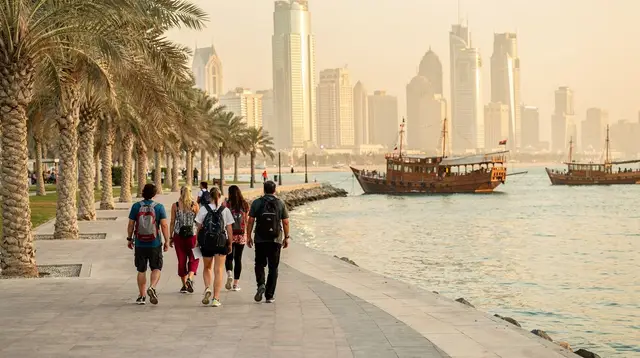
The second chapter moves into human history before the 20th century: Bedouin desert life, the coastal towns, and above all the pearling economy that supported much of the population for generations before oil was found. Pearl diving is treated at length, since it was for a long period Qatar’s main source of income and a defining part of its identity — the dhows moored today along the Corniche are direct descendants of the pearling fleet’s working boats, and seeing the exhibits here alongside a later dhow cruise on the water gives useful context to both.
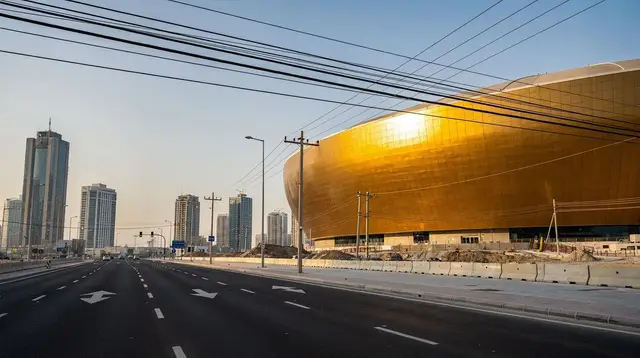
The third chapter covers the founding of the modern state of Qatar, the development of Doha as a capital, and the discovery and exploitation of oil and later natural gas, which reshaped the country’s economy and infrastructure within a few decades. This is the section that connects most directly to the Doha a visitor sees outside the museum walls — the skyline of West Bay, the planned city of Lusail, and the wealth that built them all trace back to the resources this final chapter describes.
Because the museum’s own gallery layout, room numbering and any temporary exhibitions change over time, this guide deliberately does not attempt to map out gallery-by-gallery timings or a fixed route beyond this general chronological shape. Confirm the current gallery arrangement with museum staff or signage on arrival.
Why this history matters for understanding Doha
A lot of what makes modern Doha distinctive only makes sense with some of this pre-oil context in hand. The wealth behind the Museum of Islamic Art’s art collection, the ambition behind Msheireb Downtown’s rebuilt heritage quarter, and the sheer scale of construction in Lusail all sit on an economic base that, within living memory, did not exist.
Before oil, Qatar’s coastal towns depended on pearling, fishing and trade, and the interior population lived a largely Bedouin, desert-based life. The National Museum of Qatar is the one place in the country that lays this transition out in a structured, chronological way, rather than leaving it implicit in the skyline.
This is also why the museum rewards a visit early in a trip rather than late. Seeing the pearling and pre-oil galleries before wandering Souq Waqif or taking an evening dhow cruise on the Corniche adds a layer of context to both: the restored souq and the wooden boats stop being simply attractive backdrops and start reading as descendants of a specific economic history. Several visitors build a first day in Doha around the museum and Msheireb Downtown together, since both engage with the same pre-oil-to-modern arc from different angles — one through objects and film, the other through a rebuilt streetscape.
Visiting with a guide versus on your own
The museum can be visited independently, and its scale and design reward simply wandering the disks and following the chronological galleries at your own pace. For visitors who want the historical narrative explained rather than read off wall text, a guided option adds real value here, since a lot of the pearling and founding-era history benefits from a human explanation rather than a self-guided audio track.
A dedicated guided walk-through of the National Museum with a local guide narrating the country’s story chapter by chapter is the most direct way to do this, aimed specifically at visitors who want the history explained rather than self-guided.
For visitors combining the museum with a wider look at the city, a half-day city tour that pairs central Doha’s landmarks with a visit inside the National Museum covers both in one outing, useful for a stopover or a first day when time is tight.
There are also broader combination options, including a full city tour taking in Souq Waqif, Katara Cultural Village and the National Museum together, which suits visitors who want the museum as one stop within a wider orientation to Doha rather than as a stand-alone outing.
Getting there and practical basics
The museum sits near the southern end of the Corniche, within easy reach of central Doha by taxi or ride-hailing app; it is not currently served directly by a Doha Metro station on the same footprint as some other landmarks, so most visitors arrive by road. It is a short drive from Souq Waqif and from the hotels around West Bay, and it can reasonably be combined with either on the same day.
This guide will not state fixed opening hours, a closing day, or a ticket price, because all three are the kind of detail that changes and that a written guide risks getting wrong the moment it is out of date. Check the current information directly with Qatar Museums or the official Visit Qatar site before you go, and check again if your visit is more than a few weeks after you first plan it. The same caution applies to exact visit duration: how long you need depends on how much of the chronological galleries you want to see in depth, so treat any fixed number you read elsewhere with some scepticism and budget a flexible half-day rather than a tight slot.
As with other major indoor sights in Doha, modest dress is expected — shoulders and knees covered — and this is worth planning for given how hot the climate can make outdoor alternatives feel for much of the year, discussed further in the guide to Doha’s cool season versus its summer heat.
Planning your visit around the rest of Doha
Because the museum sits close to the older heart of the city, it pairs naturally with a walk through the rebuilt streets of Msheireb Downtown, an evening at Souq Waqif, or a look at The Pearl-Qatar and Katara Cultural Village later the same day. Visitors on a short stopover often anchor a one-day Doha itinerary around the museum precisely because it is a single, weatherproof, air-conditioned site that still delivers a strong sense of the country, which matters given how extreme the midday heat can be for much of the year.
For a longer stay, the museum fits well into a broader two-day first-timer itinerary, usually on the same day as Msheireb or Souq Waqif rather than doubled up with the Museum of Islamic Art, simply to avoid museum fatigue. If deciding how to allocate limited time across Doha’s two flagship museums, the direct comparison in Museum of Islamic Art vs National Museum sets out how the two differ in focus and scale.
Finally, for a fuller day built around Doha’s museums and public art more broadly, a full-day city tour that also takes in Education City and the wider Al Rayyan area gives context on how Qatar has invested in culture and education alongside its historical narrative, useful for visitors who want to see the National Museum as one part of a bigger picture of the country’s priorities since the oil era began.
General planning advice, including how to sequence museums against desert and coastal days, is covered in the Doha trip planning checklist and in general notes on avoiding first-trip mistakes such as over-scheduling indoor sights on the same day as an outdoor desert excursion.
National Museum of Qatar visit questions
Is the National Museum of Qatar the same as the Museum of Islamic Art?
No. They are two separate institutions on opposite sides of Doha. The Museum of Islamic Art, designed by I. M. Pei, sits on its own island off the Corniche and covers Islamic art from across the wider Muslim world. The National Museum of Qatar, designed by Jean Nouvel, sits near the Corniche’s southern end and tells the specific history of Qatar itself, built around the old Amiri palace.
Who designed the National Museum of Qatar and when did it open?
The French architect Jean Nouvel designed the building, which opened in 2019. Its interlocking disks are inspired by the desert rose, a crystal formation that forms naturally in Qatar’s sabkha (salt flat) soil.
What was on the site before the museum was built?
The palace of Sheikh Abdullah bin Jassim Al Thani, an early 20th-century ruler of Qatar, stood on the site and served for a time as the seat of government and a royal residence. The restored palace building is preserved inside the museum grounds and forms part of the visitor route.
What period of history does the museum cover?
The permanent galleries move chronologically from Qatar’s geology and desert and marine environments through Bedouin and coastal life, pearling and trade, the founding of the modern state, and into the 20th-century discovery of oil and gas. The emphasis is on the country’s identity before the hydrocarbon era, not on the modern skyline.
How much time should I plan for a visit?
This guide does not state a fixed visit length, since the right amount of time depends on how many of the chronological galleries a visitor wants to see in full versus skim. Treat it as at least a half-day outing and check the museum’s own guidance on-site or via Qatar Museums for a realistic pace.
What are the opening hours and ticket prices?
These are not listed here because they change over time. Check the current hours, closing day and ticket prices directly with Qatar Museums or the official Visit Qatar site before travelling, rather than relying on a fixed figure written in advance.
Can I combine the National Museum of Qatar with other sights on the same day?
Yes. It sits close to the southern Corniche, within reach of Souq Waqif and a short taxi or drive from Msheireb Downtown, so a half-day at the museum pairs naturally with an afternoon or evening at either.
Is the museum suitable for visitors with limited time, such as a stopover?
It can work well for a longer layover since it is a single, self-contained site rather than a scattered itinerary, but a visitor should still confirm current opening hours against their layover window before committing to it.
Museums and Culture in Doha
Verified deep-linked GetYourGuide tours. Book through these links and we earn a small commission at no cost to you.
GetYourGuide does not provide a product photo for this activity — the image shows the meeting point, photographed by us.