Doha Neighborhoods Guide: West Bay to The Pearl
What are the main neighborhoods in Doha?
Doha's core areas are West Bay (the skyscraper skyline), the Corniche and Souq Waqif (the historic waterfront and market), Msheireb Downtown (the rebuilt heritage quarter), Katara and The Pearl (cultural village and artificial island), Lusail (a new city to the north) and Al Rayyan (Education City and the Aspire Zone to the west). They are linked by the Doha Metro, several tram lines and short taxi or ride-hailing rides.
How Doha’s areas fit together
Doha does not have the kind of sprawling, ambiguous districts that make some capitals confusing to navigate. The city is compact, built mostly along and around a curved bay, and its main areas each have a clear identity: a business skyline, a historic waterfront, a rebuilt heritage quarter, a couple of purpose-built leisure zones, and a new city taking shape just to the north. Understanding how these pieces connect matters more for planning a trip than ranking them against each other, and there is no single “best” base — the right area depends on what a visitor wants from their days in Doha.
This guide is a hub. For details on any single area — opening hours, what to see there, how long to spend — the destination pages linked throughout are the place to go; this page focuses on geography and how to move between neighborhoods.
Doha’s neighborhoods also read differently by time of day. The Corniche and Souq Waqif are pleasant at almost any hour but come alive after sunset, when the heat has dropped and the market alleys fill up. West Bay is at its most photogenic at dusk, when the towers light up against the sky. Katara and The Pearl suit a slower daytime pace — a walk on the beach, lunch by the marina — followed by an evening return for dinner. None of this changes where the areas physically sit, but it is worth factoring into which order a first-time visitor tackles them.
Doha in three concentric ideas
It helps to think of central Doha in three loose bands. The innermost band hugs Doha Bay: the Corniche waterfront promenade, Souq Waqif just inland from it, and the Museum of Islamic Art on its own small island near the southern end of the bay. This is the oldest and most walkable part of the city for a visitor.
Wrapped around and beyond that core sit the newer, purpose-built areas: West Bay with its cluster of skyscrapers on a promontory north of the bay; Msheireb Downtown, a low-rise heritage-style quarter built where the old commercial centre once stood, just inland of the Corniche; and the National Museum of Qatar, built around the former palace of Sheikh Abdullah bin Jassim, close to the bay’s edge.
Further out again are the leisure and residential developments: Katara Cultural Village and its beach, the artificial island of The Pearl-Qatar just north of Katara, the entirely new city of Lusail further north still, and Al Rayyan inland to the west, home to Education City and the Aspire Zone. None of these is a suburb in the ordinary sense — each was master-planned with its own identity, and each is worth visiting on its own terms rather than as a detour from somewhere else.
West Bay: the skyline
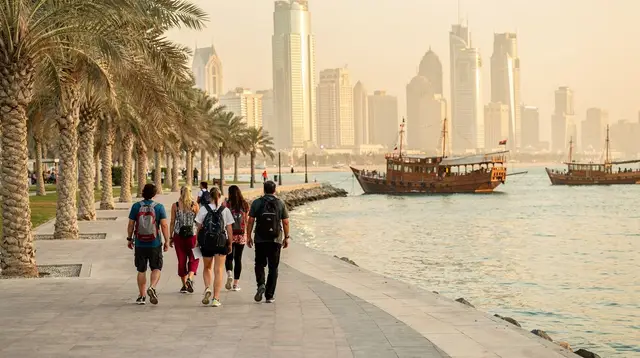
West Bay is Doha’s financial and hotel district, the cluster of towers most visible in any skyline photo of the city, sitting on a promontory that juts into the bay north of the Corniche. It is where a large share of the city’s business hotels and towers are concentrated, and it gives the best vantage points back across the water toward the Corniche and Museum of Islamic Art. For what there is to see and do there, the West Bay destination page has the detail; this page is only concerned with how it sits relative to everything else.
West Bay connects to central Doha by metro (the Red Line runs through it) and by a short taxi or ride-hailing trip to the Corniche or Souq Waqif — typically well under 20 minutes depending on traffic. Because most of the district’s towers face the water, rooms on the bay side of a West Bay hotel usually look straight across to the Corniche and the Museum of Islamic Art’s island, which is part of why the area is popular with business travellers who still want an evening view worth photographing.
The Corniche and Souq Waqif: the historic waterfront
The Corniche is the roughly 7 km curved promenade tracing the edge of Doha Bay, and it is one of the few parts of the city genuinely made for walking. Traditional wooden dhows moor along stretches of it, and evening dhow cruises depart from here — usually an hour or so on the water at sunset, with the West Bay skyline as the backdrop. Full detail on the promenade itself lives on the Corniche destination page.
A short walk inland from the Corniche is Souq Waqif, a market rebuilt in the 2000s on the footprint of the historic souq rather than an untouched ancient bazaar. It is quiet in the early afternoon and comes properly alive in the late afternoon and evening, when stalls open and the alleys fill with visitors and residents alike; the Falcon Souq and a falcon hospital sit alongside it. Because the Corniche and Souq Waqif are within easy walking distance of each other, most visitors treat them as a single outing.
Msheireb Downtown: the rebuilt heritage quarter
Msheireb Downtown sits just inland from the Corniche, on the site of Doha’s original commercial centre, redeveloped as a low-rise, heritage-influenced district with four dedicated Msheireb Museums. It is compact enough to explore on foot and is served by a free tram loop that circles the district, making it one of the easiest areas in the city to get around without a taxi. The Msheireb destination page covers what to see there in detail.
The district’s low, sand-toned buildings and shaded walkways are a deliberate contrast with West Bay’s glass towers a few minutes away by metro, and the two areas are often paired in a single day: heritage architecture and museums in the morning or late afternoon in Msheireb, skyline views in the evening from West Bay. Because both sit on the Red Line, moving between them rarely takes more than a short metro ride.
Katara and The Pearl: culture and the artificial island
North along the coast from West Bay, Katara Cultural Village combines cultural venues, restaurants and a public beach in a single walkable precinct, and it is a common choice for an evening outing. Immediately north of Katara is The Pearl-Qatar, an artificial island of marinas, waterfront promenades and residential towers. The Pearl is not within walking distance of West Bay or Katara — it is reached by road, and taxis or ride-hailing apps are the practical way in and out, since metro does not currently serve the island directly.
Lusail: the new city to the north
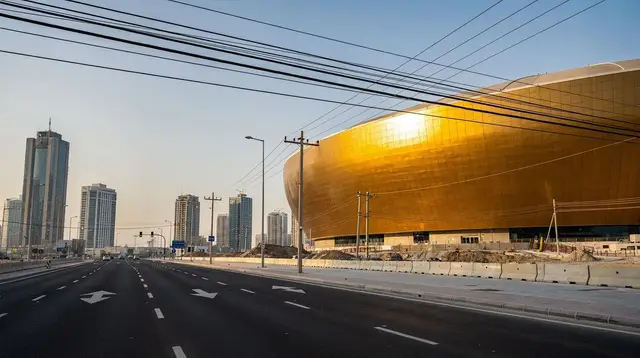
Lusail is a purpose-built city immediately north of Doha, most widely known internationally as the site of Lusail Stadium, which hosted the 2022 World Cup final. Beyond the stadium, it has its own marina district and the Place Vendôme retail and entertainment complex. Lusail has its own tram network and metro connections, and while it is a separate city rather than a Doha neighborhood in the strict sense, its proximity means it is routinely included on Doha-based itineraries. Details are on the Lusail destination page, and the Lusail Marina and Place Vendôme guide covers those two spots in more depth for anyone planning an evening there.
Because Lusail is newer and more spread out than the older coastal neighborhoods, walking between its own landmarks — the stadium, the marina and Place Vendôme — takes longer than the equivalent walk in Msheireb or along the Corniche, and a taxi or the tram between them is generally more practical than covering the district entirely on foot.
Al Rayyan: Education City and the Aspire Zone
West of central Doha, Al Rayyan is home to Education City’s cluster of university campuses (served by its own campus tram), the Aspire Zone sporting complex, and the 3-2-1 Qatar Olympic and Sports Museum. It is more spread out than the coastal neighborhoods and is generally reached by taxi, ride-hailing or car rather than on foot.
Getting between neighborhoods
Doha’s public transport has grown substantially since the Doha Metro opened in 2019, and for a visitor moving between the main central areas, it is usually the fastest and cheapest option. For the parts of the city the metro does not reach directly, or for late-evening trips, taxis and ride-hailing apps fill the gap reliably. A dedicated Doha Metro and tram guide covers lines, fares and stations in full; the summary below is enough for planning which areas to combine on a given day.
| Connection | Typical mode | Approximate time |
|---|---|---|
| West Bay ↔ Corniche / Souq Waqif | Metro (Red Line) or taxi | 10–20 minutes |
| Corniche ↔ Souq Waqif | Walking | 10–15 minutes |
| West Bay ↔ Msheireb | Metro | 10–15 minutes |
| Msheireb, within the district | Free Msheireb tram | A few minutes |
| West Bay / Katara ↔ The Pearl | Taxi or ride-hailing | 15–25 minutes |
| Doha centre ↔ Lusail | Metro/tram connection or taxi | 20–30 minutes |
| Doha centre ↔ Al Rayyan | Taxi or ride-hailing | 20–30 minutes |
| Hamad International Airport ↔ West Bay / Souq Waqif | Metro (Red Line) or taxi | 15–25 minutes |
Traffic in Doha drives on the right, and ride-hailing apps such as Uber and Careem operate alongside Karwa taxis, so a phone with a working data connection makes moving between areas straightforward even without transit.
Choosing where to spend time, not where to “base”
Because Doha is compact and well connected, the useful question for most visitors is less “which neighborhood should I stay in” and more “which areas suit what I want to do.” Someone prioritising museums and the old waterfront will naturally spend more time around the Corniche, Souq Waqif and Msheireb. Someone drawn to marinas, beaches and newer architecture will lean toward The Pearl, Katara and Lusail.
Visitors with a business trip built around West Bay’s hotels can still reach the historic core in well under half an hour. None of these choices is a compromise; they simply serve different trips, and it is entirely possible to cover most of them within a few days — see the two-day first-time Doha itinerary for one way to sequence it.
A guided overview is a practical way to get oriented on a first day, since it covers several of these areas in one outing with a driver rather than requiring several separate taxi trips. Options include a half-day guided city tour taking in the main downtown areas, or, for arrivals with only a few hours in hand, a private airport transfer combined with a city tour.
Beyond the core neighborhoods
The areas covered here sit within roughly 20–30 minutes of central Doha and make up the neighborhoods most visitors move between day to day. Qatar’s other regions — the southern desert around Sealine and the Inland Sea, the northern coastal towns near Al Khor and Al Zubarah, and the western sites near Zekreet and Al Shahaniya — are day-trip territory rather than neighborhoods, covered on their own day trips from Doha pages.
The closest of these outlying areas is Al Wakrah, a fishing town roughly 15–20 km south of central Doha with its own restored souq and beachfront — close enough that some visitors fold it into a longer day rather than treating it as a separate excursion. Further south again, the dunes around Sealine and the industrial port of Mesaieed sit roughly 50–60 km out, and Khor Al Adaid — the Inland Sea — on the Saudi border is reachable only by 4x4 across the sand, not by any of the transport options that serve the neighborhoods above.
For visitors planning to combine central Doha with these outlying areas over several days, a rental car is one option worth weighing against a series of day tours; the renting a car in Qatar guide covers what that involves in practice, from licensing to the roads themselves.
To get a feel for Souq Waqif’s alleys and market culture up close, a guided walking tour of Souq Waqif pairs naturally with a Corniche stroll, and for a different vantage point on the bay separating West Bay from the Corniche, a guided kayak tour along the Doha skyline is worth considering in cooler months.
Frequently asked questions about Doha’s neighborhoods
Which is the best neighborhood to stay in Doha?
It depends on what a visitor wants. West Bay suits skyline views and business hotels, Msheireb and the Corniche area suit walkable sightseeing near Souq Waqif, and The Pearl or Lusail suit longer stays with marina and beach access. None is objectively best; each serves a different trip.
Is Doha divided into safe and unsafe areas?
No. Qatar has very low crime nationwide, and there is no part of Doha that tour guides or residents treat as unsafe for visitors. Ordinary travel caution applies everywhere, as it would in any city.
How do you get between Doha’s neighborhoods?
The Doha Metro’s Red, Green and Gold lines connect West Bay, Msheireb, the airport and several other hubs. Lusail has its own tram, Msheireb has a free tram loop, and Education City runs a campus tram. Taxis and ride-hailing apps such as Uber and Careem cover the rest, including The Pearl and Katara.
Is Souq Waqif in the same area as the Corniche?
Yes. Souq Waqif sits just inland from the Corniche waterfront, within easy walking distance, and the two are usually visited together in the same outing.
Is The Pearl-Qatar within walking distance of West Bay?
No. The Pearl is a separate artificial island north of West Bay, reached by road or taxi rather than on foot. Metro does not currently reach the island itself.
Is Lusail part of Doha?
Lusail is a distinct planned city just north of Doha, connected by road and by the Lusail Tram and metro extensions. It is often covered on Doha itineraries because of the short distance, but it is administratively its own city.
Do all neighborhoods have a metro station?
Most of the central areas do, including West Bay, Msheireb and stations near the Corniche, but some destinations, such as The Pearl and Katara, are better reached by taxi, ride-hailing or the Msheireb/Lusail tram network than on foot from a metro stop.
Is it worth renting a car to get around Doha’s neighborhoods?
Not for most first-time visitors. The core neighborhoods are close enough together that metro, tram and taxi or ride-hailing cover them comfortably, and parking in West Bay or around Souq Waqif can be more hassle than it saves. A car becomes more useful once a trip extends beyond the city to the southern desert, the north coast or west Qatar, where public transport does not reach.
How far is Al Wakrah from central Doha’s neighborhoods?
Al Wakrah, a fishing town with its own restored souq, sits roughly 15–20 km south of central Doha, making it closer to the city than the desert areas further south around Mesaieed and Sealine. It is usually treated as a short day trip rather than a Doha neighborhood proper.
Doha by Neighborhood
Verified deep-linked GetYourGuide tours. Book through these links and we earn a small commission at no cost to you.
GetYourGuide does not provide a product photo for this activity — the image shows the meeting point, photographed by us.