Museum of Islamic Art, Doha: A Visitor's Guide
What is the Museum of Islamic Art in Doha and is it worth visiting?
The Museum of Islamic Art (MIA) is Doha's flagship museum, designed by architect I. M. Pei and built on its own island off the Corniche. It holds one of the world's leading collections of Islamic art across more than a thousand years, and the surrounding MIA Park gives one of the best views of the West Bay skyline in the city.
A museum built on its own island
Of all the landmarks along the Corniche, the Museum of Islamic Art is the one that visitors to Doha tend to remember longest. It stands alone on a purpose-built island off the southern curve of the waterfront, reached by a short causeway, with open water and a wide lawn park wrapped around the building on every side. The architect was I. M.
Pei, the same designer behind the glass pyramid at the Louvre, and MIA was one of his last major projects: he came out of retirement for it, travelled across Egypt, Tunisia and Syria to study historic Islamic architecture, and eventually decided the building itself should sit apart from the city, isolated on the water so nothing crowds its silhouette. It opened in 2008 and has anchored Doha’s museum scene ever since.
It is worth saying clearly, because the two are confused constantly: MIA is not the National Museum of Qatar. That building, the desert-rose-shaped structure built around the old palace of Sheikh Abdullah bin Jassim, opened over a decade later, in 2019, and was designed by the French architect Jean Nouvel. Different architect, different building, different collection, a short distance apart. If you only remember one fact from this page, make it that one — see our comparison of the two museums if you are trying to decide which to prioritise, or whether to see both.
What the collection actually holds
MIA’s galleries bring together Islamic art from three continents and more than a thousand years: manuscripts and Qurans with illuminated calligraphy, ceramics from Persia and Central Asia, glasswork and metalwork from Egypt and Syria, textiles, astronomical instruments, and jewellery. The collection was assembled specifically for this building rather than inherited from an older institution, which shows in how deliberately it is arranged — galleries are organised loosely by theme and period rather than by country, so you move through calligraphy, then geometric pattern, then figurative art, tracing ideas across the Islamic world rather than jumping between national collections.
The building itself is as much a part of the experience as the objects in it. Pei’s design leans on geometric abstraction drawn from Islamic architecture — a stepped, layered exterior in pale limestone, a central atrium under a coffered dome that changes the quality of light through the day, and a deliberate restraint in ornamentation that lets the collection carry the visual weight. The atrium alone, with its scale and the way daylight falls through the dome, is worth pausing in rather than walking straight past on the way to the galleries.
MIA Park and the view back to West Bay
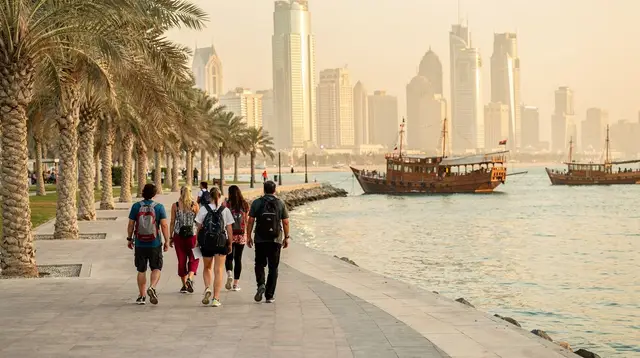
The park that surrounds the museum, MIA Park, is a destination of its own and free to walk regardless of whether you go inside the building. It runs along the full edge of the island: open lawns, palm-lined paths, public art, and benches set specifically to face back across the water toward the West Bay skyline. Sunset is the best time to be here for that view — the towers catch the last light, the water goes still, and the museum’s own pale stone glows against it. It is one of the more reliable, low-effort photo spots in Doha, and unlike some viewpoints in the city it costs nothing and needs no ticket.
The park also connects on foot to the wider Corniche promenade, so it works well as one stop on a longer waterfront walk that also takes in the dhow harbour and the approach to Souq Waqif. In the cooler months, roughly November to March, this whole stretch is genuinely pleasant to walk in the evening; in summer, the shaded paths inside the park are more comfortable than the open promenade, but the honest advice for the hottest months is still to save extended outdoor walking for the early morning or after sunset.
Getting there
MIA sits close enough to the centre of Doha that most visitors reach it by taxi, ride-hailing app or a short walk from nearby hotels rather than by metro — the Doha Metro doesn’t run a station directly onto the museum island, so a car or a walk along the Corniche from Souq Waqif or West Bay is the practical route. From most hotels in West Bay or Souq Waqif, the trip is well under fifteen minutes by road. If you’re staying further out, in Lusail or the Pearl-Qatar, budget closer to twenty or twenty-five minutes depending on traffic.
Parking exists near the museum for visitors arriving by car, but given how central the location is, most people find a taxi or ride-hailing drop-off simpler than driving and parking themselves, especially on a first visit when you don’t yet know the road layout around the Corniche.
Hours, closing day and tickets — check before you go
This guide will not print a fixed set of opening hours, a weekly closing day, or ticket prices, because all three are set and occasionally revised by Qatar Museums, the body that runs MIA along with the National Museum and several smaller institutions. Any number printed here would risk being wrong by the time you read it. Before you plan your day, check the current hours and closing day directly on the Qatar Museums website, or on the Qatar Tourism portal, and confirm again a day or two before your visit — museums in Doha do occasionally adjust hours around public holidays and during Ramadan, when opening times across the city shift to accommodate fasting hours.
If you’d rather not track this yourself, a guided tour that includes MIA as a stop takes the scheduling off your hands entirely, since the operator manages entry timing as part of the itinerary. It’s a reasonable option on a first trip or a short stopover, when you don’t want to spend planning time confirming museum hours against the rest of your day.
Making the most of a visit
A visit of one and a half to two hours inside the galleries covers the highlights without rushing, and gives enough time to sit in the atrium and take in the dome before moving on. Add thirty to forty-five minutes in MIA Park if the weather is good, more if you’re timing it for sunset. The museum has a café and, at various points, a restaurant space with a direct view back toward West Bay across the water — a genuinely good spot for a coffee or a meal that isn’t just a tourist add-on, since the view alone makes it worth the stop.
Photography is generally allowed in the public areas and much of the collection, though flash and tripods are typically restricted inside the galleries — signage on site will confirm current rules, since these can change gallery by gallery. As with any museum, mosque or public building in Qatar, dress modestly: shoulders and knees covered is the baseline expectation for both men and women, the same standard that applies across Souq Waqif, Msheireb and most indoor public spaces in the city. It’s a low bar to clear and nobody visiting MIA in ordinary daytime clothing needs to think twice about it.
Combining MIA with the rest of Doha
Because of where it sits, MIA slots naturally into a wider day around the old city and the Corniche rather than standing alone. A common pattern: start with Souq Waqif in the late morning before the midday heat, walk or take a short taxi to MIA for the museum and the park in the early afternoon, then finish along the Corniche toward evening, either for a dhow cruise at sunset or dinner back in the souq. The Msheireb Museums a little further inland pair well on the same day if you want a deeper look at Doha’s more recent history alongside MIA’s older, broader collection.
If you’re short on time — a stopover between flights, or just one day in the city — a structured city tour that bundles MIA with Souq Waqif, the Corniche and sometimes Katara or the Pearl removes the need to plan logistics yourself. For visitors who want the museum specifically alongside other cultural landmarks in one guided outing:
a half-day city tour that includes a guided visit to the Museum of Islamic Art covers the Corniche and old town alongside the museum itself, with a guide handling the route and the timing.
For a broader sweep across Doha’s cultural sites in a single outing, including museums beyond MIA:
a guided tour of Doha’s museums and cultural landmarks strings together several of the city’s key institutions with commentary from a local guide.
If your day also takes in the waterfront villages and cultural quarter further along the coast:
a combined tour of the Corniche, the Pearl-Qatar, Souq Waqif, Katara and the museum is built specifically to link MIA with these nearby districts in one trip.
And for visitors who want to see both of Doha’s major museums back to back with context from a guide rather than working it out alone:
a guided tour of the National Museum of Qatar is worth booking as a separate stop the same day or the next, since the two museums cover very different ground and neither substitutes for the other.
A short checklist before you go
| What to confirm | Where to check |
|---|---|
| Opening hours and weekly closing day | Qatar Museums official site |
| Ticket prices and any free-entry days | Qatar Museums official site |
| Ramadan or public holiday schedule changes | Qatar Museums official site, checked close to your travel date |
| Dress code reminders | General Qatar visitor guidance — shoulders and knees covered |
| Getting there from your hotel | Taxi or ride-hailing app; no direct metro station on the island |
Why MIA is worth the detour
Doha has no shortage of striking buildings, but few reward an unhurried visit the way MIA does. The building rewards close attention to Pei’s use of light and geometry, the collection rewards visitors willing to slow down through galleries organised by idea rather than by country, and the park outside rewards nothing more than showing up near sunset and looking back across the water.
It is a rare stop in the city that works equally well as a two-hour cultural visit or a free half-hour walk, and it sits close enough to West Bay, Souq Waqif and the rest of central Doha that skipping it on a city visit is a genuine missed opportunity rather than a reasonable trade-off. See the museums and culture category and the Museum of Islamic Art activities page for more ways to build it into your plans, and the attraction tickets guide if you’re weighing MIA against Doha’s other paid sights.
Frequently asked questions about visiting the Museum of Islamic Art
Who designed the Museum of Islamic Art in Doha?
The Museum of Islamic Art was designed by the architect I. M. Pei, who came out of retirement for the project and studied Islamic architecture across the Middle East before drawing up the design. It opened in 2008. It is a separate building from the National Museum of Qatar, which was designed by Jean Nouvel and opened in 2019 — the two are easy to mix up, but they are different buildings by different architects.
Where exactly is the Museum of Islamic Art?
MIA sits on its own artificial island just off the southern end of the Corniche, a short walk or a quick taxi ride from Souq Waqif and central Doha. The building and the park around it, MIA Park, occupy the whole island, with the West Bay skyline visible across the water.
What are the opening hours and ticket prices?
Opening hours, the weekly closing day and ticket prices are set by Qatar Museums and do change from time to time, so this guide does not print a fixed schedule. Check the official Qatar Museums website or the Qatar Tourism portal shortly before you go, and confirm whether your visit falls on the closing day.
How much time should I set aside for the museum?
Most visitors spend one and a half to two and a half hours inside the galleries, plus extra time outside in MIA Park. If you also want to walk the park at sunset for the skyline view, or stop at the museum’s café or restaurant, allow closer to three hours in total.
Can I combine the Museum of Islamic Art with other sights in one day?
Yes. It sits close to Souq Waqif, the Corniche and Msheireb Downtown, and many visitors combine it with a walk along the Corniche, a stop in Souq Waqif for lunch or dinner, and an evening dhow cruise. A guided city tour that includes the museum is a straightforward way to link these together without planning the logistics yourself.
What should I wear to visit the museum?
Modest dress is expected: shoulders and knees covered for both men and women, as in any museum, mall or public building in Qatar. There is no stricter dress code specific to MIA beyond this general standard, but comfortable shoes are worth it given the size of the park and the causeway leading to the building.
Is the Museum of Islamic Art suitable for children?
Yes, particularly the ground floor galleries and the outdoor park, which has open lawns, shaded paths and skyline views that work well for families. The upper galleries hold more detailed historical objects, which older children and adults tend to appreciate more than very young ones.
Do I need to book tickets in advance?
Qatar Museums’ own site is the authority on whether advance booking is required or recommended at any given time. If you would rather not deal with ticketing logistics at all, a guided tour that includes museum entry bundles this together with a driver and a guide for the rest of the itinerary, such as a full-day city tour taking in Doha and Education City for visitors who want museum time folded into a longer day out.
Museums and Culture in Doha
Verified deep-linked GetYourGuide tours. Book through these links and we earn a small commission at no cost to you.
GetYourGuide does not provide a product photo for this activity — the image shows the meeting point, photographed by us.