The Pearl and Katara Tour: Doha's Modern Waterfront Combined
Why do tours combine The Pearl-Qatar and Katara Cultural Village?
The two sit right next to each other on the coast just north of West Bay, so a single afternoon or evening tour can cover both without backtracking. Neither is a historic site: The Pearl is an artificial island of marinas and cafes, and Katara is a purpose-built cultural district, so the visit is about architecture, waterfront strolling and dining rather than heritage.
Two modern neighbourhoods, one easy afternoon
The Pearl-Qatar and Katara Cultural Village are the two stops that turn up together on almost every Doha city tour that ventures north of West Bay, and there is a simple, practical reason for that: they sit right next to each other on the same stretch of coast. Neither one is old. The Pearl is an artificial island reclaimed from the sea and developed mainly through the 2000s and 2010s, and Katara was purpose-built in roughly the same period as a cultural and residential district.
If you are hoping for ruins, a walled town or centuries of layered history, look instead at Al Zubarah in the north or the restored market at Souq Waqif in the centre. What The Pearl and Katara offer is something different and, for a lot of visitors, just as worthwhile: a look at what Qatar has built with its wealth over the last two decades, plus a genuinely pleasant few hours of walking, browsing and eating by the water.
This guide covers why these two areas are almost always paired on tours, what a typical combined itinerary actually involves, what there is to do at each stop, and how to decide whether a guided version is worth booking over doing it yourself by taxi.
Why The Pearl and Katara get combined
Doha’s tourist geography clusters loosely around a handful of pockets: the museums and Corniche in the centre, West Bay’s skyscraper cluster just north of that, then The Pearl and Katara a little further north again, and finally Lusail beyond them. The Pearl and Katara are close enough to each other, and far enough from the centre, that it makes sense to visit them back to back rather than as two separate outings.
There is also a complementary logic to what each place offers. The Pearl is almost entirely about the built environment: super-yacht marinas, European-styled boulevards, high-rise apartment towers and a dense strip of cafes and restaurants. Katara adds cultural programming to that same modern-development formula: an open-air amphitheatre, art galleries, two striking mosques and a public beach, all designed with a more Arabian and Islamic architectural vocabulary than The Pearl’s Mediterranean-inspired quarters. Seeing both back to back gives a sense of the range of styles Qatar has built in a short span of years, from a district that reads almost like a European resort town to one built with clearer regional references.
Timing matters too. Both places are at their best in the late afternoon and evening, when the heat has eased and the lighting flatters the architecture, which means they slot naturally into the same half-day or evening window rather than each needing its own dedicated visit.
What you actually do at The Pearl-Qatar
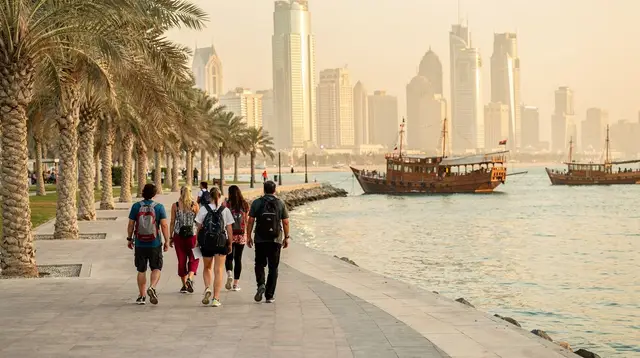
The Pearl-Qatar is a large reclaimed island connected to the mainland near West Bay, built around a series of marinas and residential precincts. For a visitor, the main draw is the Qanat Quartier, a canal-side neighbourhood built in a Venetian-influenced style with pastel facades, small bridges and waterside walkways. It photographs well and is genuinely pleasant to wander through on foot, especially in the evening when the cafes along the canal fill up.
Beyond the Qanat Quartier, the main activity at The Pearl is strolling the marina promenades and browsing the retail strip known as the Porto Arabia boardwalk, lined with international restaurants, coffee chains and boutiques, with rows of private yachts moored alongside. There is no single ticketed attraction here; the point of a visit is simply to walk, look at the yachts and buildings, and sit down for a coffee or a meal with a marina view. It is a district built for residents and diners more than for sightseeing checklists, which is exactly why it pairs well with somewhere like Katara that has a bit more to actively do.
What you actually do at Katara Cultural Village
Katara sits just south of The Pearl, closer to West Bay, and was built as a dedicated cultural and public space rather than a residential development. Its centrepiece is a Greek-style open-air amphitheatre set into the hillside, used for concerts and cultural events; even when nothing is on, it is worth a look for the setting alone, framed by the sea on one side.
Katara’s two mosques are among its most photographed buildings: the gold-domed Katara Mosque and the striped, more contemporary Golden Mosque nearby, both viewable from the outside without needing to enter. The village also holds a cluster of small art galleries and cultural exhibition spaces, a traditional dhow-building yard where you can sometimes see wooden boats under construction by hand, and a public beach that is one of the more accessible stretches of sand close to central Doha, popular for an evening walk even outside swimming hours.
Katara’s dining strip runs along its waterfront, with restaurants and cafes facing the sea and, in the cooler months, outdoor seating that makes for one of the more relaxed dinner settings in the city. Combined with The Pearl’s marina restaurants a short drive away, this stretch of coast gives visitors two distinct dining backdrops within the same short excursion.
Comparing the two stops
| The Pearl-Qatar | Katara Cultural Village | |
|---|---|---|
| Built | Reclaimed island, developed mainly 2000s–2010s | Purpose-built cultural district, opened late 2000s |
| Main draw | Marinas, Qanat Quartier canals, yachts | Amphitheatre, mosques, galleries, beach |
| Typical activity | Walking, browsing boutiques, cafes | Walking, viewing architecture, cultural events |
| Best time to visit | Evening, for marina lights and cooler air | Late afternoon into evening |
| Historic site? | No — modern development | No — modern development |
| Dining style | International restaurants, marina views | Waterfront restaurants, sea views |
How a combined tour usually runs
Most operators fold The Pearl and Katara into a wider city-tour itinerary rather than selling a visit to just these two districts alone, since on their own they are a couple of hours of walking rather than a full day. A typical combined tour picks up from a central Doha hotel, drives north past or through West Bay, stops first at Katara for the mosques, amphitheatre and a walk along the waterfront, then continues a short distance further to The Pearl for the Qanat Quartier and marina promenade, often finishing around sunset when both locations look their best.
Several tours widen this out further to include the museums, Souq Waqif or the newer district of Msheireb, which makes sense given how compact central Doha is by road. If your priority is specifically the modern waterfront side of the city rather than the museums or old souq, look for an itinerary description that puts The Pearl and Katara first rather than as an afterthought.
A private, guided cultural tour taking in the museums, souq, Katara and The Pearl is the most complete version of this combination, useful if you want the modern waterfront alongside Doha’s two flagship museums in a single outing. A more compact option is a guided city tour pairing Souq Waqif with Katara and The Pearl, which drops the museums but keeps the souq’s atmosphere alongside the waterfront districts.
If your interest leans more towards Doha’s newer skyline than its market culture, an icons tour covering Msheireb, West Bay, Lusail and The Pearl strings together the city’s contemporary developments in one loop.
For a broader first-timer’s overview that still touches these two districts, a highlights tour covering the best of Doha is a reasonable starting point, and for total flexibility a private city tour covering Souq Waqif, Katara and The Pearl lets you set the pace and skip anything that does not interest you.
Doing it yourself instead
Neither The Pearl nor Katara requires a guide to visit. Both are open public districts served by taxis and ride-hailing apps from anywhere in central Doha, and a return trip covering both in one evening is a straightforward, inexpensive taxi outing rather than something that needs booking in advance. The Doha Metro does not run directly to either district, so a car remains the practical way to get there regardless of whether you book a tour or arrange your own transport.
Where a guided tour adds value is in context: a guide can point out which buildings are residential versus commercial, explain the design references behind Katara’s two mosques, and keep the visit moving efficiently if it is folded into a longer day that also covers the museums or Souq Waqif. If you are comfortable navigating on your own and simply want to walk, photograph and eat, doing it independently by taxi works just as well and gives you full control over how long you linger at each stop.
Combining with the rest of Doha’s north side
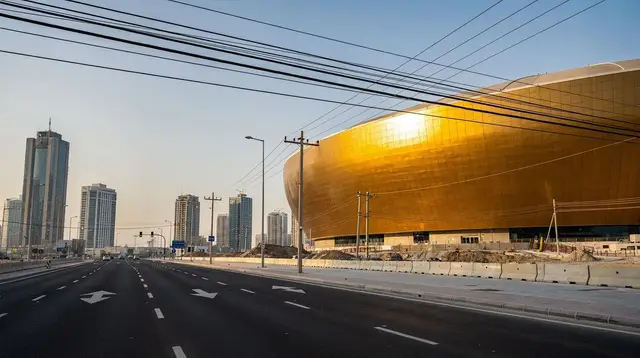
Because The Pearl and Katara sit on the route between central Doha and Lusail, some visitors extend the same outing north to see Lusail’s marina and Place Vendôme mall, or Lusail Stadium from the outside, rather than treating The Pearl as the northern end point. Others prefer to keep the day centred on the museums and old town and treat The Pearl and Katara as a standalone evening excursion, which avoids the fatigue of trying to cover too much modern architecture in a single sitting.
Either approach works; the deciding factor is usually how many days you have in Doha overall. On a one-day itinerary built around the museums and souq, The Pearl and Katara are best treated as an optional evening add-on rather than a core stop. On a two- or three-day visit, they earn a dedicated half-day of their own, ideally scheduled for late afternoon so the walking coincides with cooler temperatures and better light.
Practical notes for visiting
Both districts are walkable but spread out enough that some driving between sections is normal, particularly at The Pearl, where the Qanat Quartier and the main marina promenade are a fair distance apart on foot. Comfortable shoes matter more than they might seem to for what looks like a leisurely stroll. Dress remains the same as anywhere else in public Doha: modest, with shoulders and knees covered, and covered arms and legs if you plan to approach either of Katara’s mosques closely, even though entry to the mosque interiors is not typically offered to casual visitors.
Summer heat (roughly May to September) makes daytime visits to either district uncomfortable, reinforcing the case for an evening visit even outside of scheduling convenience. In the cooler months from November to March, an earlier afternoon start is more workable if you want to see the architecture in full daylight before the evening crowds and dinner rush arrive.
For photography, both districts photograph best in the last hour of daylight and just after sunset, when The Pearl’s marina lighting and Katara’s illuminated mosques and amphitheatre are at their most striking, which is one more reason operators consistently schedule this combination for the end of the day rather than the morning.
The Pearl and Katara Tour FAQ
Are The Pearl and Katara historic sites?
No. The Pearl-Qatar is a reclaimed artificial island developed mainly in the 2000s and 2010s, and Katara Cultural Village was purpose-built in the same period. Both are modern developments designed to look at and enjoy, not archaeological or heritage sites.
How far apart are The Pearl and Katara?
They sit directly next to each other on the coast just north of West Bay, only a few minutes apart by road. That short distance is the main reason tour operators combine them into a single itinerary.
What do you actually do on a Pearl and Katara tour?
Mostly walking and looking: strolling the marina promenades and Qanat Quartier of The Pearl, browsing boutiques and cafes, then walking Katara’s amphitheatre, mosques and beachfront, often finishing with dinner or a sunset view.
Is a Pearl and Katara tour worth it if I only have one day in Doha?
It works well as an afternoon or evening add-on to a museum-focused morning, since both areas are best appreciated at golden hour or after dark when the lighting and temperature both improve, rather than as the single focus of a very short stay.
Can I visit The Pearl and Katara without a guided tour?
Yes, both are open public districts reachable by taxi or ride-hailing app, and a guide is not required to walk around. A guided or private tour mainly adds context, transport between the two, and a fixed itinerary if time is limited.
Is there an entrance fee for The Pearl or Katara?
No, both are free, open neighbourhoods to walk through. Costs come from what you choose to do there, such as dining, boat trips or specific paid attractions inside Katara.
What is the best time of day to see The Pearl and Katara?
Late afternoon into evening, when the heat drops, the marina lights come on at The Pearl, and Katara’s amphitheatre and beachfront are at their most atmospheric; midday visits in summer are best avoided.
Doha and Souq Waqif City Tours
Verified deep-linked GetYourGuide tours. Book through these links and we earn a small commission at no cost to you.
GetYourGuide does not provide a product photo for this activity — the image shows the meeting point, photographed by us.