What to Wear in Doha: A Practical Dress Code Guide
What should I wear in Doha?
In malls, museums, souqs and government buildings, cover your shoulders and knees. Swimwear is for beaches, pools and hotel grounds only, and mosques ask for covered arms and legs, plus a headscarf for women. Nothing here is enforced by a fixed fine — it is a shared expectation, not a courtroom.
The first time I packed for Doha, I overthought it badly. I read three contradictory blog posts, packed a long-sleeved abaya I never once needed, and still managed to feel underdressed on day one because I walked into Souq Waqif in shorts that hit mid-thigh. Nobody said anything. Nobody fined me. But I felt the gap between what I was wearing and what everyone around me was wearing, and that gap is really what this guide is about.
The rule of thumb that actually works
Forget the checklists that read like customs regulations. The real, working rule in Doha is simple: shoulders and knees covered in indoor public places — malls, museums, souqs, government offices, the airport. That is it. Nobody carries a tape measure. Nobody hands out tickets. I have seen tourists in vest tops get politely waved into a mall with barely a glance, and I have seen others get a soft word from mall security asking them to cover up before entering a store. It depends a bit on the day, the venue and honestly the mood of whoever is at the door, but the expectation is consistent enough to plan around.
For men, that means: no bare chest anywhere except a beach or pool, and shorts that come down toward the knee rather than short-shorts. For women, it means: a top that covers the shoulders (a light cardigan over a strappy dress works fine) and something — a skirt, dress or trousers — that covers the knees. Leggings alone, in my experience, get treated as not quite covering enough; pair them with a longer top or a skirt over them.
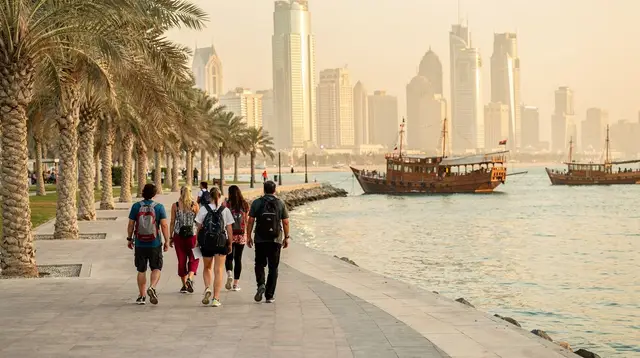
None of this means head-to-toe covering. I wear normal linen trousers and a t-shirt most days in West Bay and around The Pearl, and I have never felt out of place. Doha is an international, cosmopolitan city with a huge expatriate population, and the dress code reflects a shared public modesty, not a uniform.
Where the line actually sits
I think the confusion comes from lumping every space into one rule, when Doha really has three different zones.
Everyday indoor and public spaces — malls, the National Museum of Qatar, the Museum of Islamic Art, Katara, government buildings, the metro — want shoulders and knees covered. Loose, breathable clothing is not just polite here, it is also what you’ll want anyway once the heat hits.
Beaches, pools and hotel grounds are the exception, and a real one. Swimwear belongs there and nowhere else. I have swum at hotel pools in a normal swimsuit with zero issue, then thrown a cover-up on for the ten-metre walk back through the lobby, mostly out of habit rather than obligation.
Mosques are stricter, and rightly so — you’re a guest in someone’s place of worship. Arms and legs need to be covered, and women are asked to wear a headscarf. Most mosques that welcome visitors, including the Education City mosque, keep loaner abayas and scarves at the entrance for exactly this reason, so you genuinely do not need to arrive prepared. I found this out on a tour that combined the mosque with the Qatar National Library — a guided visit to the Education City mosque, the national library and the Quranic Garden — and the loaner robes were simply handed out at the door, no fuss.
What I actually pack
| Item | Why |
|---|---|
| Loose linen or cotton trousers | Covers knees, breathes in the heat |
| Midi or maxi dress + light cardigan | Covers shoulders and knees in one go |
| Lightweight long-sleeve shirt | Sun protection, doubles as mosque-ready cover |
| One swimsuit | Pool and beach only |
| Closed, comfortable shoes | Souq floors and museum tiles add up fast |
| Light scarf (for women) | Doubles as mosque headscarf and sun cover |
I go into far more detail on the full packing list, including what changes if you’re travelling in summer versus the cooler months, in what to pack for Doha — that’s the piece to read before you actually fill a suitcase.
Souqs, malls and the golden hour effect
Souq Waqif genuinely feels different depending on the hour, and I noticed dress expectations soften along with the crowd. In the late afternoon and evening, when the souq properly wakes up, you’ll see everything from full traditional dress to families in shorts and t-shirts wandering the same lane. What stays constant is the shoulders-and-knees baseline; what shifts is how relaxed everyone feels about it once the sun is down and the whole city is out for karak and grilled meat.
Malls run a slightly tighter version of the same rule, partly because they’re air-conditioned indoor spaces used by families of every background, and partly because individual stores sometimes post their own sign at the door. I’ve never been stopped, but I’ve read the signs and adjusted a cardigan before walking in, and that’s really the whole system in practice.
Men’s dress code, specifically
Men get an easier ride, but not a free one. Shorts are fine almost everywhere as long as they’re not the very short athletic kind, and a t-shirt is fine everywhere except a mosque. The one place I’d genuinely rethink is a formal restaurant or a sit-down dinner cruise — not because of any rule, but because Doha’s dining scene, from the Corniche dhows to the West Bay towers, tends to dress up in the evening, and a collared shirt just fits the room better. I noticed this most clearly on a full day tour covering the city’s landmarks, where the group ranged from shorts and sandals in the morning heat to smart-casual by the time we reached the evening stops.
What I’d tell a first-time visitor
Don’t buy a special “Doha outfit.” Bring the loose, breathable clothes you’d pack for any hot climate, add one long-sleeve layer and one scarf, and keep your swimsuit for the pool and the beach. If in doubt at a mosque, just ask at the entrance — loaner cover-ups are the norm, not the exception, and I’ve never seen anyone turned away for asking. The goal isn’t to memorise a rulebook; it’s to read the room the way you would in any conservative-leaning public space, and Doha makes that easy once you’ve done it once.
FAQ: dress code in Doha
Do I need to cover my shoulders and knees everywhere in Doha?
In indoor public places — malls, museums, souqs and government buildings — yes, shoulders and knees covered is the working expectation for both women and men. Beaches, pools and hotel grounds are the exception, where swimwear is normal.
Can I wear a swimsuit outside the pool or beach?
No. Swimwear is treated as beach and pool wear only; walking through a hotel lobby, mall or street in just a swimsuit is out of place. A cover-up or light layer for the short walk back is the easiest fix.
What do I need to wear inside a mosque in Doha?
Mosques ask for covered arms and legs for everyone, plus a headscarf for women. Most mosques that welcome visitors, including the Education City mosque, keep loaner abayas and scarves at the entrance, so you don’t need to arrive already dressed for it.
Is the dress code different for men and women?
The baseline is the same — shoulders and knees covered in public indoor spaces — but women are also asked to cover their hair inside a mosque, which doesn’t apply to men. Otherwise the expectations run in parallel.
Will I be fined or stopped for wearing the wrong thing?
I’ve never seen or heard of a fixed fine for a dress-code slip in Doha, and this guide won’t invent one. In practice, the worst you’ll get is a polite word from mall or venue staff, or simply not being let past a specific door until you cover up.
What should I wear to Souq Waqif?
The same shoulders-and-knees baseline applies, though the atmosphere relaxes in the evening when the souq is at its busiest. Comfortable, closed shoes matter more than most people expect, given the uneven stone lanes.
Is it okay to wear shorts in Doha?
Yes, for both men and women, as long as they’re not the very short athletic style — something closer to knee-length is the safe, comfortable choice for museums, malls and souqs.
Where can I read more about packing for the heat and the dress code together?
The full breakdown of what to bring, month by month, is in what to pack for Doha, which pairs well with this guide once you know the general rules.
tours.Practical
Verified deep-linked GetYourGuide tours. Book through these links and we earn a small commission at no cost to you.
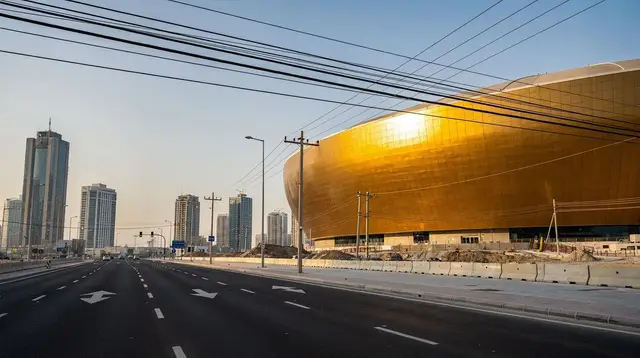
GetYourGuide does not provide a product photo for this activity — the image shows the meeting point, photographed by us.