Guided Walking Tours of Doha: Souq Waqif, Msheireb and the Corniche
Are guided walking tours a good way to see Doha?
Yes, for a handful of compact, pedestrian-friendly quarters — Souq Waqif, Msheireb Downtown, Al Bidda Park and the Corniche — where a local guide adds context that a car window cannot. Doha as a whole is a car-oriented city, so walking works best in the cool season or after sunset, on a route that stays inside these connected areas rather than crossing the wider metropolitan area on foot.
Where walking actually makes sense in Doha
Most visitors arrive in Doha expecting a walkable Gulf capital, because that is how cities like Dubai’s Al Fahidi or Muscat’s old quarters are sometimes described. Doha is different. It was built out fast, in a few decades, around wide arterial roads, elevated highways and enormous setbacks between buildings, with the Doha Metro and taxis doing the work that pavements would do elsewhere. Walk out of most hotels in West Bay or Lusail and you will find yourself on a service road with no shade, no crossing and nowhere obvious to go on foot.
There is, however, a genuine exception, and it is exactly the corridor this page covers: Souq Waqif, the rebuilt heritage quarter of Msheireb Downtown, Al Bidda Park, and the Corniche that curves along Doha Bay. These four areas sit close enough together, and are built at a human scale with actual pavements, shade structures and street life, that stringing them into a single walking route is not only possible but genuinely one of the best ways to understand old and new Doha side by side.
A guided walking tour through this corridor is popular precisely because it solves the problem most visitors run into on their own: knowing which alleys in Souq Waqif lead somewhere interesting, which of Msheireb’s four museums rewards a look inside, and where along the Corniche the skyline view is worth the stop. A knowledgeable guide adds context — on falconry, on pearling history, on why Msheireb was rebuilt the way it was — that a self-directed stroll will not surface on its own.
The four stops that make up a walking route
Souq Waqif is the natural starting point for almost every guided walk. It looks and feels centuries old, with narrow lanes, wind-tower facades and the smell of spices and grilled meat drifting between stalls, but it is worth knowing this is a restoration: the market was rebuilt in the 2000s on the footprint of the original souq, which had fallen into disrepair.
That does not make it any less atmospheric — if anything, the rebuild is why it works so well as a walking destination, with even paving, working shade and none of the hazards of a genuinely ancient bazaar. The Falcon Souq, a row of shops selling and treating falcons, sits at one edge and is a highlight most guides build a stop around. Note that the souq is at its liveliest in the late afternoon and evening; a good number of stalls stay shuttered through the early afternoon, which is one more reason guided walks here tend to run later in the day.
From Souq Waqif, routes typically continue into Msheireb Downtown, the rebuilt heritage quarter just to the south. This is new construction designed to look and function like a traditional Qatari neighborhood, arranged around the preserved houses that now form the four Msheireb Museums. It is one of the only parts of central Doha genuinely designed with pedestrians in mind, with a free tram loop threading through it if you want to rest your feet partway round. A guide here can do real work, walking you through the significance of the individual heritage houses and how the district’s design draws on older Qatari building traditions, in a way that a plaque alone will not.
Al Bidda Park, a green space near the coast, sometimes features on routes that link the old town to the waterfront, offering a shaded, grassy break between the density of the souq and the openness of the Corniche.
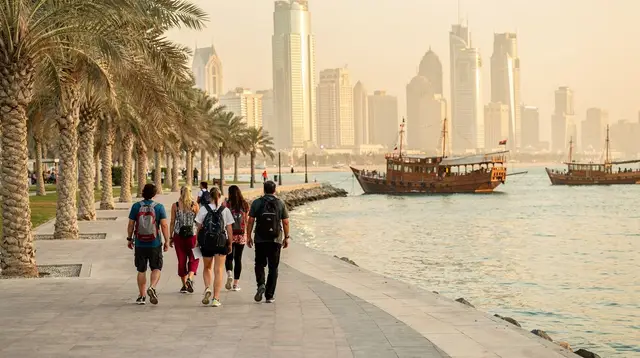
The Corniche is where most walks end, and for good reason: this seven-kilometre waterfront promenade curves around Doha Bay with the towers of West Bay rising across the water and traditional wooden dhows moored along the shore. Evening is when the Corniche earns its reputation, as the skyline lights up and the heat of the day has passed. Many guided walks time their route so the Corniche segment lands at or after sunset.
Why the season and the time of day decide everything
Doha runs on a hot desert climate, and the practical reality is that the comfort — and in the hottest months, the safety — of any outdoor walking route depends entirely on when you do it. Roughly November through March is the cool season: warm, often pleasant days and genuinely comfortable evenings, when a daytime walking tour through Souq Waqif and Msheireb is a completely reasonable way to spend a few hours.
From roughly May through September, conditions are a different matter. Temperatures routinely climb past 40°C with high humidity, and walking outdoors in the middle of the day during these months is not simply uncomfortable, it carries a real risk of heat exhaustion. This is exactly why so many Doha walking tours, including guided city tours built around the same Souq Waqif–Msheireb–Corniche corridor, run in the evening or after dark for most of the year: the heat drops enough after sunset to make an hour or more of unhurried walking genuinely enjoyable, and the souq and Corniche are, if anything, more atmospheric lit up at night than they are at midday.
This page will not put a number on how long a route takes or how far it covers. Pacing varies with the guide, the group and how many stops are built in along the way, and promising a fixed distance or duration would be more likely to mislead than help. What is consistent is the advice to check the specific tour listing for its structure, to wear shoes you are happy walking in for an extended stretch, and to carry water regardless of the season — the humidity along the Corniche can be higher than it feels.
Guided or independent: which suits you
If you enjoy setting your own pace, ducking into whichever alley in Souq Waqif looks interesting and lingering as long as you like at the museums in Msheireb, a self-guided walk works well and needs no booking at all. For a fully independent route through the heritage quarter, the companion page on walking Msheireb Downtown on your own lays out a route without a fixed schedule to work around.
A guided tour earns its place when you want the context filled in as you go: why Msheireb’s houses are arranged the way they are, how falconry fits into Qatari culture beyond the shopfronts of the Falcon Souq, or which of the dhows moored on the Corniche still sail for pearling-heritage demonstrations. Guides also tend to know the souq’s rhythm well enough to time a route around when specific lanes and cafes are actually open, which matters given how much of Souq Waqif shuts down in the early afternoon.
a guided walk that goes beyond the main lanes of the old town into some of Doha’s lesser-seen corners is one option built specifically around this kind of local knowledge, pairing Souq Waqif with pockets of the surrounding streets that most visitors would otherwise walk straight past.
For travellers who want the route built entirely around their own interests and pace, a private walking tour with a guide who tailors the stops to what you actually want to see avoids the fixed itinerary of a group departure altogether, whether that means more time in the Falcon Souq or a longer stretch along the Corniche at sunset.
Combining a walk with the wider city
Because Souq Waqif, Msheireb and the Corniche sit so close together, a walking route through them slots naturally into a broader half-day or evening in Doha rather than standing alone. a broader city tour that takes in Doha’s landmark sights beyond the old town on foot and by vehicle is a useful option if you want the walking corridor bookended by West Bay, Katara or the National Museum, none of which are realistic walking distances from Souq Waqif.
If you would rather sit down partway through, a city tour built around a sit-down buffet lunch alongside the main sightseeing stops gives the day some structure, useful if a midday walk in warmer months does not appeal but you still want to see the same landmarks.
And because the Corniche is also where dhow cruises depart, a boat tour along Doha Bay that shows the West Bay skyline from the water is the natural way to end a walking route that finishes at the waterfront, watching the towers you have just been walking beneath from a completely different angle.
Practical notes before you go
Dress for the same standard you would use anywhere in Doha’s public spaces: shoulders and knees covered, which matters as much in Souq Waqif and Msheireb as it does in any Doha mosque you might pass along the way. Shoes matter more than anything else — Souq Waqif’s paving is uneven in places, and an evening on the Corniche is far more pleasant in something you can walk in without thinking about it.
Fridays change the rhythm of the old town: it is the main day of prayer, and stalls in Souq Waqif typically open later, after midday prayers finish, so a Friday morning is the wrong time to plan a walking route through the souq. Evenings, Friday included, are unaffected and tend to be lively.
During Ramadan, which follows the Islamic lunar calendar and shifts earlier each year, daytime eating and drinking in public are not permitted, and opening hours across Souq Waqif and Msheireb shift accordingly, with many places closing through the day and staying open late into the night. A guided walk booked during Ramadan is worth checking for any adjusted timing, since evening becomes even more clearly the default for this route during that period.
Finally, keep the geography in mind: Souq Waqif, Msheireb, Al Bidda Park and the Corniche form one connected walking corridor, but they are not the whole of Doha, let alone the whole of Qatar. West Bay’s towers, Lusail and the desert sites south of the city are all a taxi, ride-hailing trip or metro ride away, not a walking extension of this route — a distinction worth keeping straight so a single afternoon on foot does not turn into an unplanned trek along a highway shoulder.
Frequently asked questions about walking tours in Doha
Is Doha a walkable city?
Only in patches. Souq Waqif, the Corniche, Msheireb Downtown and Al Bidda Park sit close enough together to link on foot, with shade, paving and street life that reward walking. Outside that corridor, Doha was built around wide roads and the metro rather than pavements, so most trips between neighborhoods are made by car, taxi or the Doha Metro.
What does a guided walking tour of Doha usually cover?
Most guided walks combine two or three of the same core stops: the alleys and coffee houses of Souq Waqif, the Falcon Souq, the restored heritage houses and museums of Msheireb Downtown, and a stretch of the Corniche with its dhows and skyline views. Some itineraries add Al Bidda Park or a viewpoint over West Bay.
When is the best time of day or year to walk in Doha?
The cool season, roughly November to March, is the most comfortable time for daytime walking. In the hotter months, evening and night walks are far more practical than anything in the middle of the day, when the heat and humidity make extended outdoor walking uncomfortable and, at the peak of summer, genuinely risky.
Do I need a guide, or can I walk Souq Waqif and Msheireb on my own?
Both areas are safe and easy to explore independently, and a self-guided route works well if you prefer your own pace. A guide adds value through stories, historical context and access to details — a falconer’s perspective at the Falcon Souq, or the layout logic of Msheireb’s heritage houses — that are easy to miss walking alone.
How much walking is actually involved?
This depends on the specific tour and how much ground it covers, and operators vary in how they structure a route, so it is worth checking the listing for pacing and any stops built in. As a rule, comfortable shoes and a refillable water bottle matter more than any fixed expectation of distance.
Are these walking routes suitable for children or older travellers?
Souq Waqif and the Corniche are flat, paved and easy-going, which suits most fitness levels and families with children, especially outside the hottest hours. Msheireb Downtown is similarly level. Check individual tour listings for any specific age guidance or mobility notes before booking.
What should I wear for a walking tour in Doha?
Modest dress that covers shoulders and knees is expected in Souq Waqif, Msheireb and around any mosque along the route, in line with general etiquette across Doha’s public spaces. Pair that with comfortable closed shoes, sun protection and a bottle of water, and add a light layer for evening walks when air conditioning indoors can be strong.
Can I combine a walking tour with a dhow cruise or the museums nearby?
Yes. The Museum of Islamic Art and the Corniche promenade sit close to Souq Waqif, and dhow cruises depart from the Corniche itself, so a walking route through the old town often connects naturally into an evening boat trip or a museum visit on the same outing.
For more on timing a visit around the climate, see the guides on Doha’s cool season and on surviving the Doha summer. For dress expectations across the city, the page on what to wear in Doha covers the same standard that applies along this walking route, and Friday opening hours in Doha explains the souq’s weekend rhythm in more detail.
If you want the old town folded into a single first day, the one-day Doha highlights itinerary sequences it alongside the city’s other landmarks, and the wider city tours category lists further options for exploring central Doha, on foot or otherwise, including a dedicated Doha city tour guide, a Doha night tour for after-dark sightseeing, a Souq Waqif shopping guide for what to buy along the way, and a food and karak walk through Souq Waqif for anyone who wants the route built around eating rather than sightseeing.
Doha and Souq Waqif City Tours
Verified deep-linked GetYourGuide tours. Book through these links and we earn a small commission at no cost to you.
GetYourGuide does not provide a product photo for this activity — the image shows the meeting point, photographed by us.