Doha at Night: The After-Dark City Tour That Actually Works
What is the best way to see Doha at night?
Walk the Corniche for the illuminated West Bay skyline, then head into Souq Waqif once it fills with people in the late afternoon and evening. Katara and Lusail add a second evening if you have more time, and a dhow cruise or a guided night tour can string these together with transport included.
Why evening is the right time to see Doha
Doha is a desert city, and for a large part of the year that fact shapes the whole day. Midday sightseeing outdoors in the hot season is not just uncomfortable, it is a genuine health risk, and even in the cooler months an afternoon in direct sun wears visitors down fast. Evening solves this. Once the sun drops, the temperature becomes bearable, the light turns the West Bay towers gold and then electric white, and the city’s public spaces fill with people rather than emptying out. If you only have a limited window to explore Doha on foot, the hours after sunset are usually the best hours you get.
This guide covers the three places that make up a classic Doha night tour: the Corniche for the skyline, Souq Waqif for atmosphere, and Katara or Lusail if you have a second evening to spend. It also explains where a dhow cruise fits in, and where a guided night tour earns its cost over doing it yourself.
The Corniche and the West Bay skyline
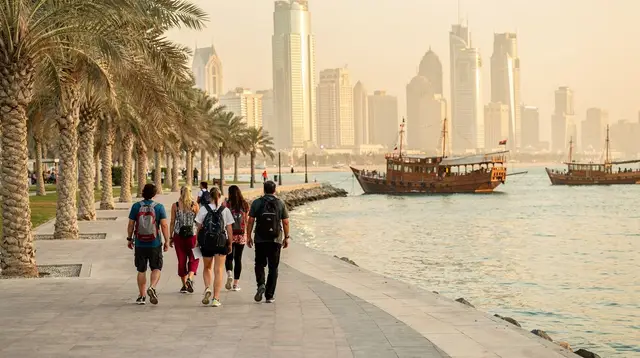
The Corniche is a roughly seven-kilometre waterfront promenade curving around Doha Bay, and it is where the city’s skyline photograph comes from. By day, West Bay’s towers are a fairly ordinary cluster of glass; after dark, they light up individually, and the effect from across the bay is genuinely striking. Traditional wooden dhows moor along stretches of the Corniche too, their outlines lit against the water, which gives the view a layer that skyline shots alone would not have.
Walking the Corniche at night costs nothing and needs no booking. Pick a stretch near the middle of the bay, close to Souq Waqif, and you get a clear line across the water to the towers without needing to walk the whole seven kilometres. Families, joggers and food carts share the promenade in the evening, and it stays busy and well lit late into the night, particularly on the Thursday and Friday weekend evenings.
If you want the skyline from the water rather than from the shore, that is what a dhow cruise is for. Rather than describe the cruise experience in detail here, it is worth reading that dedicated guide, since the practicalities (routes, timing, what a sunset sailing versus a dinner sailing includes) deserve their own space. Several guided night tours also fold a short dhow segment into a wider evening itinerary, which is a convenient way to combine the boat with the souq and the skyline in a single booking.
Souq Waqif after dark
Souq Waqif is Doha’s most recognisable market, and it is important to understand what it actually is: a restored traditional souq, rebuilt in the 2000s on the footprint of the old market, rather than an untouched relic. That does not make it feel manufactured in practice. The narrow lanes, wind-tower architecture, spice stalls, textile shops and the attached Falcon Souq (with its adjoining falcon hospital) give it real texture, and the restoration is convincing enough that most visitors never think about the distinction once they are inside.
What matters more for planning is timing. Souq Waqif is a daytime market on paper but an evening destination in practice: many stalls close in the early afternoon and the place properly comes alive in the late afternoon and evening, when temperatures drop and the restaurants along the main lanes fill their outdoor seating. We are deliberately not printing specific opening hours here, because they vary by day, by season and, significantly, during Ramadan, when the whole rhythm of the souq shifts: shops close for much of the day and reopen after sunset for a lively, crowded evening.
Ramadan itself moves roughly eleven days earlier every year on the Gregorian calendar, so a fixed month or date printed in a guide like this would be wrong within a year or two. The practical takeaway is simple: arrive in the late afternoon, expect things to still be waking up, and plan your evening around the souq filling in around you rather than around a printed schedule.
Inside the souq, look for the falconry section, the working art galleries tucked into side alleys, and the rooftop and courtyard restaurants that open onto the lanes. A shisha café with a view over the main square is a reasonable way to sit still for half an hour between walking stretches. Modest dress applies here as everywhere in public Doha: shoulders and knees covered is the expected standard, even in the evening heat.
Katara and Lusail: a second evening
If one night in Doha only stretches to the Corniche and Souq Waqif, a second evening opens up two more distinct moods. Katara Cultural Village sits between West Bay and The Pearl, built around an amphitheatre, galleries and a beach, and its architecture (deliberately drawing on the region’s older building styles) reads differently once it is lit at night, with a quieter, more contemplative feel than the souq’s crowds. Katara’s beach and waterfront paths make a good stop for dinner with a view rather than a full evening of activity in themselves.
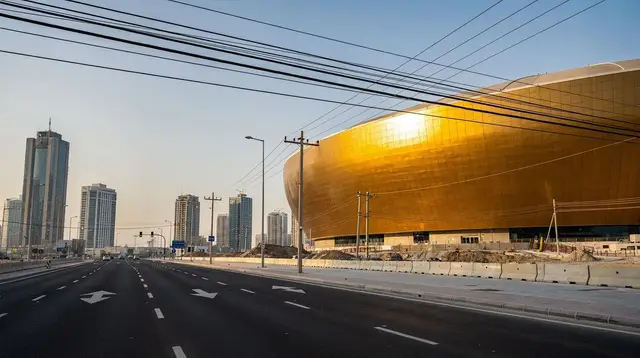
Lusail, north of Doha, is the newer story: a purpose-built city that most visitors now recognise for Lusail Stadium, the venue of the 2022 World Cup final, along with the Lusail Marina and the Place Vendôme shopping and entertainment district. At night, Lusail’s marina and fountain areas take on a different character again, closer to a large-scale planned waterfront than to the older, denser fabric of central Doha. It is not a substitute for Souq Waqif or the Corniche; it is a contrast to them, and worth the detour if you are staying more than a couple of nights or have already covered the classic route.
Both Katara and Lusail sit outside easy walking distance from central Doha and from each other, so budget for a taxi, a ride-hailing app, or a tour that includes transport between stops.
How a guided night tour fits in
None of this requires a guide. The Corniche and Souq Waqif are walkable, well signed and connected by Doha’s metro and tram network, and a self-guided evening covering both is entirely realistic for a confident independent traveller. Where a guided night tour earns its cost is in stitching together sights that are not close to each other, particularly if your evening includes Katara or Lusail alongside the Corniche and souq, or if you are short on time and want the route planned rather than worked out on the fly.
A private night city tour with a driver typically removes the logistics of getting between West Bay, the Corniche, Souq Waqif and, depending on the itinerary, Katara or Lusail, without you needing to negotiate taxis between each stop. If your evening is squeezed into a layover, a tour built specifically for that purpose can also handle the airport pickup and drop-off, which matters more than it might seem given how tight a stopover window usually is.
For a comfortable, low-effort version of the classic route with drinks included along the way, consider a private night city tour with refreshments, which covers the Corniche, West Bay and Souq Waqif at a relaxed pace. Travellers who want the souq’s atmosphere combined with Katara, The Pearl and Lusail in one outing might prefer a guided evening covering Souq Waqif, Katara, The Pearl and Lusail, which does the stitching-together mentioned above for you.
If your evening starts or ends at the airport, a night city tour with hotel or airport pickup removes one more logistical step. And for a shorter, simpler introduction to the illuminated skyline without a longer itinerary attached, there is also a standalone Doha by Night tour.
Building an evening around the heat
The argument for a Doha night tour is not really about atmosphere for its own sake, though the atmosphere is real. It is about the climate. Roughly from May to September, Doha’s daytime heat and humidity make extended outdoor walking genuinely unpleasant and, at the extremes, risky, while evenings remain warm but manageable. Even in the cooler months, from roughly November to March, an evening out is simply more comfortable than a midday one, since the sun stops being a factor and the Corniche and souq fill with local families rather than tourists alone.
If you are visiting during the hot months, treat the evening as your primary sightseeing window and push more of your indoor activity, such as the Museum of Islamic Art or the National Museum of Qatar, into the day. Our guide to indoor activities in Doha’s summer covers that side of the split in more detail.
A simple two-stop evening itinerary
For a first evening in Doha with no guide and no car, the following sequence works well and needs no reservations beyond dinner:
| Time | Stop | What to do |
|---|---|---|
| Late afternoon | Corniche (Souq Waqif end) | Walk toward West Bay as the light softens; watch the towers switch on |
| Early evening | Souq Waqif | Wander the lanes, visit the Falcon Souq, browse spice and textile stalls |
| Evening | Souq Waqif restaurant or rooftop café | Dinner with a view over the main square or the Corniche |
| Late evening | Corniche return walk | Second look at the skyline, now fully lit, dhows visible on the water |
Travellers based near West Bay or The Pearl can simply reverse the direction, starting at the skyline end of the Corniche and finishing at Souq Waqif for dinner. Either way, the metro’s Red and Green lines and the free Msheireb tram loop connect most of these points if you would rather not walk the full distance.
Practical notes for an evening out
A few points worth keeping in mind rather than treating as fixed rules. Dress modestly, as you would during the day: shoulders and knees covered is the expected standard in the souq and other public places, even after dark. Bring a light layer; Doha evenings are cooler than the daytime but rarely cold, so this is about comfort rather than necessity. Cards are accepted almost everywhere, including souq stalls and restaurants, so there is little need to carry large amounts of cash.
And if your visit falls during Ramadan, expect the whole rhythm described above to shift toward the evening even further, with the liveliest hours starting only after sunset; check current opening patterns closer to your travel dates rather than relying on a fixed schedule, since Ramadan’s dates move each year and no printed guide can track them precisely.
If you are combining a night tour with other parts of Doha, our Doha city tour guide covers the daytime landmarks, and the first-timer’s guide to Doha is a useful starting point for building out a fuller itinerary around this evening.
Doha night tour: frequently asked questions
Is Doha better at night or during the day?
For outdoor sightseeing, evening usually wins, especially outside the cool season. The heat drops, the Corniche and Souq Waqif fill with people, and the skyline lights up. Museums and indoor sights still work fine by day.
What time does Souq Waqif open in the evening?
It varies by season, by day of the week and especially during Ramadan, when hours shift significantly. Rather than plan around a fixed time, aim to arrive in the late afternoon and let the souq fill in around you.
Is Doha safe to walk around at night?
Yes. Qatar has very low crime, and the Corniche, Souq Waqif, Katara and Lusail are all well lit, well patrolled and busy with families well into the evening.
Do I need a car for a Doha night tour?
Not for the Corniche or Souq Waqif, which are walkable and metro-accessible. Katara, The Pearl and Lusail are more spread out, so a taxi, ride-hailing app or a guided night tour makes moving between them easier.
Can I do a Doha night tour on a layover?
Yes, if your transit rules and timing allow you to leave Hamad International Airport. Many visitors combine a short layover with an evening Corniche and Souq Waqif visit; whether you personally can exit the airport depends on your nationality and the entry rules in force at the time of travel.
What should I wear for an evening out in Doha?
The same modest standard as during the day: shoulders and knees covered in public places such as souqs and cultural sites. Evenings are cooler than midday but rarely cold, so light layers are usually enough.
Does Ramadan change the night scene in Doha?
Considerably. Daytime hours contract, many places close in the afternoon, and the evening after sunset becomes the liveliest part of the day, with Souq Waqif and family gatherings running late. Ramadan follows the lunar calendar and shifts about eleven days earlier each year, so treat any specific date as approximate.
Doha and Souq Waqif City Tours
Verified deep-linked GetYourGuide tours. Book through these links and we earn a small commission at no cost to you.
GetYourGuide does not provide a product photo for this activity — the image shows the meeting point, photographed by us.