Parasailing, Flyboard and Towables in Doha
Can you go parasailing or flyboarding in Doha?
Yes. Operators along the Doha waterfront and at The Pearl-Qatar run parasailing, flyboard and towable rides such as banana boats and donuts, mostly from spring through autumn. Sessions depend on calm sea and low wind, so exact height, speed and duration are never fixed in advance and can be cut short or cancelled.
What parasailing, flyboard and towables actually involve
Doha’s flat, sheltered waters and warm climate have made watersports a normal add-on to a beach afternoon rather than a niche pursuit. Three activities come up again and again when visitors ask what is on offer beyond swimming: parasailing, where a harnessed rider is towed behind a speedboat under a parachute canopy and lifted into the air; flyboarding, where a rider stands on a board connected by a hose to a jet ski, using the redirected thrust of water to hover and manoeuvre above the surface; and towables, the umbrella term for inflatable rides such as banana boats, donuts and biscuits pulled behind a boat, usually as a shared group activity rather than a solo one.
All three are run commercially from a handful of bases along the Corniche and Doha’s West Bay waterfront, and from the marina area of The Pearl-Qatar, with a smaller presence at Katara.
None of them require previous experience: parasailing needs none at all beyond fitting into a harness, flyboard sessions for beginners come with an instructor who controls the throttle remotely at first, and towables are simply a case of holding on. This guide sets out who each activity actually suits, what can cancel a session, and what to expect from a typical booking, without promising a specific height, speed or duration, because none of that is fixed in advance for any operator.
Who each activity suits
Parasailing suits travellers who want the view and the sensation of height without any physical exertion. You are strapped into a harness attached to a canopy, the boat accelerates, and the canopy lifts you off the rear deck; landing is usually back onto the boat or a floating platform.
It works well for a wide age range, for people who cannot swim confidently (you never enter the water in a normal flight), and for anyone happier watching than doing, since a shared ride sometimes takes two riders side by side while others in the group stay in the boat. It is a poor fit for anyone with a fear of heights that a few minutes’ airtime would not settle, or for people with neck, back or shoulder problems that a webbing harness under tension could aggravate.
Flyboarding is a different kind of activity: it is physical, it involves falling into the water repeatedly while you learn balance, and it rewards a degree of core strength and comfort in the water. First-time sessions are supervised closely, with an instructor holding a second control that limits thrust until the rider finds their balance, so it is more approachable than watching an expert clip online might suggest. It suits travellers who want an active, slightly adrenaline-driven experience and don’t mind getting thoroughly wet; it suits non-swimmers far less well than parasailing does, and most operators are cautious about booking flyboard for anyone who is not at least a reasonably confident swimmer, life jacket or not.
Towables — banana boats, donuts, biscuits — are the group option: several riders sit or lie on an inflatable and get pulled, bounced and occasionally tipped off behind a boat. They suit families with older children, groups of friends who want something silly and photogenic rather than technical, and anyone who wants a shorter, cheaper, lower-commitment taste of being on the water. They are the least demanding of the three physically, though falling off at speed is part of the experience, so the same basic water confidence and life-jacket rule applies.
None of the three is well suited to very young children, and each operator sets its own minimum age and, for parasailing, a maximum combined weight for the harness — worth checking directly if travelling with kids or as a larger group, since it is not standardised across Doha’s operators.
The conditions that decide whether a session runs
This is the part worth understanding before booking anything, because it is the single biggest source of disappointment for visitors who assume a paid slot guarantees a fixed experience. Parasailing, flyboard and towable rides all depend on the state of the sea and the wind on the day, and operators in Doha will delay, shorten or cancel a session rather than run it in unsafe conditions.
Wind is usually the deciding factor for parasailing: too little and the canopy won’t lift properly, too much and the ride becomes unsafe or the operator simply won’t risk it. Flyboard is less wind-sensitive but still affected by chop, since a rough surface makes balance far harder and increases the risk of a bad fall. Towables need enough calm water for the boat to tow safely without swamping the inflatable.
Sea state — swell, chop, visible whitecaps — matters across all three, and a day that looks calm from a hotel balcony can be different once a boat is a few hundred metres offshore. Marine traffic and, occasionally, security restrictions near certain stretches of coastline can also affect where and when operators are permitted to run.
Because none of this is under the operator’s control, no reputable business in Doha will promise you a specific height for parasailing, a guaranteed flight time for flyboard, or an exact ride duration for a towable, and any listing that states one as a hard fact is describing a typical case rather than a guarantee. What operators can promise is a booked time slot, safety equipment, and briefing; what they generally cannot promise is that the slot goes ahead exactly as described if the sea has other ideas. Bad-weather policies vary — some reschedule automatically, some offer a refund, some ask you to call ahead on the morning — so it is worth asking the specific policy at the time of booking rather than assuming.
Season and time of day
Doha’s watersports season broadly tracks its climate: activity is busiest from around October through April, when the weather is comfortable enough to spend a full afternoon outdoors, and demand drops off during the hottest stretch of summer even though the sea itself stays warm. Some operators keep running through summer with shaded waiting areas and earlier or later time slots to avoid the worst of the midday heat; others reduce their schedule.
If your trip lands in Doha’s cool season, availability tends to be broader and worth booking a day or two ahead; if you are visiting in the depths of summer, check what an operator can actually offer before assuming a slot exists, and see our notes on indoor options for the hottest months as a backup plan.
Morning and late afternoon slots are generally more comfortable than midday, both for the heat and for calmer wind patterns that often build through the day. A dawn or late-afternoon booking also tends to give better light for photos over the West Bay skyline.
Where to base yourself and how bookings work
The two practical hubs are the Doha waterfront near West Bay and the Corniche, and the marina side of The Pearl-Qatar; both are a short taxi or ride-hailing trip from most hotels, and neither is served directly by the Doha Metro, so budget for a taxi both ways. A handful of resort-attached operators run from private beach frontage, in which case access may be limited to hotel guests or day-pass holders.
Bookings are typically for a fixed time window rather than a fixed duration of activity — you show up, get briefed and kitted out, and the actual time in the air or in the water is set on the day by the instructor or boat crew based on conditions and how the group is doing. Group sizes for parasailing are often one or two riders per flight; flyboard is almost always one rider at a time with an instructor supervising; towables carry several riders per pass. If you specifically want an instructor-led first flyboard attempt, a guided jet ski tour around the bay, or a look at the skyline from the water without the adrenaline of flyboard, options exist for each:
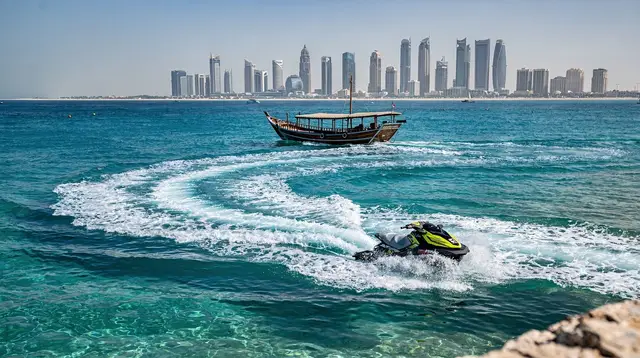
an instructor-supervised flyboard session for first-timers, a guided jet ski tour past the West Bay skyline, a self-drive jet ski ride with beach access for a more independent alternative, or a private boat tour if you’d rather watch the water than be pulled through it.
What to bring and wear
Swimwear under light, quick-drying clothing works for all three activities, and a rash guard is worth packing for flyboard given the repeated falls. Bring a change of clothes, a towel if the operator doesn’t provide one, and reef-safe sunscreen applied well before you arrive, since it washes off fast once you’re in the water.
A GoPro or waterproof phone case is useful, though many operators also offer photo or video packages, worth asking about at booking rather than assuming it’s included. Modesty norms that apply on Doha’s public beaches are relaxed at private beach clubs and resort watersports areas, where standard swimwear is normal; away from those areas, more coverage is expected, in line with general guidance on what to wear in Doha.
Comparing the three at a glance
| Activity | Physical demand | Water contact | Best suited to |
|---|---|---|---|
| Parasailing | Low | None (stays dry, harnessed above boat) | Non-swimmers, wide age range, view-seekers |
| Flyboard | High | Constant, repeated falls | Confident swimmers wanting an active challenge |
| Towables (banana boat, donut) | Moderate | Frequent, brief | Families, groups, shorter and cheaper outings |
Combining watersports with the rest of a Doha trip
A watersports afternoon slots naturally around a day otherwise spent on land. Many visitors pair it with time at the beach clubs near the Corniche or at The Pearl-Qatar, or fold it into a longer stay that also covers Doha’s museums and souqs — see our Doha city tour guide for how those pieces fit together. If you’re arriving on a stopover rather than a full trip, check what’s realistic to fit in on our Doha stopover guide before booking a fixed time slot, since airport transfer times and the rest of your itinerary need to line up.
Families weighing up watersports against calmer options should also look at our family-friendly beaches and parks page and the wider Doha with kids guide, and anyone deciding which waterfront neighbourhood to base themselves in for easy access to the water can compare options in West Bay vs Souq Waqif vs The Pearl.
For a broader look at what’s on the water beyond parasailing and flyboard, our jet ski guide, dhow cruise guide and scuba and pearl diving guide cover the calmer and the more traditional ends of the spectrum, and the Doha beaches guide lays out which stretches of coast have watersports operators on site versus which are simply for swimming and sunbathing. If you’d rather stay dry entirely, the Doha water parks guide is a land-based alternative that doesn’t depend on sea conditions at all.
Frequently asked questions about parasailing and flyboard in Doha
Is parasailing available all year in Doha?
Most operators run through the warmer months and scale back in winter when demand drops, though the limiting factor day to day is sea and wind conditions rather than the calendar. Always confirm with the operator close to your date rather than assuming a season guarantees a slot.
What is flyboarding and is it hard to learn?
Flyboard uses the thrust from a jet ski’s pump, redirected through a hose to boots on a board, to lift the rider above the water. Sessions for first-timers include an instructor and a short briefing, and most people manage a basic hover within their allotted time, though controlled flight and tricks take longer to master.
Will I definitely go up a certain height on parasailing?
No reputable operator promises an exact height or flight time in Doha, because both depend on wind strength, boat speed and the winch operator’s judgement on the day. Treat any specific number quoted in advance as an estimate, not a guarantee.
What can cancel or shorten a session?
Strong wind, choppy sea, poor visibility and, in some cases, marine traffic restrictions can all delay, shorten or cancel parasailing, flyboard or towable rides. Operators prioritise safety over sticking to a schedule, and a cancelled slot is usually rescheduled or refunded rather than run in unsafe conditions.
Who should avoid these activities?
Pregnant travellers, people with heart, spine or shoulder conditions, and non-swimmers attempting flyboard without close instructor supervision should generally avoid or take extra caution with these activities. Most operators set a minimum age and a maximum weight for parasailing harnesses, so check before booking if travelling with children or as a larger group.
Do I need to know how to swim?
For parasailing you stay dry and harnessed above the boat, so swimming ability matters less, though a life jacket is still worn. For flyboard and towables you go in the water repeatedly, so basic water confidence is genuinely useful even though a life jacket is provided.
Where in Doha do these activities run from?
The main bases are along the Doha waterfront near West Bay and the Corniche, and at The Pearl-Qatar’s marina area, both a short taxi ride from most hotels. A few operators also work from Katara’s beach frontage.
How much do parasailing and flyboard cost in Doha?
Prices vary by operator, group size and whether the ride is shared or private, and change over time, so treat any figure as indicative rather than fixed. Booking ahead, especially in cooler months, secures a time slot rather than a guaranteed price.
Water Sports in Doha
Verified deep-linked GetYourGuide tours. Book through these links and we earn a small commission at no cost to you.
GetYourGuide does not provide a product photo for this activity — the image shows the meeting point, photographed by us.