Doha for First-Timers: What to Know Before You Go
What should a first-time visitor to Doha know before arriving?
Doha is the capital of an independent state, not part of the UAE. The city is spread out and mostly car- or taxi-dependent, though the Doha Metro covers the main sights well. Summers are extremely hot, public dress should be modest, and the essentials are the Corniche, Souq Waqif, the Museum of Islamic Art and the National Museum of Qatar.
Getting your bearings before you land
Doha is the capital of Qatar, a small, independent peninsula state ruled by the Emir, jutting north into the Persian Gulf from the Arabian mainland. Qatar’s only land border is with Saudi Arabia to the south, and the country is not part of the United Arab Emirates. It is a genuinely separate confusion worth clearing up before you go: Doha is not an emirate of Dubai or Abu Dhabi, it has its own government, its own currency, and its own rules, some of which differ noticeably from what a visitor to the UAE might expect. If you only take one fact from this page, take that one; it shapes what to expect on dress, alcohol and entry rules far more than the general Gulf reputation does.
Most visitors arrive through Hamad International Airport, on the east side of the city, roughly 15 to 25 minutes by road from West Bay or Souq Waqif, and served directly by the Red Line of the Doha Metro. A large share of arrivals are actually passing through on a stopover rather than staying for a full trip; if that is you, the practicalities are different enough that it deserves its own read, in our Doha stopover guide.
Doha itself is compact by capital-city standards but spread out at street level: the skyline of West Bay, the waterfront Corniche, the restored market of Souq Waqif, the island museums, the new city of Lusail and the university district of Al Rayyan are each their own pocket, connected by wide roads rather than a single dense old town you can cross on foot. Plan your days around one or two of these areas rather than trying to zigzag between all of them, and expect to use transport, even for short-looking hops on a map.
How to get around
The good news is that Doha’s transport options are unusually easy for a first-time visitor to use. The Doha Metro, opened in 2019, runs three lines (Red, Green and Gold), is clean, fully air-conditioned, and cheap, with a standard class, a paid Gold Club upgrade and family carriages. It covers the airport, West Bay, Msheireb, Education City and much of the city’s spine well. On top of the metro, Doha has three trams: the Lusail Tram, the free Msheireb tram loop around the downtown heritage quarter, and the Education City tram.
For the rest, and for anywhere the metro doesn’t go, taxis and ride-hailing apps (Karwa, Uber, Careem) are in everyday use and are how most visitors reach the desert, the north and the west of the country, none of which the metro serves. Traffic in Qatar drives on the right, and renting a self-drive car is possible but rarely necessary for a first trip focused on the city; it becomes more relevant if you plan to explore the north or west coast independently rather than on an organised day trip.
For a fuller comparison of your options, see our guide to getting around Doha by metro and tram, on taxis and ride-hailing, and on renting a car in Qatar.
A few practical numbers worth carrying in your head: the currency is the Qatari riyal (QAR), pegged to the US dollar at about 3.64 QAR to 1 USD, and cards are accepted almost everywhere, so cash needs are modest. Qatar runs on UTC+3 year-round with no daylight saving, so there is never a clock change to account for. Sockets are mainly the British-style Type G three-pin, at 240V/50Hz, so visitors from continental Europe or the Americas need an adapter. The emergency number is 999.
The essentials for a first visit
If this is your first time in Doha, a handful of sights carry the trip and are worth prioritising over anything else.
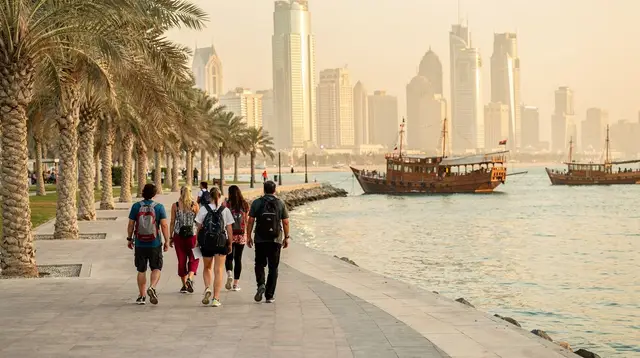
The Corniche is the 7km waterfront promenade curving around Doha Bay, where traditional wooden dhows moor and the West Bay skyline provides the classic photo. It’s free, walkable in sections, and a natural anchor for orientation. A short dhow cruise from here, usually an hour or so around the bay at sunset or in the evening, is one of the simplest ways to see the skyline from the water; you can read more in our dhow cruise guide, and if you’d rather combine the boat with a look at the city first, an organised city tour paired with a Corniche dhow cruise covers both in one booking.
Souq Waqif is a restored traditional market, rebuilt in the 2000s on the footprint of the old souq rather than an untouched ancient bazaar, and it comes alive in the late afternoon and evening; many stalls close in the early afternoon, so a midday visit undersells it. The Falcon Souq and a falcon hospital sit right beside it. Details on timing and shopping are in our Souq Waqif shopping guide.
The Museum of Islamic Art, designed by I. M. Pei and opened in 2008, sits on its own island just off the Corniche, with MIA Park around it. A short distance away, the National Museum of Qatar, designed by Jean Nouvel and opened in 2019, is built around the old palace of Sheikh Abdullah bin Jassim and shaped like a desert rose.
Both are run by Qatar Museums, both are ticketed, and both close one day a week, so check current hours before you go; our guides to the Museum of Islamic Art and the National Museum of Qatar cover what each one holds. If you want to see both without worrying about logistics, a full-day guided museum tour pairs them with a knowledgeable guide.
Beyond those four, first-timers usually add Katara Cultural Village and its beach, the artificial island of The Pearl-Qatar for its marina and restaurants, and the rebuilt heritage quarter of Msheireb Downtown with its four Msheireb Museums. Newer Doha is worth a look too: Lusail, north of the centre, holds Lusail Stadium, the venue of the 2022 World Cup final, alongside the Marina and Place Vendôme, while Al Rayyan to the west is home to Education City, the Aspire Zone and the 3-2-1 Qatar Olympic and Sports Museum.
A well-run half or full-day city tour is a practical way to string several of these together on your first day, and evenings are their own experience: our Doha night tour covers the illuminated skyline and Corniche after dark, which an evening Doha by Night tour is built specifically around.
For a broader menu of what’s on offer without an entry fee, see our free things to do in Doha, and for a general first-day city tour breakdown, half-day Doha city tour.
Mistakes first-time visitors make
Sightseeing outdoors in the middle of the day, especially in summer. Doha has a genuine hot desert climate, and from roughly May to September temperatures routinely pass 40°C with high humidity; walking the Corniche or the souq at noon in July is a real health risk, not just an inconvenience. The best season to visit is roughly November to March, warm by day and pleasant in the evening. If you’re travelling outside that window, our guide to Doha in summer: indoor activities has workable alternatives, and best time to visit Doha lays out the seasonal picture month by month.
Dressing as if for a beach resort. Modest dress is expected in public places: shoulders and knees covered in malls, museums, souqs and government buildings, with swimwear reserved for beaches, pools and hotel grounds. Mosques require covered arms and legs, and a headscarf for women. It’s a low-effort adjustment, but one visitors forget to plan for; see what to wear in Doha for specifics.
Confusing Qatar with the UAE. It comes up constantly and it matters practically: rules on alcohol, entry requirements and local etiquette are set by Qatar’s own government, not by Dubai’s or Abu Dhabi’s. Our Doha vs Dubai comparison is written for exactly this mix-up.
Assuming alcohol is easy to find, or bringing your own. Alcohol isn’t sold in supermarkets or souqs; it’s served to adults in licensed hotel bars and restaurants, and public drunkenness is an offence. Bringing alcohol into the country, including from duty-free, isn’t allowed. See alcohol rules in Qatar if you want the full picture.
Not checking entry requirements for your own nationality. Rules on visas and waivers depend on nationality and change over time, so this page won’t state a rule for you: check the official Qatari portals or your own government’s travel advisory before booking. Our Qatar visa and entry requirements page points you to the right sources.
Forgetting Friday is the main day of prayer. The weekend in Qatar is Friday and Saturday, and many shops and souq stalls open later on Friday, after midday prayers. If you land on a Friday morning expecting a full souq, adjust your plan; see Fridays in Doha: opening hours for the detail.
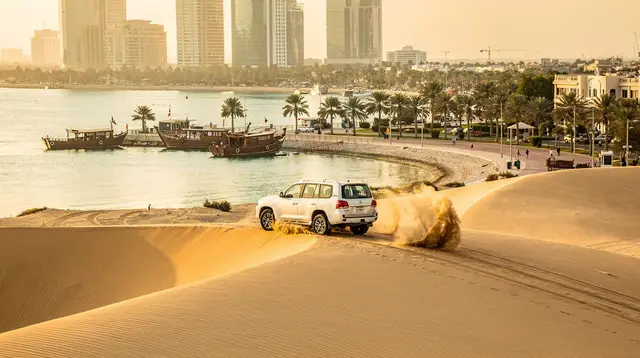
Trying to reach the desert or the Inland Sea in an ordinary rental car. Khor Al Adaid, the Inland Sea, is reachable only by 4x4 across the sand, and dune bashing should be done with an experienced driver, never a rental saloon. That side of Qatar deserves its own planning; our day trips from Doha guide and Doha desert safari guide explain how those excursions are actually organised.
A note on what this page won’t do
This page is an orientation, not a schedule: it tells you what Doha is, how it’s laid out, how to move around it and what trips people regret. It deliberately doesn’t lay out a day-by-day plan, because how you sequence Doha depends on how many days you have, whether you’re on a stopover, and whether the desert or the north coast fits your trip. For that, go to our itinerary pages: one day in Doha, two days in Doha for first-timers, or three days covering the essentials if you have more time to work with.
Doha for first-timers: frequently asked questions
Is Doha part of Dubai or the United Arab Emirates?
No. Doha is the capital of Qatar, a separate, independent country and absolute monarchy that shares its only land border with Saudi Arabia. Qatar is not part of the UAE, and Doha is not an emirate of Dubai or Abu Dhabi.
How many days do first-time visitors need in Doha?
Most first-timers find two to three days enough to cover the city’s landmarks at a comfortable pace, with an extra day if a desert safari or a trip north or west is added. This page covers what to see and how the city works, not a day-by-day plan.
Do I need a car in Doha?
Not for the city itself. Doha’s core sights sit along or near the Corniche and the Doha Metro’s Red, Green and Gold lines, and taxis and ride-hailing apps cover the rest cheaply. A vehicle only becomes useful for the desert, the north and the west, which the metro does not reach.
What is the biggest mistake first-time visitors make in Doha?
Underestimating the heat and overestimating what a midday walk can cover, especially from May to September. Other common mistakes are dressing for a beach resort in malls and museums, and assuming Doha and Dubai are the same city.
Is Doha safe for tourists?
Yes, Qatar has very low crime and Doha is considered one of the safer capitals to visit. The real hazards for visitors are heat, dehydration and off-road driving in the desert, not personal safety.
Can alcohol be found in Doha?
Alcohol is not sold in supermarkets or souqs, but it is served to adults in licensed hotel bars and restaurants. Bringing alcohol into the country, including from duty-free, is not permitted.
What should I pack for a first trip to Doha?
Light, breathable clothing that still covers shoulders and knees for malls, museums and souqs, a scarf for mosque visits, comfortable walking shoes, sun protection, and a jacket for strongly air-conditioned interiors.
Trip Planning
Verified deep-linked GetYourGuide tours. Book through these links and we earn a small commission at no cost to you.
GetYourGuide does not provide a product photo for this activity — the image shows the meeting point, photographed by us.