Doha vs Dubai: Which One Fits Your Trip
Is Doha or Dubai better to visit?
Neither is simply better; they are different countries with different strengths. Doha is Qatar's capital, a compact, calmer city built around museums, a restored souq and a short desert loop. Dubai is one of the seven emirates of the United Arab Emirates, larger, faster-paced, and built around nightlife, shopping and record-breaking towers. The right choice depends on pace, budget for alcohol, and how long the stopover is.
Two Gulf capitals, two different countries
Doha and Dubai get lumped together often enough that it is worth saying plainly: Qatar is an independent state, and Doha is not part of the United Arab Emirates. Qatar is its own country, ruled by its own Emir, with its own currency, its own laws and its own peninsula jutting into the Persian Gulf. Dubai is one of seven emirates that together make up the UAE, a separate federation with its own head of state. They sit in the same region, speak the same official language, and share plenty of cultural ground, but comparing them is a comparison between two countries, not two cities in the same one.
That distinction matters for planning. A visa or transit rule that applies in Dubai does not automatically apply in Doha, and vice versa; entry requirements for each depend on nationality and change over time, so check the current rules for the country you are actually flying into rather than assuming they line up. What follows is not a ranking. Both places do some things well and some things differently, and which one suits a given trip depends on pace, interests and how the alcohol and dress questions weigh in.
Size and pace
Dubai is the larger and busier of the two by most measures that matter to a visitor: more districts, more malls, a longer built-up coastline, and a skyline that keeps adding record-breaking towers. Getting from one end of Dubai to the other can mean a real trip across the city.
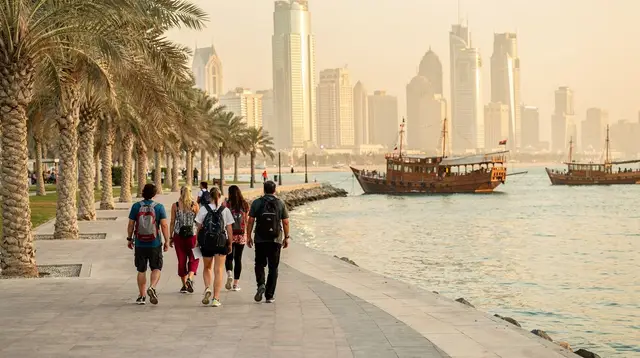
Doha is more compact. Its landmark sights cluster within a fairly short drive of each other: West Bay, the Corniche, Souq Waqif and Msheireb are all within about fifteen to twenty minutes of one another by car or metro. Newer districts like Lusail sit a bit further north, and The Pearl and Katara are a short hop from West Bay.
For a visitor with two or three days, that density means less time spent commuting between sights and more time actually seeing them. A half-day Doha city tour can realistically cover several of the city’s headline sights without feeling rushed, something that is harder to pull off across Dubai’s wider footprint.
Neither city is walkable in the way a European capital might be; both rely on cars, taxis, metro or organised tours to move between districts, especially given the heat for much of the year.
Museums and culture
This is where Doha tends to surprise first-time visitors. The city has built two internationally significant museums in the space of about a decade: the Museum of Islamic Art, designed by I. M. Pei and set on its own island off the Corniche, and the National Museum of Qatar, designed by Jean Nouvel around the old palace of Sheikh Abdullah bin Jassim and shaped like a desert rose.
Both are run by Qatar Museums, both are ticketed, and both close one day a week, so it is worth checking current hours before planning around them. A dedicated Museum of Islamic Art visit guide and a National Museum of Qatar guide cover what each actually involves, and a comparison of the two helps if time only allows one.
Beyond the two flagship museums, Doha’s Msheireb Downtown rebuild includes four Msheireb Museums housed in restored historic buildings, and 3-2-1 Qatar Olympic and Sports Museum in Al Rayyan adds a third major institution focused on sport. Dubai has its own museum scene and is expanding it, but its cultural identity has historically leaned more on architecture, shopping and entertainment than on a concentrated museum district. Travellers who prioritise museums on a trip may find Doha’s offering more focused relative to the size of the city.
Souq Waqif is Doha’s other cultural anchor: a restored traditional market rebuilt in the 2000s on the footprint of the old souq, not an ancient bazaar preserved unchanged. It comes alive in the late afternoon and evening, with many stalls closing in the early afternoon, and the Falcon Souq and a falcon hospital sit right next to it. A Souq Waqif shopping guide and a food and karak walk through it both work well as an evening activity.
Desert and outdoor experiences
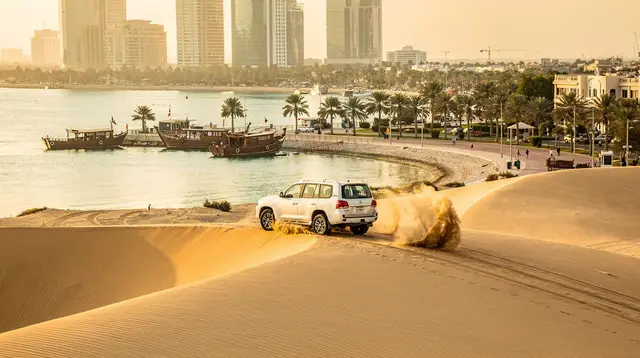
Both countries share the same desert geography, and both build a significant part of their tourism around it, but the experiences differ in scale and setup. In Qatar, almost all desert excursions are based around Sealine, south of the industrial port of Mesaieed and roughly an hour’s drive from Doha.
From there, operators run dune bashing, sandboarding, quad biking and camel rides, often continuing to Khor Al Adaid, the Inland Sea, a tidal inlet among high dunes on the border with Saudi Arabia that can only be reached by 4x4 across the sand. A full guide to the desert safari and a dedicated Inland Sea tour guide lay out what to expect; an overnight desert camp is also an option for travellers with more than a day to spare.
Dubai’s desert experiences run on a broadly similar format, based out of areas like the Dubai Desert Conservation Reserve, and are, if anything, more heavily commercialised given the emirate’s larger tourism volume. Neither destination’s desert programme should be attempted in a rental saloon car; dune bashing and routes like the Inland Sea call for an experienced driver in a proper 4x4. For visitors weighing the two, the practical difference is mostly logistical: Doha’s desert sits closer to the city centre than some of Dubai’s more remote desert circuits, which can matter on a tight stopover.
Alcohol rules
This is one of the more concrete differences between the two, and one worth understanding before booking rather than after arriving. In Qatar, alcohol is not sold in supermarkets or souqs; it is served only in licensed hotel bars and restaurants, to adults, and public drunkenness is an offence. Bringing alcohol into the country, including from duty-free, is not permitted. A dedicated guide to alcohol rules in Qatar covers the details.
Dubai follows a broadly similar licensing principle — alcohol is confined to licensed venues rather than general retail — but in practice the emirate has built out a much larger number of licensed bars, clubs, beach clubs and lounges across more of the city, and nightlife is a bigger part of its tourism identity. Travellers for whom evening drinks or nightlife are a priority will generally find Dubai easier going; travellers happy to keep drinking to hotel restaurants and bars, or to skip it, will find Doha no harder to navigate on this front, just quieter in the evenings outside those venues.
Dress expectations
Both places expect modest dress in public settings: shoulders and knees covered in malls, museums, souqs and government buildings, with swimwear reserved for beaches, pools and hotel grounds. Mosques in both countries require covered arms and legs, and a headscarf for women visiting them.
In everyday practice, Doha’s expectations feel a touch more conservative outside tourist-heavy zones — it is a smaller, less internationally saturated city than Dubai, and locals notice more. Dubai’s beach and hotel districts are more accustomed to visitors moving between pool and street in beachwear, though the same underlying etiquette (cover up away from beaches and pools) applies in both. Neither city requires a headscarf for women outside religious sites, and Qatar’s official guidance is the one to check for anything specific: an overview of what to wear in Doha covers the practical version.
Currency, language and getting around
Qatar uses the Qatari riyal (QAR), pegged to the US dollar at roughly 3.64 to 1; the UAE uses the dirham, also pegged to the dollar, at a different fixed rate. Cards are widely accepted in both. Arabic is the official language of both countries, and English is used throughout signage, shops and transport in each; the large majority of residents in both are expatriates, which shows in how international both cities feel day to day.
Doha’s public transport centres on the Doha Metro, a clean, air-conditioned three-line network (Red, Green and Gold) opened in 2019, supplemented by the Lusail Tram, a free Msheireb tram loop, and the Education City tram; buses run under the Karwa brand, and taxis and ride-hailing apps cover routes the metro does not, including the desert, the north and the west of the country. A Doha Metro and tram guide and a taxis and ride-hailing overview cover the practicalities. Dubai runs its own metro network, generally covering a wider area given the emirate’s larger footprint, alongside its own taxi and ride-hailing systems.
Weather and best time to visit
Both countries share the same hot desert climate, and the same seasonal advice applies to each: summer, roughly May to September, is extremely hot and humid, routinely above 40°C, and outdoor sightseeing at midday during those months carries genuine health risk in both places. The more comfortable window for either destination runs roughly November to March, warm by day and pleasant in the evenings, with rain rare in both and falling mainly in winter. A guide to the cooler Qatar season and a summer survival guide apply the same logic Dubai visitors will recognise from their own city’s climate advice.
Both observe Ramadan according to the Islamic lunar calendar, which shifts roughly eleven days earlier each year; during it, eating, drinking and smoking in public during daylight hours are not permitted in either country, and opening hours shift toward the evening in both. Neither guide should attach Ramadan to a fixed month, since it moves annually.
Which one for a stopover
Both Doha’s Hamad International Airport and Dubai’s main hub are major long-haul connection points with well-developed stopover programmes, and airlines in both cities actively market extended layovers as mini-trips. Hamad International sits roughly fifteen to twenty-five minutes by road from West Bay or Souq Waqif, with the Red Line of the Doha Metro serving the airport directly, which makes a same-day dash into central Doha realistic on a layover of several hours.
Whether a given traveller can leave either airport at all depends on nationality and the entry rules in force at the time of travel, so that is worth confirming before counting on a stopover city tour. A Doha stopover guide and a note on what a short layover actually allows cover the Doha side of that question, and an airport transfer guide covers the practical first step.
For travellers connecting through the Gulf on a long-haul routing, the choice of stopover city usually comes down to which airline and route the itinerary is already built on, rather than one city objectively outclassing the other for a short visit.
A side-by-side summary
| Doha | Dubai | |
|---|---|---|
| Country | Qatar (independent state) | United Arab Emirates (one of seven emirates) |
| City size and pace | Compact, sights close together | Larger, more spread out |
| Signature museums | Museum of Islamic Art, National Museum of Qatar | Growing museum scene, less concentrated |
| Historic market | Souq Waqif (restored, evening-focused) | Traditional souqs in Deira/Bur Dubai |
| Desert base | Sealine, roughly an hour from the city | Dubai Desert Conservation Reserve area |
| Alcohol | Licensed hotel bars and restaurants only | Licensed venues, wider nightlife scene |
| Dress norms | Modest in public, conservative day to day | Modest in public, more relaxed near beaches |
| Climate | Same hot desert climate, best Nov–Mar | Same hot desert climate, best Nov–Mar |
| Currency | Qatari riyal (QAR) | UAE dirham (AED) |
Making the most of either visit
Whichever city ends up on the itinerary, a short, well-organised introduction tends to work better than trying to see everything. In Doha, a broad orientation tour like a full sightseeing tour covering the city’s main landmarks or a more focused half-day city tour of West Bay, the Corniche and Souq Waqif covers the essentials without overloading a short stay.
For evenings, an evening tour that takes in the illuminated skyline and waterfront shows the city at its most photogenic. And for travellers who want the desert side of the comparison firsthand, an overnight desert safari with dune bashing and a night under the stars gives a fuller picture than a rushed afternoon excursion would.
For a deeper look at either half of this comparison on its own terms, a first-timer’s guide to Doha and a guide to choosing a base between West Bay, Souq Waqif and The Pearl both help translate this comparison into an actual itinerary, and a guide for travellers with limited time sets priorities when a stopover or short trip does not allow for everything above.
Doha vs Dubai: common questions
Is Doha part of Dubai or the UAE?
No. Doha is the capital of Qatar, an independent state on its own peninsula with its own Emir. Dubai is one of seven emirates that make up the United Arab Emirates, a separate country. The two share a region and a language but not a government, a currency or a border with each other directly.
Which city is bigger, Doha or Dubai?
Dubai’s metropolitan area and skyline are larger and denser than Doha’s, with more neighbourhoods, more malls and a longer coastline built up for tourism. Doha is more compact: most of its landmark sights sit within a short drive of the Corniche, which makes it easier to cover on a short visit.
Is alcohol easier to find in Dubai or Doha?
Both restrict alcohol to licensed venues rather than supermarkets, but Dubai has a larger number of licensed bars, clubs and beach venues spread across more districts. In Doha, alcohol is served in licensed hotel bars and restaurants only, and public drunkenness is an offence in both places.
Which is better for a stopover, Doha or Dubai?
Both airports are major long-haul hubs with strong stopover programmes. A short layover favours whichever airline routes you through it; Hamad International Airport sits close to central Doha, and travellers can often reach the Corniche or Museum of Islamic Art within the same window Dubai travellers would spend reaching Downtown Dubai.
Does Doha or Dubai have better museums?
Doha has invested heavily in museums relative to its size, with the Museum of Islamic Art and the National Museum of Qatar both purpose-built by internationally known architects. Dubai has a growing museum scene too, but its identity leans more on architecture, shopping and entertainment than on a concentrated museum district.
Can I combine Doha and Dubai in one trip?
Yes. Many travellers pair the two on a single itinerary, since both are served by major airlines with frequent short flights between them, roughly an hour in the air. A few days in each gives a useful contrast without either city feeling rushed.
Which has stricter dress rules, Doha or Dubai?
Both expect modest dress in public places such as malls, museums and government buildings, with swimwear reserved for beaches and pools. Doha’s expectations feel slightly more conservative in everyday settings, while Dubai’s tourist zones are somewhat more used to beachwear spilling into nearby streets.
Tour Comparisons
Verified deep-linked GetYourGuide tours. Book through these links and we earn a small commission at no cost to you.
GetYourGuide does not provide a product photo for this activity — the image shows the meeting point, photographed by us.