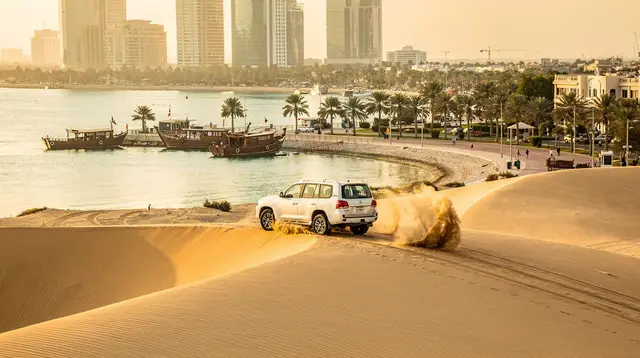
Khor Al Adaid Inland Sea Tour: What the Crossing Actually Looks Like
Can you drive to Khor Al Adaid yourself?
No. Khor Al Adaid, the Inland Sea, sits among high dunes on the Saudi border and is reached only by 4x4 across open sand, with an experienced driver. There is no metro, bus or paved road for the final stretch, and a rental saloon car cannot make the crossing.
Why the Inland Sea is a different trip from a regular desert safari
Khor Al Adaid, usually translated as the Inland Sea, is a tidal inlet where the waters of the Persian Gulf push in among a wall of high dunes right on the border with Saudi Arabia. It is one of the few places in the world where a sea reaches this deep into a sand desert, and it is the single farthest point most visitors to Qatar will travel south of Doha. Many tour listings group it under Doha’s wider desert safari options, and it is worth being clear from the start about what makes this specific excursion different from a standard afternoon of dune bashing at Sealine.
A typical Sealine safari loops through the dune field near Mesaieed and comes back within a couple of hours. A Khor Al Adaid run goes further, deeper into the sand, and ends at open water instead of turning back at the first ridge line. The dunes get taller, the tracks get softer, and the margin for driver error gets smaller. This is the reason every operator running this route uses an experienced 4x4 driver and a vehicle actually built for soft sand, never a standard rental saloon, and never a self-drive attempt.
If you are choosing between the two experiences, our Sealine versus Inland Sea comparison lays out the practical differences in more detail. This page focuses on Khor Al Adaid itself: what the crossing looks like, what you actually see once you arrive, and how to prepare.
Why you cannot drive there yourself
This point is worth repeating because it catches out visitors who are used to renting a car and finding their own way around a destination. The road south from Doha towards Al Wakrah and Mesaieed is a normal paved highway, and a rental car handles it without issue. Past a certain point, though, the route to Khor Al Adaid leaves the tarmac entirely and continues across open desert, over dune faces that shift with wind and heat, with no marked track and no signage.
A two-wheel-drive car will bury itself in soft sand within the first few hundred metres of open desert. Even a four-wheel-drive rental, driven without experience, without the tyres deflated to the right pressure, and without knowledge of how to read a dune face before committing to climb or descend it, is a genuine hazard: vehicles roll on badly judged dunes, and recovery in a remote stretch of desert near a border is not a quick fix. There is no metro line, no Karwa bus route and no scheduled shuttle anywhere near the final stretch, unlike central Doha, where the Doha Metro and tram network covers most everyday journeys.
In practice this means the only sensible way to see Khor Al Adaid is a booked 4x4 tour with a driver who does this crossing regularly, or a private arrangement with an equally experienced desert driver. General guidance on preparing for this kind of trip is in our desert safari safety tips and what to wear and bring guides.
How the day usually runs
Details vary by operator, but the shape of the trip is consistent enough to describe.
Pickup and drive south. Most tours collect guests from hotels in central Doha, West Bay or The Pearl in the morning or early afternoon. The drive south passes Al Wakrah and the industrial area around Mesaieed before turning off the highway into the dune field near Sealine.
The dune-bashing stretch. Before, or sometimes after, the run to Khor Al Adaid, drivers deflate their tyres and take groups through a stretch of dune bashing: sharp climbs, drops and side-slopes taken at a controlled speed, with the vehicle’s weight and momentum doing the work rather than raw speed. This is the part of the day that feels most like a ride, and it is genuinely part of the driving skill the crossing depends on, not just entertainment tacked onto transport.
The approach to the Inland Sea. From the Sealine dune field, convoys head further south and east towards the border, climbing increasingly tall dune ridges. Vehicles typically travel in small convoys rather than alone, partly for safety and partly because a stuck vehicle is far easier to recover with a second one nearby. This stretch is longer and slower than the distance on a map suggests, since a sand crossing is measured in driving time over dunes, not straight-line kilometres.
Arrival at the water. The convoy comes over a final ridge to the inlet itself: a flat sheet of shallow, often turquoise water sitting directly against a wall of tall dunes, with the far shore, and the Saudi border, visible across the water depending on the day’s haze and light. Groups usually stop here for a while, sometimes with refreshments laid out, sometimes with the option to walk down to the shoreline or wade in if a guide judges conditions suitable that day. Some operators build in a stop for photographs on the dune crest itself, since the view back over the water and the sand is the visual highlight most people remember.
The return. The convoy retraces the dune crossing back to the highway, tyres are re-inflated, and the drive back to Doha follows the same road north. Full-day tours often finish with drop-off back at your hotel in the late afternoon or early evening; sunset departures time the water stop to coincide with the light dropping over the dunes.
What to actually expect versus what not to expect
Some tour marketing leans hard on two promises worth treating with caution.
A view across into Saudi Arabia. Khor Al Adaid does sit on the border, and the far shore is close. Whether it reads as a clear, photogenic view of “Saudi Arabia” on a given day depends on haze, sun angle and exactly where the group stops — it is a real geographic fact about the location, not a staged attraction, and no operator can promise a specific vista on demand.
A swim in the Inland Sea. Some visits include time at the water’s edge and an option to go in, but tidal conditions vary through the day and through the seasons, and it is the guide’s call on site whether wading or swimming makes sense that day. Pack a swimsuit as something you might use, not as a guaranteed part of the itinerary, and do not build a plan around it.
Beyond those two points, the trip delivers what it actually is: one of the more dramatic landscapes in the country, reached by a genuinely skilled piece of driving, in a part of Qatar most visitors never otherwise see.
Comparing the main ways to book this trip
| Tour style | What it adds to the basic crossing | Typical length |
|---|---|---|
| Inland Sea 4WD desert excursion | Dune bashing plus the Khor Al Adaid crossing, no extra activities | Half day to full day |
| Inland Sea safari with camel ride and sandboarding | Adds camel riding and sandboarding stops at the dune field | Half day to full day |
| Overnight desert safari | Combines the crossing with a night in a desert camp under the stars | Overnight |
| Inland Sea tour with multiple activities | Bundles quad biking or additional stops with the water excursion | Full day |
For the driving and dune-bashing itself, this Inland Sea 4WD excursion is built specifically around the crossing rather than treating it as an add-on. If you would rather combine the trip with sandboarding and a camel ride at the dune field, this combined desert safari and camel ride option covers both in one outing.
Travellers who want to extend the desert stay into the evening and sleep out under open sky can look at the overnight desert safari with a night in a desert camp, which typically routes through the same dune country. For a day that stacks in extra activities around the same drive, this multi-activity Inland Sea 4x4 tour is worth comparing against the simpler options above.
Planning notes
Khor Al Adaid sits at the far southern edge of the country, well beyond the reach of the metro or city buses, so this is not a trip to improvise on the day. Book ahead, confirm pickup times and location with the operator, and check current advice on conditions before travelling, since dune routes and water levels shift with weather and season. Our desert safari guide is the right starting point if you are still deciding between Sealine-only trips and a full run to the Inland Sea, and the what to wear and bring and safety tips pages cover the practical preparation in more depth than fits here.
Bring far more water than feels necessary, dress for full sun exposure during the day and cooler air once the sun drops, and wear closed shoes rather than sandals for getting in and out of the vehicle on soft sand. If you are combining this with other southern stops, Al Wakrah’s restored souq sits on the same route south and makes a reasonable stop on the way down or back.
Khor Al Adaid Inland Sea: common questions
Can you drive to Khor Al Adaid in a normal car?
No. The last stretch to Khor Al Adaid is open sand with no paved road, and a two-wheel-drive rental car will get stuck. The crossing is done in a 4x4 with an experienced driver who reads the dune faces.
Is the Inland Sea reachable by public transport?
No. The Doha Metro and Karwa buses do not run south of Mesaieed, and there is no scheduled bus service to the dunes. The only practical way in is a booked 4x4 tour or a private driver with proper desert vehicle experience.
How far is Khor Al Adaid from Doha?
It is roughly 60 to 80 kilometres south of central Doha depending on the route, but the time on tarmac is only part of the trip: the dune crossing itself, done at low speed over soft sand, takes considerably longer than the same distance on a road.
Can you see Saudi Arabia from Khor Al Adaid?
Khor Al Adaid sits on the Saudi border and the far shore of the inlet is close, but visibility depends on haze, light and exactly where the vehicles stop. It is not sold here as a sightseeing promise, and no tour can guarantee a clear cross-border view on a given day.
Can you swim at the Inland Sea?
Some visits include time at the water’s edge, but conditions change with the tide and the season, and a guide decides on the day whether it is sensible to go in. Treat any swim as a possibility, not a fixture of the itinerary, and bring a swimsuit only as a backup option.
Is dune bashing at Khor Al Adaid safe?
It is safe with an experienced, licensed driver in a properly prepared 4x4, which is what booked tours use. The real risks are heat, dehydration and inexperienced driving, so this is not a route to attempt in a self-driven rental, however capable the car looks on paper.
What should you bring on the Inland Sea crossing?
Bring more water than feels necessary, sunglasses, sun protection, closed shoes for getting in and out of the vehicle on sand, and a scarf or buff if you mind dust. A phone or camera is worth protecting from sand rather than leaving loose on a seat.
Is Khor Al Adaid combined with other stops?
Most operators combine it with the Sealine dune area, since both sit on the same southern route out of Doha. Dune bashing, sandboarding and sometimes camel rides happen at Sealine before or after the run out to the Inland Sea itself.
Desert Safari and Dune Bashing Excursions
Verified deep-linked GetYourGuide tours. Book through these links and we earn a small commission at no cost to you.
GetYourGuide does not provide a product photo for this activity — the image shows the meeting point, photographed by us.