Overnight Desert Camp in Qatar: What a Night in the Dunes Is Really Like
What actually happens on an overnight desert camp in Qatar?
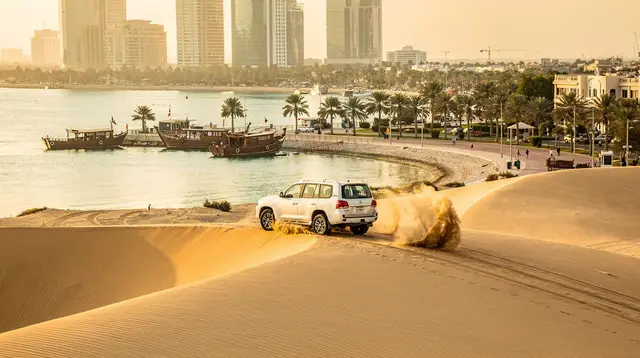
A 4x4 collects you in the afternoon, drives across the dunes toward the Khor Al Adaid area, and stops for dune bashing before reaching camp for dinner and a night under canvas. Guests wake before sunrise to watch the light hit the dunes, then return to Doha by mid-morning. Exact tents, meals and facilities vary by operator and are never guaranteed beyond what each listing states.
Why spend a night in the Qatari desert
Most visitors to Doha experience the desert as a half-day or sunset outing: an hour’s drive south, some dune bashing, a short stop, and a return to the city before dinner. An overnight camp is a different, slower version of the same landscape. Instead of turning back at dusk, you stay through the night near the dunes that ring Khor Al Adaid, the tidal inlet Qatar calls the Inland Sea, and you get the two hours that a day trip cannot offer: the desert after dark and the desert at first light.
The appeal is specific. During the day, the dunes near the Saudi border are a striking but fairly ordinary sight of sand meeting water. At night, away from Doha’s glow, the same dunes turn quiet and the stars become genuinely dense overhead. At dawn, low sunlight rakes across the ridgelines and throws long shadows that disappear again within an hour. Neither of those windows fits inside a half-day tour, which is the entire reason an overnight camp exists as a separate product rather than a longer version of a sunset desert safari.
This guide covers what actually happens on a typical overnight trip, what varies between a rustic camp and a comfort camp, what is realistic to expect in terms of facilities, and the practical points — access, weather, clothing, and Qatar’s rules on alcohol — that shape the experience.
How the day (and night) unfolds
Overnight camps generally follow the same rough shape, even though timings and inclusions differ by operator. A typical schedule looks like this.
| Time | What happens |
|---|---|
| Early to mid afternoon | Pickup from a Doha hotel or a central meeting point; drive south past Al Wakrah toward Mesaieed and Sealine |
| Late afternoon | 4x4 convoy leaves the paved road for the dunes; dune bashing for 30–60 minutes |
| Before sunset | Stop at or near camp, sometimes with a short excursion toward Khor Al Adaid itself |
| Evening | Dinner at camp, often with some form of entertainment, campfire or stargazing |
| Overnight | Sleep in a tent; temperatures drop noticeably compared with the daytime |
| Before or at sunrise | Wake for the sunrise over the dunes, sometimes with tea or coffee |
| Morning | Breakfast, pack-up, return drive to Doha, arriving mid-morning |
The one part of this sequence that never changes is the 4x4 transfer. There is no version of an overnight desert stay in this area that starts or ends with a normal car.
You cannot drive yourself in a normal car
This is worth stating plainly because it is one of the more common misunderstandings among first-time visitors: the tracks that lead from the paved road near Mesaieed into the dune belt, and onward toward the Inland Sea, are soft sand requiring a proper 4x4 and a driver who knows the terrain. A sedan, a city SUV without low-range gearing, or an unfamiliar driver attempting the same route risks getting stuck, sometimes a long way from help and cell coverage.
This is also why dune bashing and the run out to Khor Al Adaid are almost always sold as guided trips rather than self-drive itineraries — it is not a formality, it reflects the actual difficulty of the sand.
There is no free, unsupervised camping option in this landscape that substitutes for a proper operator. Anyone wanting to spend a night among these dunes needs either a booked overnight tour or their own convoy with a qualified 4x4 driver and full recovery equipment, which is not a realistic option for most travellers passing through on a Doha stopover or a short holiday.
a booked overnight stay with 4x4 transfer, dinner and a night under canvas is the practical way most visitors reach this part of the desert safely.
Rustic camp or comfort camp: what the difference actually is
Overnight camps in Qatar are not standardised, and operators use “rustic,” “traditional,” “deluxe” or “comfort” loosely. Rather than ranking one tier as better, it is more useful to understand what each generally implies — and to check the specific listing rather than assume.
Rustic or traditional camps tend to mean simple canvas tents, shared or basic sanitary facilities, no guaranteed power beyond limited lighting, and a closer, more exposed relationship with the desert itself. Meals are typically served communally, often with a barbecue element similar to what you would find on a desert safari with a barbecue dinner. Nights can feel genuinely quiet and dark, which is part of the appeal for people who want an unfiltered version of the experience.
Comfort or deluxe camps usually add some combination of: sturdier or more private tents, en-suite or semi-private washrooms, generator-run lighting or fans, and sometimes proper beds rather than mattresses on the ground. Some also add extras such as a stargazing session with a guide, a campfire with music, or a paired activity like a night safari with stargazing and a camel ride before or after the overnight stay.
Neither tier is objectively the right choice — it is a trade-off between cost, the kind of experience wanted, and tolerance for basic conditions. What matters more than the label is reading the specific tour’s inclusions before booking.
Do not assume air conditioning, private bathrooms or specific meals
Because “comfort” and “deluxe” are marketing terms rather than fixed standards, this guide will not claim that any particular amenity is guaranteed. Air conditioning, heating, en-suite bathrooms, hot showers, Wi-Fi and specific meal formats all vary between operators and even between seasons for the same operator (a generator-run air-conditioned tent in summer, for instance, may not be offered or needed in the cooler months). The only reliable way to know what a given night includes is to read that tour’s own description and, where relevant, its guest reviews, rather than to rely on general assumptions about what a “premium” desert camp should include.
Sunset, night activities and stargazing
The evening at camp is usually the most programmed part of the trip. Depending on the operator, it can include a barbecue or buffet dinner, live music or a dance performance, a campfire, and time set aside for stargazing once the camp’s own lights are dimmed. Because there is very little light pollution this far from Doha, even a short unaided look at the sky shows far more stars than anywhere in the city, and some operators build a dedicated stargazing segment into the evening, sometimes paired with a camel ride as part of a stargazing and camel ride add-on.
Travellers who want a broader wildlife or cultural element alongside the dunes sometimes combine their trip with a falconry stop, since falconry has deep roots in the region; a desert safari that pairs a camel ride with a falcon photo opportunity is one way to add that without a separate outing.
Sunrise over the dunes
The sunrise is, for many guests, the single reason to choose an overnight camp over a same-day trip. Camps typically wake guests 30–45 minutes before sunrise, sometimes with tea, coffee or a light snack, for a short walk or short drive to a nearby dune crest with an open view east. The light changes quickly — the flat, colourless pre-dawn desert turns gold and then white within about 20–30 minutes — and then the heat starts to build again, so this window does not last. Outside of it, the desert during the day, particularly from late morning onward in the warmer months, is not a comfortable place to linger, which is part of why the best season for outdoor activity in Qatar runs roughly from November to March.
Dune bashing, sandboarding and the transfer itself
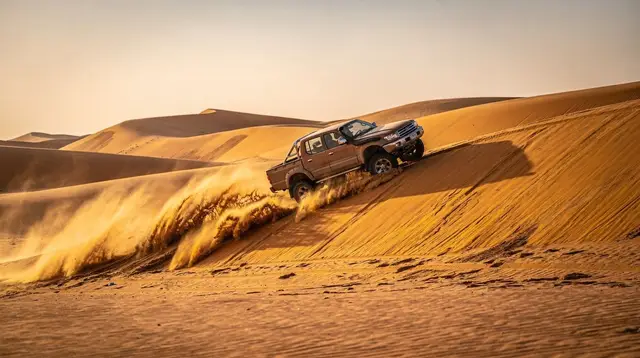
The 4x4 transfer to and from camp typically includes a stretch of dune bashing — a series of controlled climbs, drops and turns across soft dune faces, done by an experienced driver in a vehicle built for it. Some operators combine this more explicitly with sandboarding on a suitable slope near camp, similar to what is offered on a standalone desert safari built around dune bashing and sandboarding.
This segment is intense for some passengers; anyone prone to motion sickness should mention it to the driver, and children or older travellers with back or neck issues should check an operator’s guidance before booking, in line with general desert safari safety practices.
Alcohol, dress and desert etiquette
Qatar’s alcohol rules apply everywhere outside licensed hotel venues, and a desert camp is not a licensed premises, so no overnight desert experience in this country includes alcohol as part of the package, and none should be expected. This is consistent with the wider rules on alcohol in Qatar: it is available in hotel bars and restaurants, not in the open desert, at souqs, or at camps.
Dress for the evening and the following morning should be practical rather than formal: closed shoes or trainers rather than sandals for walking on sand and around a camp after dark, a light layer for the cooler evening and pre-dawn hours, and the same general modesty expected across Qatar’s public spaces, even at an outdoor camp. What to pack in more detail is covered in a dedicated guide on what to wear and bring on a desert safari.
Choosing between an overnight camp and a shorter safari
Not every visitor has the extra day an overnight stay requires, and it is worth being honest about the trade-off. A same-day sunset desert safari or sunrise desert safari delivers dune bashing and one dramatic light window without needing an extra night in the itinerary, which suits travellers with limited time, including those on a longer Doha stopover rather than a full holiday.
An overnight camp suits travellers who have a spare day, want both the evening and the sunrise rather than one or the other, and are comfortable with variable, sometimes basic, overnight facilities. Comparing the two directly is covered in a separate guide on Sealine versus Inland Sea safari options.
Those travelling as a family may also want to weigh a family-oriented desert safari against a full overnight stay, since the longer schedule and less predictable amenities of an overnight camp are more demanding for young children than a half-day outing.
Practical checklist before booking
- Confirm the exact pickup time and location; most overnight camps collect guests from central Doha hotels in the afternoon.
- Read the listing’s specific description of tents, bathrooms and any electricity or air conditioning rather than assuming a “deluxe” label guarantees a particular feature.
- Pack a light jacket or layer for the evening and pre-dawn hours, even in the warmer months, since desert nights cool down noticeably.
- Bring closed shoes, a headlamp or phone torch, and any personal medication; camps are remote and not close to a pharmacy.
- Expect no alcohol to be served or available at camp, in line with national rules.
- Book ahead, particularly from November to March when demand for overnight camps is highest and capacity is limited.
- If travelling with children, older relatives, or anyone with mobility or health concerns, check the operator’s own suitability notes before booking rather than assuming the trip is uniformly easy.
Overnight desert camp FAQ
Can I drive myself to a desert camp in a normal rental car?
No. The tracks leading into the dunes and toward Khor Al Adaid require a 4x4 with an experienced driver; an ordinary saloon car will get stuck, and self-guided overnight camping in the open desert is not how visitors legally or practically access this area.
Is air conditioning guaranteed in the tent?
Not as a rule. Some comfort-tier camps run generators and offer air-conditioned or fan-cooled tents, while rustic camps rely on the desert night cooling down naturally. Always check the specific tour’s description rather than assuming a feature is included.
Will there be a private bathroom?
It depends entirely on the camp tier booked. Rustic setups typically share basic facilities, while some comfort camps offer en-suite or semi-private options. This is one of the details that varies most between operators, so read the listing before booking.
Is alcohol served at the desert camp?
No. Alcohol in Qatar is restricted to licensed hotel bars and restaurants, and desert camps are not licensed premises, so no overnight desert experience includes alcohol.
How cold does it get at night in the desert?
Outside the hot summer months, desert nights cool down noticeably compared to daytime highs, and temperatures can feel cold after dark, especially in winter. Bringing a light jacket or layer for the evening and early morning is worth doing even though days are warm.
Is an overnight desert camp suitable for young children or older travellers?
It can be, but the dune-bashing transfer, uneven ground at camp, and lack of guaranteed amenities make it more demanding than a short city outing. Families and less mobile travellers should check an operator’s specific notes on suitability before booking.
How is this different from a sunset or half-day desert safari?
A half-day or sunset safari returns to Doha the same evening after dune bashing and a short stop; an overnight camp adds dinner, a night under canvas, and a sunrise before heading back, which is a longer and more involved experience.
Do I need to book in advance, and can plans change with weather?
Yes, overnight camps run on limited capacity and should be booked ahead, particularly in the cooler months when demand is highest. Extreme heat, wind or rare rain can also lead an operator to adjust or reschedule departures.
Desert Safari and Dune Bashing Excursions
Verified deep-linked GetYourGuide tours. Book through these links and we earn a small commission at no cost to you.
GetYourGuide does not provide a product photo for this activity — the image shows the meeting point, photographed by us.