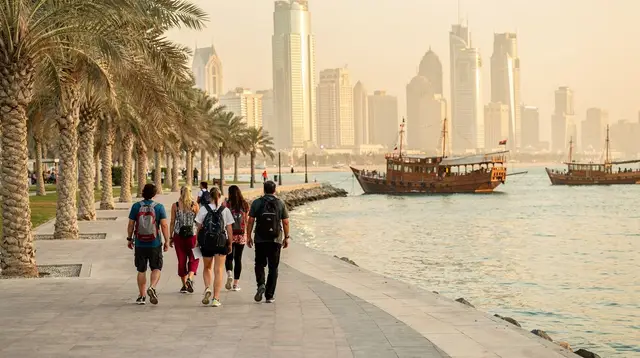
Souq Waqif Food and Karak Walk: An Evening Guide
What is the Souq Waqif food and karak walk?
It is a short, self-guided (or guided) evening walk inside Souq Waqif focused on karak tea, grilled meat and Gulf sweets. It works best from late afternoon into the evening, when the souq's food stalls and shisha cafes actually open, not at midday.
Why an evening food walk, not a daytime one
Souq Waqif looks, in daylight photographs, like a market that never stops. It does stop, or at least it dozes: a good number of the food stalls, tea houses and shisha cafes that make the place worth visiting for eating are closed or half-shuttered through the middle of the day, and many reopen properly only from the late afternoon onward. If a first-timer arrives at noon expecting sizzling grills and a crowded karak stand, they will mostly find shut doors and a handful of shops catering to daytime shoppers. The souq’s real character as a food destination shows up once the heat breaks and the evening lights come on, which in practice means planning this walk for late afternoon into the evening rather than treating it as a lunchtime stop.
This is deliberately a narrow, short-format guide: one evening, one market, three things to focus on — karak, grilled food, and sweets — walked on foot. For a broader tour that also covers other Doha neighbourhoods and full meals across the city, see the separate Doha food tour guide. This page stays inside Souq Waqif.
Getting there and getting oriented
Souq Waqif sits close to the Corniche, a short walk or a quick taxi ride from most central Doha hotels. It is one of the easier Doha destinations to reach without a car: metro, taxi and ride-hailing apps all work, and once you arrive the whole point is to be on foot. The souq is a dense grid of covered and open-air lanes, wooden beams and low buildings restored in the 2000s on the footprint of the historic market — worth knowing, because it is not an untouched ancient bazaar, but a deliberately rebuilt one that still functions as a working market for Qataris and residents, not only visitors.
Give yourself at least ninety minutes to two hours for the food side of a visit, more if you want to add shopping. If you are combining this with the Corniche or a dhow cruise, that pairing works well: see the dhow cruise practical tips for the Corniche or the broader Doha dhow cruise guide for timing an evening that includes both.
Karak: where and how to drink it
Karak is the drink to build the walk around. It is strong black tea boiled with milk and spices — cardamom is the constant, with variations adding saffron, ginger or extra sugar — served hot in small glasses, usually for a modest price. It is not a souq souvenir item sold at one fixed stand; small tea stalls and karak cafes are scattered through several of the alleys and near the main squares, often no more than a hole-in-the-wall counter with a few outdoor seats or a bench along the lane.
The practical approach is to walk rather than search for one specific address: follow the smell of boiling tea and the small clusters of people standing or sitting with a glass in hand, especially in the evening when these stands are busiest. Karak is inexpensive and meant to be drunk quickly and often, so it works well as a punctuation mark between other stops on the walk rather than a single destination in itself.
Grilled meat and mains along the lanes
Once karak has set the pace, the souq’s restaurants and grill stalls are the next stop. Souq Waqif has a wide spread of Qatari, wider Gulf and broader Middle Eastern restaurants, many with grills visible from the lane and outdoor seating that fills up as the evening goes on. Skewered meats, grilled chicken and lamb dishes are common, alongside rice-based mains. For a sense of the wider Qatari dishes worth looking for beyond the grill stalls specifically, the guide to what to eat in Qatar covers dishes like machboos alongside karak itself.
Because menus, prices and which restaurants are open change over time and by season, this guide will not invent specific prices or name a single “best” restaurant — that is the kind of detail that goes stale fast and is better checked on the spot or through current listings. What is reliable is the pattern: arrive hungry in the early evening, expect outdoor seating to be the main draw, and expect the liveliest stretches of restaurants to be full by mid-evening, particularly on weekend evenings.
Sweets and the closing stretch of the walk
After the grills, a sweets stop is the natural way to close out a food walk through the souq. Gulf and wider Middle Eastern sweets — often nut-based or syrup-soaked — are sold from a number of small shops through the lanes, alongside dates, which are a staple gift item as much as a snack. This is also a good point to slow down: the souq’s architecture, with its wooden beams, archways and low buildings, is easiest to appreciate once you are not rushing between food stops, and the evening lighting through the lanes is part of the reason this walk works better after dark than in daylight.
If falconry interests you, the Falcon Souq sits right alongside the main market and is worth a short detour on the same evening; see the dedicated Falcon Souq guide for what to expect there, including the falcon hospital.
A simple walking order
There is no single correct route through Souq Waqif, but a workable structure for a first visit looks like this:
| Stage | What to do | Rough share of time |
|---|---|---|
| Arrival, late afternoon to early evening | Orient yourself in the main lanes, first karak stop | 15–20 minutes |
| Wander and browse | Shops, spice stalls, Falcon Souq detour if wanted | 30–40 minutes |
| Dinner stop | Grilled mains at a restaurant with outdoor seating | 45–60 minutes |
| Sweets and second karak | Dessert shop, dates, one more tea | 15–20 minutes |
| Closing walk | Slow loop back through the lit lanes | 15–20 minutes |
This is a guideline, not a schedule to force. The souq rewards wandering more than it rewards a checklist, and the busiest, most atmospheric stretches are usually the ones you find by following the crowd rather than a map.
Timing it around the week and the calendar
Fridays run differently in Doha: it is the main day of prayer, and a number of souq stalls open later in the day, picking up only after midday prayers finish. If your visit falls on a Friday, plan the food walk for the evening rather than the afternoon — see the guide to Fridays in Doha and opening hours for more on how the week’s rhythm shifts.
Ramadan changes things further. Dates and opening patterns shift because Ramadan follows the Islamic lunar calendar and moves roughly eleven days earlier each year, so it falls in a different Gregorian month annually — this guide will not attach it to a fixed month. During Ramadan, eating and drinking in public during daylight hours is not permitted, many places close through the day, and Souq Waqif in particular becomes busy and lively late into the night once the fast breaks, which actually makes it one of the better times to do a food walk here, just shifted later.
Dress, alcohol and other practical notes
Souq Waqif is a public market in a conservative country, and modest dress is expected: shoulders and knees covered is the safe standard for both men and women, the same as in malls and museums elsewhere in Doha. Alcohol is not part of this walk at all — it is not sold in the souq, and is restricted to licensed hotel bars and restaurants elsewhere in the city, so plan this evening as a tea-and-food outing rather than one that includes drinks.
Card payments are accepted at many restaurants and larger shops, though smaller stalls, including some karak stands, may be cash-only or prefer cash for small amounts — carrying some Qatari riyal in small notes makes the walk smoother.
Doing it guided versus doing it yourself
Wandering Souq Waqif on your own for karak and grills needs no booking and no fixed plan — that is arguably the point of this kind of walk. A guided option is worth it mainly if you want the historical and cultural context of the market explained as you go, or if you would rather not spend part of a short evening figuring out which lanes have the busiest food stalls.
an evening walking tour that combines Souq Waqif’s food stalls with the market’s heritage and history is built for exactly this pairing of eating and context. For a shorter, more general introduction to the souq’s layout without a specific food focus, a straightforward walk-and-visit tour of Souq Waqif covers the basics. If you would rather have a local guide point out specific stalls and shortcuts through the lanes, a guided walking tour of the souq is the more hands-on option.
None of these bookings are necessary to enjoy karak and grilled food here — plenty of visitors simply walk in around sunset and follow their nose. They are worth considering mainly for context, for a first-time visitor short on time, or for anyone who prefers not to plan the route themselves.
Pairing this walk with the rest of an evening
Souq Waqif sits close enough to the Corniche and West Bay that this food walk fits naturally into a longer evening rather than standing alone. A short walk from the Corniche, a dhow cruise around sunset, or a broader loop through Doha’s night-time sights all combine well with an evening that starts or ends here. If you are also weighing where to base yourself for a Doha trip, the comparison of West Bay versus Souq Waqif versus The Pearl covers how staying near the souq changes the shape of an evening like this one.
For visitors building a single busy day around Doha’s highlights, the one-day Doha highlights itinerary already slots an evening at the souq into a full day, and the wider Doha city tour guide and Doha walking tours guide both cover how the souq fits into a longer city visit.
If dinner elsewhere in the city interests you as well, the Doha dinner experiences guide rounds out options beyond the souq itself, and the wider souqs of Doha beyond Souq Waqif guide is useful if this evening leaves you wanting to see more of the city’s other markets. For shopping rather than eating at Souq Waqif specifically, see the separate Souq Waqif shopping guide, and for a look at Doha’s neighbourhoods more broadly, the Doha neighbourhoods guide places the souq in context against Katara, the Corniche and West Bay.
The honest summary
This is a small, low-cost, no-booking-required evening: karak, grilled food, sweets, walked on foot through a rebuilt but genuinely functioning traditional market. Its one real trap is timing — arrive at midday and it can look sleepy; arrive from late afternoon into the evening and it is one of the more atmospheric short outings in Doha. Beyond that, there is little to overthink: wander, follow the crowds toward the busiest stalls, and let the karak stops set the pace.
Souq Waqif food and karak walk: frequently asked questions
What time does Souq Waqif actually come alive for food?
Late afternoon into the evening. Many food stalls, cafes and shisha spots are shuttered or quiet at midday and fill up from roughly sunset onward, especially on cooler-season evenings and after Friday midday prayers.
What is karak and where do I find it in the souq?
Karak is strong, spiced milk tea, usually cardamom and sometimes saffron or ginger, served sweet in small glasses. It is sold from small stalls and tea houses scattered through the alleys and near the main squares, rather than at one single fixed address.
Is Souq Waqif good for a first-time visitor to Doha with only one evening?
Yes. It is compact, walkable, air of a working market rather than a museum piece, and close to the Corniche, which makes it an easy single-evening stop for a stopover or a short trip.
Can I eat street food safely at Souq Waqif?
The souq’s food stalls and restaurants operate under normal Qatari food-safety rules and are used daily by residents, so there is no particular reason to avoid them beyond ordinary travel common sense.
Is alcohol available at Souq Waqif?
No. Alcohol is not sold in the souq itself; it is restricted to licensed hotel bars and restaurants elsewhere in Doha. A karak walk here is a tea-and-food outing, not a drinks outing.
How is this different from a full Doha food tour?
This guide stays inside Souq Waqif and is built around one focused evening: karak, grills and sweets on foot. A wider Doha food tour moves between several neighbourhoods and covers more ground and more meals.
Do I need to book anything for this walk?
No booking is required to wander and eat on your own. A guided evening food and heritage walk is worth considering if you want context on the souq’s history and help finding specific stalls without wasting time.
Souq Waqif and Doha's Markets
Verified deep-linked GetYourGuide tours. Book through these links and we earn a small commission at no cost to you.
GetYourGuide does not provide a product photo for this activity — the image shows the meeting point, photographed by us.