Free Things to Do in Doha: A Budget Traveller's Guide
Can you visit Doha on a tight budget?
Yes. The Corniche, MIA Park, Souq Waqif's lanes, Katara's public areas, The Pearl's promenade and the Msheireb heritage quarter cost nothing to walk through, and the Doha Metro plus the free Msheireb tram make getting between them cheap. Museum entry fees change, so check current ticket prices with Qatar Museums before assuming a visit is free.
Doha does not have to be expensive
Doha has a reputation as a luxury stopover city, full of five-star hotels and glass towers, and it is easy to assume that seeing it means paying for entry everywhere you go. In practice, a large share of what makes the capital worth visiting costs nothing at all: a walk along the Corniche, an afternoon in the alleys of Souq Waqif, the public squares of Katara, the rebuilt lanes of Msheireb, and the waterfront park around the Museum of Islamic Art. None of these require a ticket to enter the area itself, even if some individual attractions inside them do.
This guide sticks to what can be verified: public spaces with no admission fee, and transport that is genuinely cheap rather than free. Where a sight is sometimes described as “free” but ticket policy actually depends on the operator, such as the Museum of Islamic Art or the National Museum of Qatar, that distinction is spelled out rather than glossed over, because pricing at Qatar Museums venues has changed over time and an old blog post is not a reliable source for today’s fee.
The Corniche: Doha’s free waterfront spine
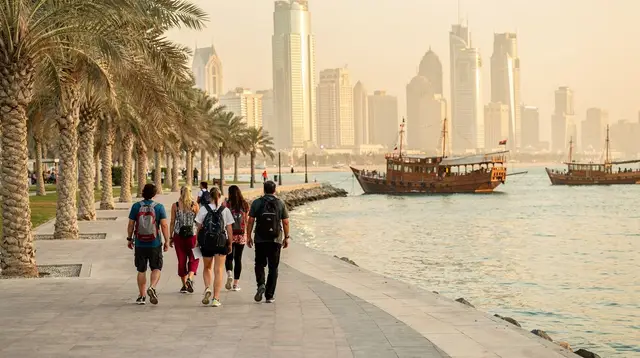
The Corniche is a roughly 7-kilometre promenade that curves around Doha Bay, and it is the single best free activity in the city. Traditional wooden dhows moor along stretches of the bay, families come out in the evening once the heat has eased, and the view across the water takes in the West Bay skyline on one side and the low, sail-like curves of the Museum of Islamic Art on the other. Walking a section of it costs nothing, and the pavement is wide, shaded in parts and well maintained.
The practical way to use the Corniche on a budget trip is as a connector rather than a single stop: it runs close to Souq Waqif at one end and toward West Bay and the Museum of Islamic Art area at the other, so a morning or evening plan can string several free sights together on foot, provided the weather cooperates. Renting a bicycle along the route or joining a paid dhow cruise are optional add-ons, not requirements — you can watch the same dhows from the shore for free.
For travellers who only have a few hours and want the classic photo and the classic walk without spending anything, the Corniche at sunset, combined with a stroll into Souq Waqif afterwards, covers the two most photographed free experiences in the city in a single outing.
MIA Park: the free ground floor of a paid museum
The Museum of Islamic Art itself, designed by I. M. Pei and sitting on its own island just off the Corniche, is one of Doha’s two landmark museums, alongside the Jean Nouvel–designed National Museum of Qatar. Both are run by Qatar Museums, and both charge for entry under terms that Qatar Museums sets and periodically revises — so this guide will not state a fixed “free” or a fixed price for either building. Check the current ticket information through Qatar Museums’ own channels before you plan around a specific figure.
What is unambiguous is MIA Park, the landscaped public park that wraps around the museum building on its island. It is open ground, not a ticketed courtyard: joggers, families and picnickers use it daily, there are shaded benches facing the bay, and the view of the museum’s geometric stone façade from outside is arguably as striking as anything inside. Arriving by the pedestrian route from the Corniche or a short metro-and-walk combination costs nothing beyond the transport fare, and the park alone is worth the detour even for travellers who decide to skip the paid galleries.
If you want to actually see the collection inside, budget separately for a ticket and read our dedicated Museum of Islamic Art visit guide for current practicalities, and do the same with the National Museum of Qatar visit guide before assuming either is included in a free day.
Souq Waqif: browsing costs nothing
Souq Waqif is a restored traditional market rebuilt in the 2000s on the footprint of the old souq, not an untouched ancient bazaar, and that history matters for a budget visit: the lanes, courtyards and covered walkways are open public space, and simply wandering through them, watching the Falcon Souq’s handlers work with their birds, or sitting to watch the evening crowd costs nothing at all. The souq comes alive in the late afternoon and evening, since many stalls close in the early afternoon heat, so timing a free wander here for after about 4 or 5 pm gets the atmosphere at its best.
Spending only happens when you choose it: a snack from a stall, a cup of karak tea, a shisha at a café terrace, or a purchase from one of the spice, textile or souvenir shops. None of that is required to enjoy the walk itself. If food is part of your plan, our souq food and karak walk guide and broader Souq Waqif shopping guide lay out what things typically cost so you can set your own limit rather than guess.
Katara Cultural Village: public squares and a public beach
Katara sits between West Bay and The Pearl, and its main public areas — the amphitheatre’s exterior, the pigeon towers, the main square, the mosque courtyards and the beachfront promenade — are open to walk through without any entry fee. It is one of the more pleasant places in Doha for an early-evening stroll, since the layout is pedestrian-friendly and shaded walkways connect the squares to the beach.
Katara’s public beach is a genuinely free stretch of sand and sea, distinct from the paid beach clubs found elsewhere in the city, though facilities there are basic rather than resort-style. Galleries, exhibitions and ticketed events inside specific Katara venues can carry their own charge, and that varies by what happens to be showing when you visit, so treat the walk-through experience as the free layer and anything ticketed as a separate decision. For an evening-focused plan, see the Katara Cultural Village evening guide.
Msheireb Downtown and its free heritage tram
Msheireb is the rebuilt heritage quarter just south of the old city centre, redeveloped as a low-rise district of traditional-style architecture, public squares and museums built around preserved historic houses. Walking through Msheireb’s squares and passages costs nothing, and the district was specifically designed as a pedestrian-first area, which makes it one of the more comfortable places in Doha to explore on foot outside of the hottest months.
A short heritage tram loop has run through Msheireb Downtown Doha connecting its main squares and museum buildings as a free service — a useful way to cover the district’s spread-out layout without walking every stretch in the heat, though schedules on small heritage trams can change, so it is worth confirming current operating hours locally rather than assuming a fixed timetable. The four Msheireb Museums, built inside restored historic houses, are separately ticketed; a walk through the surrounding public squares does not require a ticket even if you skip the museums themselves. Our Msheireb Downtown walking guide covers a suggested route through the district.
The Pearl-Qatar: a free walk around a private island
The artificial island of The Pearl is best known for its marina, boutiques and waterfront restaurants, but the public promenades that ring much of the island are open and free to walk. The Qanat Quartier, with its Venice-styled canals and pastel buildings, and the main marina walkway both make for an atmospheric evening stroll with no admission charge, and it is a popular spot for both residents and visitors to watch the sunset over the yachts.
As with Katara, spending here is optional rather than built into the visit: cafés and restaurants line the marina, but nothing stops you from walking the full loop, taking photographs and leaving without paying for anything beyond the transport to get there and back.
Lusail: the new city’s free public spaces
North of central Doha, Lusail is a newer planned city, home to Lusail Stadium, which hosted the 2022 World Cup final, alongside the Lusail Marina and the Place Vendôme shopping and entertainment complex. The marina promenade and the public plazas around Place Vendôme can be walked for free, and the Lusail Tram, a separate light-rail line from the Doha Metro, serves the district. Riding the tram itself carries a fare rather than being free, but the outdoor public spaces along the marina do not. For a fuller look at the area, see Lusail Marina and Place Vendôme.
Getting around cheaply: metro, tram and walking in cool season
None of the free sights above are useful if getting between them costs more than the sights themselves would have. The Doha Metro is the backbone of a low-budget itinerary: it is clean, air-conditioned, and charges a low flat fare rather than a distance-based one, with three lines — Red, Green and Gold — covering West Bay, the areas near Msheireb and Souq Waqif, and onward connections. The metro will not get you everywhere, though: several of the sights described above sit close to a station, but stretches of the Corniche, Katara and The Pearl still require a walk or a short taxi or ride-hailing hop from the nearest stop.
The table below is a rough guide to how the free sights connect, using the metro plus walking as the default and noting where a short taxi hop makes more sense.
| Area | Nearest metro line | Typical last stretch |
|---|---|---|
| Corniche / Souq Waqif | Green Line, Souq Waqif area | Short walk |
| Museum of Islamic Art / MIA Park | Green Line, walk or short taxi | Walk along the waterfront |
| Msheireb Downtown | Red/Green interchange, Msheireb station | Walk, or the free heritage tram |
| Katara Cultural Village | Not directly on the metro | Taxi or ride-hailing |
| The Pearl-Qatar | Not directly on the metro | Taxi or ride-hailing |
| Lusail | Red Line extension / Lusail Tram | Walk from the tram stop |
Timing is the other half of doing Doha cheaply: this only works comfortably in cool season, roughly November to March, when daytime temperatures are warm rather than extreme and walking a kilometre or two between sights is pleasant rather than a health risk. From around May to September, the heat and humidity routinely climb past 40°C, and stitching together an outdoor, on-foot itinerary in the middle of the day is genuinely dangerous rather than just uncomfortable.
In summer, shift these same free sights to early morning or after sunset, and lean more heavily on the metro between stops instead of walking. Our best time to visit Doha and cool season guide go into more detail on seasonal planning, and the getting around Doha overview covers transport options beyond the metro.
For a broader sense of how these neighbourhoods relate to each other before you map out a walking route, the Doha neighborhoods guide is a useful companion, and if you are trying to fit free sights around a short visit, our one-day Doha highlights itinerary sketches out a workable sequence.
What still costs money, and how to budget for it
A completely free trip to Doha is not realistic, and this guide is not claiming otherwise. Flights, accommodation and food are the fixed costs, and most visitors will also want to add at least one paid experience, whether that is a museum ticket, a dhow cruise on the bay, or a half-day out to the desert. Metro and tram fares, where they are not the free Msheireb loop, are low but not zero.
Ticket prices for the Museum of Islamic Art and the National Museum of Qatar change over time, so this page deliberately does not quote a figure — check current pricing through Qatar Museums before you build a budget around either museum. Our attraction tickets guide and Doha budget and currency guide go further into what a realistic daily spend looks like once the free layer of sightseeing is covered.
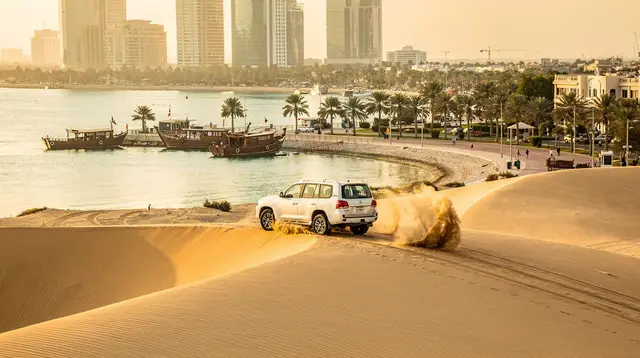
If a paid activity fits your plan alongside the free sights, a half-day city tour is a reasonable way to see West Bay, the Corniche and the older districts together with a guide, and some versions bundle in an extra like a gondola ride or a boat cruise at no separate charge. a half-day Doha city tour that pairs West Bay’s malls with a free gondola ride covers ground that would otherwise take a full day of walking and taxis to string together, and it can work well as the one paid add-on to an otherwise free-focused day.
For travellers who want the heritage side of the city without renting a car, a guided heritage tour through the old city and its restored districts covers Souq Waqif, Msheireb and the surrounding older neighbourhoods with local commentary, which fills in context that a free solo walk will not. And if your schedule allows an evening out once the day’s heat has passed, an evening Doha by Night tour along the illuminated Corniche and skyline is a low-effort way to see West Bay lit up without organising transport yourself.
Putting together a free-focused day
A realistic low-budget day in Doha, timed for cool season, might start with an early walk through MIA Park and along the Corniche before the heat builds, move on to Msheireb Downtown for a couple of hours using the free heritage tram between its squares, and finish in the late afternoon and evening at Souq Waqif, once the stalls have reopened and the temperature has dropped. That single day covers five of the free sights described above using only the metro and a short amount of walking, with no admission fee required for any part of the route itself.
Katara and The Pearl sit further apart and are best treated as a separate half-day, reached by taxi or ride-hailing rather than on foot, since the metro does not run directly to either. If time allows for a second day, pairing those two waterfront districts with a sunset walk covers the remaining major free sights without repeating ground from day one.
Free things to do in Doha: frequently asked questions
Is the Museum of Islamic Art free to enter?
Ticket policy for the Museum of Islamic Art is set by Qatar Museums and has changed over the years, so do not assume free entry. Check the current price on the official Qatar Museums channels before you go; MIA Park around the building is a public waterfront park with no entry fee.
Is the National Museum of Qatar free?
As with the Museum of Islamic Art, entry terms for the National Museum of Qatar are set by Qatar Museums and can change. Confirm the current ticket price before your visit rather than relying on an old figure. The museum’s surrounding grounds and the desert-rose exterior can be viewed from outside at no cost.
Is the Msheireb tram really free?
The short heritage tram loop through Msheireb Downtown Doha has operated as a free service connecting the Msheireb Museums and the district’s main squares. Confirm current operating hours locally, since schedules on small heritage trams can change.
Do you have to pay to enter Souq Waqif?
No. Souq Waqif is an open market district with no entry fee or gate; you only pay for what you choose to buy, eat or ride, including any horse-drawn carriage or falcon photo you might add on.
Is Katara Cultural Village free to walk around?
Yes, the public squares, amphitheatre exterior, mosque courtyards and beachfront promenade of Katara Cultural Village are open to walk through without a ticket. Individual galleries, event tickets or beach club access can carry their own separate charges.
What is the cheapest way to get between these free attractions?
The Doha Metro’s Red and Green lines connect West Bay, the Corniche area, Msheireb and The Pearl at a low flat fare, and the free Msheireb tram loop covers the last stretch through the heritage quarter. In cool season, several of these sights are also an easy walk apart along the Corniche itself.
When is the best time of year to sightsee in Doha for free without struggling in the heat?
Roughly November to March, when daytime temperatures are warm rather than extreme, is the best window for walking the Corniche, Souq Waqif and Katara on foot. From May to September the heat and humidity make midday outdoor walking genuinely risky, so budget sightseeing shifts to early morning, evening and indoor stretches.
Are there any charges just to walk along the Corniche or through The Pearl?
No. Both the Corniche promenade and the public walkways of The Pearl-Qatar are open waterfront areas with no admission charge; costs only appear if you rent a bike, book a dhow cruise or sit down at a café or restaurant along the way.
Trip Planning
Verified deep-linked GetYourGuide tours. Book through these links and we earn a small commission at no cost to you.
GetYourGuide does not provide a product photo for this activity — the image shows the meeting point, photographed by us.