Doha Trip Planning Checklist
What do I actually need to sort out before a trip to Doha?
Check entry requirements for your nationality on the official Qatari portals, pack for a hot desert climate with modest clothing, bring a Type G plug adapter, and book your desert safari or dhow cruise a few days ahead. The riyal is pegged to the US dollar, so cards work almost everywhere.
Getting your paperwork and logistics sorted before you fly
Doha rewards travellers who sort out a short list of practical questions before departure, and then largely forgets about them once the trip starts. This is not a place where a first-time visitor typically runs into daily friction: Qatar is orderly, English is widely spoken, and the transport network is modern. The list below is what actually needs attention ahead of time, in roughly the order it matters, with links to a full page on each subject rather than a shallow paragraph here.
Entry requirements: check the official source, not a blog post
Entry rules for Doha and Qatar depend on your passport and change over time, so this page will not state a rule for a given nationality. What is true in general: many nationalities receive a visa waiver on arrival, and Qatar has made entry relatively straightforward for tourism in recent years. What is also true: rules are revised, waiver lists change, and the requirements for a transit passenger differ from those for someone entering for a full stay.
Before booking anything, check the current position on the Qatari Ministry of Interior’s portal or the Hayya platform, or your own government’s travel advisory for Qatar. Our dedicated page on Qatar visa and entry requirements explains how the system works and where to verify your own case, without guessing at a rule that could be wrong by the time you land.
If you are only passing through Hamad International Airport on a stopover, the question of whether you can leave the terminal at all is a separate one, again dependent on nationality. See can you leave Hamad Airport on a layover before assuming either way, and if you do plan to explore the city on a short break between flights, our Doha stopover guide lays out what is realistic in a few hours versus overnight.
Pick your season deliberately
Qatar has a hot desert climate, and the difference between visiting in January and visiting in July is not subtle. Roughly November through March is the comfortable window: warm, sunny days and pleasant evenings, which is also when the Corniche, Souq Waqif and outdoor desert trips to Sealine are at their best. From roughly May to September, daytime temperatures routinely exceed 40°C with high humidity, and spending the middle of the day outdoors is a genuine health risk rather than mere discomfort.
That does not mean summer travel is impossible — it mostly means shifting your day around it. Our best time to visit Doha page compares the seasons month by month, and if you are locked into travelling in the hot months, Doha in summer: indoor activities and our summer survival guide cover the museums, malls and evening-only outdoor windows that make it workable. If your dates are flexible, Qatar’s cool season outdoor activities page shows what opens up once the heat breaks.
| Season | Roughly | Daytime feel | Good for |
|---|---|---|---|
| Cool season | November–March | Warm, pleasant evenings | Desert safaris, walking tours, dhow cruises |
| Shoulder | April, October | Warm, occasionally hot | Most outdoor activity, plan around midday |
| Summer | May–September | Extremely hot and humid | Museums, malls, evening-only outdoors |
One date range worth checking regardless of season is Ramadan, which follows the Islamic lunar calendar and shifts about eleven days earlier each year — it is never the same month twice running, so look up the current dates rather than assuming. During Ramadan, eating, drinking and smoking in public in daylight are not permitted for anyone, opening hours change substantially, and evenings become livelier as families and visitors go out after sunset. Our Ramadan in Qatar: rules for visitors page and our separate Eid holidays in Doha note explain what shifts and what stays open.
Pack for the plug, the heat and the dress code
Three small physical details are easy to forget and mildly annoying to fix once you have landed.
Power adapter. Qatar mainly uses Type G sockets — the same three-pin, rectangular-blade standard as the United Kingdom — running at 240V and 50Hz. Visitors from continental Europe, the Americas or much of Asia will need a plug adapter, and if a device is not rated for 240V, a voltage converter as well. Buy the adapter before you fly; hotel shops carry them but at inflated prices.
Clothing for the climate and for modesty at the same time. Lightweight, breathable clothing works for the heat, but Qatar also expects modest dress in public places: shoulders and knees covered in malls, museums, souqs such as Souq Waqif and government buildings. Swimwear belongs at beaches, pools and hotels, not elsewhere.
If you plan to visit any mosque, arms and legs need to be covered and women should carry a headscarf, since most mosques will not admit visitors dressed otherwise. Our what to wear in Doha: dress code page goes through this by setting — museum, souq, beach, mosque — in more detail, and our what to pack for Doha list rounds out the rest of the bag.
Sun protection and hydration basics. Even in the cool season, midday sun is strong. A hat, sunglasses and sunscreen matter, and carrying water is standard practice, especially for anyone heading out to Sealine or the Inland Sea for a desert excursion.
Money: a currency that does not move against the dollar
The Qatari riyal (QAR) is pegged to the US dollar at roughly 3.64 QAR to 1 USD, and has been for a long time, so there is no exchange-rate guessing game if you are coming from a dollar economy — though a euro or pound traveller will still see their own currency drift against the riyal as it drifts against the dollar.
Cards are accepted almost everywhere in Doha, from hotels and malls to most restaurants and taxis, and cash is mainly useful for smaller souq stalls and tips. There is no need to carry large amounts of cash. This page will not attach a fixed daily budget figure, since costs vary hugely by hotel category and how many paid activities you add — our Doha budget and currency page covers the mechanics of paying for things in more depth.
Getting from the airport into the city
Hamad International Airport (DOH), the hub of Qatar Airways, sits on the east side of Doha, roughly 15 to 25 minutes by road from West Bay or Souq Waqif depending on traffic. The Doha Metro’s Red Line runs directly from the airport into the city and is the cheapest, most predictable option if you are travelling light. Taxis (Karwa) and ride-hailing apps such as Uber and Careem are the more comfortable choice with luggage, a family, or a late-night arrival, and a private transfer can be booked in advance if you would rather not deal with any of it after a long flight.
Full details, including how to buy a metro card and where the taxi rank sits relative to arrivals, are in our Hamad Airport to city centre guide.
If you would rather have a driver waiting with your name on a sign, a half-day introduction to Doha’s main sights straight off the plane or a dedicated guided city tour with lunch included both bundle the transfer into the day, which is worth considering if you land tired and would rather not plan the first afternoon yourself. For late or overnight arrivals specifically, see Doha airport transfer for late-night arrivals.
Once you are settled, the Doha Metro and tram guide explains the three metro lines plus the Lusail Tram, the free Msheireb loop and the Education City tram, and where the network’s reach ends — it does not serve the desert, the north, or the west of the country, so anything beyond Al Wakrah generally means a taxi, a rented car, or a booked tour.
What is worth booking ahead of time
Doha does not require the kind of advance planning some destinations do, but a handful of things are worth locking in before you land rather than figuring out on day one:
- A desert excursion. Trips to Sealine and the Inland Sea involve dune bashing in a proper 4x4 with an experienced driver — never attempt this in a rental saloon car — and popular slots can fill up in the cool season. An adventure trip out to the desert or, for those with more time, an overnight stay at a desert camp are both worth reserving a few days ahead. Our desert safari guide and desert safari safety tips pages cover what to expect and what to wear.
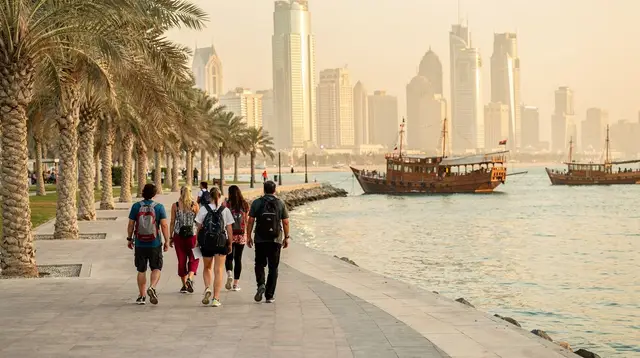
- A dhow cruise for sunset. The traditional wooden dhows that moor along the Corniche run evening cruises around Doha Bay, and the better time slots go first. See our dhow cruise guide for the options.
- Timed museum entry, particularly for the Museum of Islamic Art and the National Museum of Qatar, both of which close one day a week — check current hours before building a day around either one.
- Any north or west Qatar day trip, since Al Zubarah and Zekreet are a long half-day out and back, and are usually done as an organised tour with a 4x4 for the final stretch of track.
Our how to book tours in Doha page walks through the practical side of reserving activities, and Doha attraction tickets guide covers museum and venue tickets specifically.
A short pre-departure checklist
| Item | Action | Where to read more |
|---|---|---|
| Entry requirements | Check official Qatari portals for your nationality | Visa and entry requirements guide |
| Season | Pick cool months if your dates are flexible | Best time to visit page |
| Plug adapter | Type G, 240V/50Hz — buy before you fly | Packing tool |
| Dress | Modest clothing for malls, museums, souqs, mosques | Dress code guide |
| Money | Cards work almost everywhere; riyal pegged to USD | Budget and currency guide |
| Airport transfer | Metro Red Line, taxi, ride-hailing or private transfer | Airport to city centre guide |
| Desert safari | Book a few days ahead, licensed operator with 4x4 | Desert safari guide |
| Dhow cruise | Book ahead for sunset slots | Dhow cruise guide |
| Ramadan dates | Check the current lunar-calendar dates if travelling nearby | Ramadan rules guide |
For a broader first-timer’s orientation once the practical boxes above are ticked, our Doha for first-timers page and our Doha with limited time: priorities guide help turn this checklist into an actual day-by-day plan, and our three days in Doha: essentials itinerary shows how the pieces fit together for a typical short trip.
Doha trip planning: frequently asked questions
Do I need a visa to visit Qatar?
It depends on your nationality and can change over time. Many nationalities get a visa waiver on arrival, but you must check the official Qatari immigration portals or your own government’s travel advisory before you fly rather than rely on a fixed rule.
What plug adapter do I need for Qatar?
Qatar mainly uses Type G sockets, the British three-pin standard, at 240V and 50Hz. Visitors from continental Europe, North America or most of Asia will need an adapter, and a voltage converter if a device is not dual-voltage.
When is the best time to visit Doha?
Roughly November to March is warm by day and pleasant in the evening. Summer, from around May to September, is extremely hot and humid, often above 40°C, and midday outdoor sightseeing becomes a genuine health risk.
What should I wear in Doha?
Modest dress is expected in public places such as malls, museums, souqs and government buildings, with shoulders and knees covered. Swimwear is for beaches, pools and hotels only, and mosques require covered arms and legs plus a headscarf for women.
Is Qatar’s currency easy to deal with?
Yes. The Qatari riyal is pegged to the US dollar at roughly 3.64 QAR to 1 USD, so it does not fluctuate against the dollar, and cards are accepted almost everywhere, including taxis and souq stalls.
How do I get from Hamad International Airport into Doha?
The airport sits on the east side of the city, about 15 to 25 minutes by road from West Bay or Souq Waqif, and the Doha Metro’s Red Line serves it directly. Taxis and ride-hailing apps are also widely used, especially with luggage or a late arrival.
What should I book before I arrive?
A desert safari to Sealine, a dhow cruise on the Corniche and, if relevant, timed museum entry are worth booking a few days ahead, particularly in the cooler high season when slots fill up.
Does Ramadan affect a trip to Doha?
Yes. Ramadan follows the Islamic lunar calendar and shifts about 11 days earlier each year, so it falls in a different month annually. During it, eating, drinking and smoking in public in daylight are not allowed, and opening hours shift later into the evening.
Trip Planning
Verified deep-linked GetYourGuide tours. Book through these links and we earn a small commission at no cost to you.
GetYourGuide does not provide a product photo for this activity — the image shows the meeting point, photographed by us.