Desert Safari Safety Tips for Qatar
What is the biggest safety risk on a Qatar desert safari?
The real risks are heat, dehydration and off-road driving, not crime. A rental saloon car has no business on the dunes; safaris are done in a proper 4x4 with an experienced driver, and visitors should carry water and watch for signs of heat illness.
The real risks are heat, dehydration and driving, not crime
Qatar has very low crime, and that is true in the desert as much as anywhere else. Nobody planning a trip to Sealine or the Inland Sea needs to worry about being robbed or assaulted. That is not where the actual risk sits, and it is worth being blunt about where it does sit: extreme heat, dehydration, and off-road driving done badly.
None of this is exotic or rare in the sense of headline-grabbing accidents — there are no accident statistics worth quoting here, and this page will not invent any — but the underlying physics does not change. A desert south of Mesaieed in July is genuinely hot enough to hurt someone who is unprepared, and soft sand at speed punishes a wrong decision faster than a paved road does.
This is not a page designed to scare anyone out of a desert safari, which remains one of the most popular and, done properly, safe and well-run activities in the country. It is also not a page designed to wave away the two things that actually matter: the heat, and the vehicle underneath you.
Why nobody drives themselves to the dunes in a rental saloon car
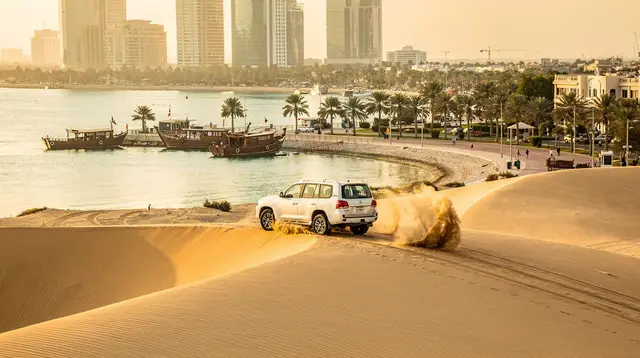
The paved road south from Doha towards Al Wakrah and on to Mesaieed is unremarkable driving. What changes at Sealine is the surface: the last stretch onto the dunes is soft, shifting sand, and an ordinary rental car — the sedan or small SUV most visitors drive around the city — will not cope with it. Tyres sink, momentum matters more than horsepower, and a vehicle without the right ground clearance, tyre pressure and low-range gearing gets stuck within metres of leaving the packed track.
The same is true, more sharply, of the run out to Khor Al Adaid, which crosses a longer stretch of open dune before reaching the water. There is no paved or graded road to the Inland Sea. It is reached only by 4x4, across the sand, and that is not a marketing detail — it is the actual physical route.
This is why the standard, sensible way to see the dunes is a booked safari with a driver who does this daily, in a vehicle built and set up for it. A proper desert 4x4 has its tyres deflated to a specific pressure for sand before the driver even leaves the paved road, and reinflated again afterwards. That single step, more than horsepower or size, is what lets a vehicle float across soft sand instead of digging in.
A rental company’s standard car is set up for tarmac, has road-pressure tyres, and is not insured or intended for dune driving in the first place. For anyone still weighing a self-drive rental for the rest of the trip, see renting a car in Qatar — a perfectly ordinary way to cover the city and the paved highways, but not a substitute for the point made above once the tarmac runs out.
Dune bashing: what a good driver is actually doing
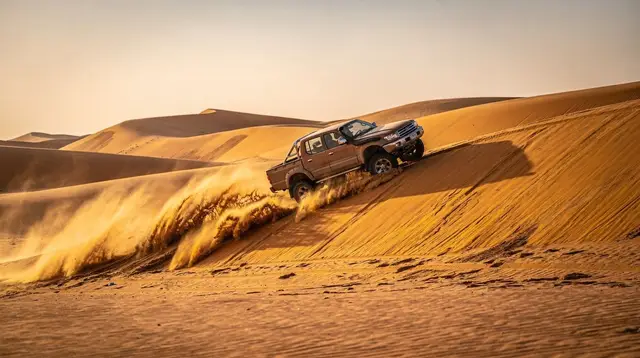
“Dune bashing” sounds like a stunt, and marketing photos of vehicles cresting a dune at an angle do not help. What an experienced driver is actually doing is reading the shape and firmness of the sand ahead, choosing lines that avoid soft pockets and steep faces at the wrong angle, controlling speed into and out of a rise, and knowing when to back off rather than push through. It is a skill built from repetition on that specific stretch of desert, not something transferable from ordinary driving experience, however confident a visitor might feel behind the wheel of a rented 4x4.
The reasonable way to enjoy this experience is inside a vehicle with that driver, rather than behind the wheel of your own. A group can still ask questions, watch the technique, and get an adrenaline afternoon out of it — the point is not to avoid dune bashing, it is to avoid doing it yourself as a first-timer in an unfamiliar 4x4 you rented an hour earlier.
a half-day dune-bashing and sandboarding trip out of Doha covers exactly this: an experienced driver, a properly prepared vehicle, and the dunes without anyone in the group needing to make a single judgement call about sand conditions.
Heat and dehydration: the everyday risk, every month of the year
Qatar’s summer, roughly May to September, is extremely hot and often humid, routinely above 40°C in the shade, let alone in direct sun on open sand. Outdoor sightseeing or activity in the middle of the day during those months is a genuine health risk, not an exaggeration for effect, and this is exactly why most operators run summer desert programmes in the cooler morning or evening hours rather than at midday. The cooler season, roughly November to March, is far more forgiving, but “cooler” in a desert climate still means real sun exposure and real fluid loss over a few hours outdoors, particularly with the physical activity of sandboarding, quad biking or camel riding layered on top.
Dehydration builds quietly. Heavy sweating in dry desert air evaporates fast enough that people often do not feel as wet or as thirsty as they are, which is part of why it catches visitors out. Symptoms worth acting on immediately include dizziness, headache, nausea, unusual tiredness, confusion, or — a more serious warning sign — skin that has gone hot and dry rather than sweaty. Anyone showing these signs should be moved out of the sun and into shade or an air-conditioned vehicle straight away, given water in small regular sips rather than gulped, and monitored. If symptoms do not improve quickly, or if there is confusion, vomiting, or loss of consciousness, call 999.
| Season | Typical daytime conditions | Practical implication |
|---|---|---|
| November–March | Warm by day, pleasant evenings | Best window for full-day outdoor activity |
| April, October | Warming up or cooling down | Still workable with normal precautions |
| May–September | Extremely hot and often humid, 40°C+ | Midday outdoor exposure is a real risk; stick to early morning, evening or indoor plans |
What to actually carry and do
None of this requires special equipment, just habits that are easy to skip when the day feels routine.
- Carry more bottled water than seems necessary, and drink it steadily through the day rather than only when thirsty.
- Wear a hat, sunglasses and sun protection, and choose loose, breathable clothing that covers shoulders and knees — it protects from sun as well as meeting the general expectation of modest dress in public.
- Wear closed shoes for sandboarding, quad biking or handling a camel; sand gets extremely hot underfoot in summer.
- Keep a phone charged and know that 999 is the national emergency number for police, ambulance and fire, reachable from anywhere with signal.
- On a booked safari, tell the driver or guide immediately if anyone feels unwell — they know the fastest way back to a paved road and, from there, to help.
- Do not wander off from the group at Sealine or the Inland Sea to explore dunes alone; it is easy to lose sight of a vehicle in featureless terrain, especially in glare or at dusk.
What a booked, experienced operator changes
Booking a safari with an established operator changes several things at once, quietly, in the background. The vehicle has been maintained and set up for sand before the day starts. The driver has done this specific route, in this specific terrain, repeatedly, and knows which dunes are currently soft after recent wind or where a track has shifted. Water is typically provided or expected as standard. And if something does go wrong — a vehicle needs recovery, or someone in the group is struggling with the heat — there is an adult in the vehicle whose job, that day, is dealing with exactly that.
a full desert day combining dune bashing, sandboarding and a camel stop or a guided dune buggy outing with a driver both put an experienced local in charge of the vehicle and the route, which is the single biggest safety decision most visitors make about their desert day. For something further off the standard loop, a guided trip out to the Musfir sinkhole is another case where local knowledge of the terrain, rather than a rental car and a map, is what makes the outing sensible.
Choosing the safest format for your group
Not every safari is the same shape, and the safety picture shifts a little with the format. A sunrise desert safari or a sunset desert safari avoids the worst of the midday heat by design, which is part of why operators build their standard schedules around those windows rather than a midday departure. Anyone travelling with young children is generally better served by an itinerary built for it — see family desert safaris in Qatar — since pacing, rest stops and vehicle choice differ from an adrenaline-focused adult trip.
Groups who would rather have a driver and vehicle to themselves, and set their own pace and rest stops, can look at a private-style desert and Inland Sea day combining dunes, camels and sandboarding rather than a shared departure; the underlying safety picture is the same either way, but a smaller group can be more deliberate about pace.
Quad biking and sandboarding are usually offered as add-ons at Sealine rather than at the Inland Sea, and each carries its own small set of precautions — see quad biking at Sealine and sandboarding in Qatar for what to expect and what to wear. For a direct comparison of how much more remote Khor Al Adaid is than Sealine, and what that means for planning a day around it, see Sealine versus the Inland Sea.
An overnight desert camp adds one further consideration: temperatures drop sharply after dark even in the hot season, so warm layers matter almost as much as sun protection did earlier in the day, and the same basic guidance on water, a charged phone and staying close to the group applies once the sun goes down.
Sealine versus the Inland Sea: different level of remoteness
Both destinations require a 4x4, but they are not the same level of commitment. Sealine sits close to a paved approach and a cluster of operators, with help, fuel and other vehicles nearby if anything goes wrong. The Inland Sea is a longer, more remote run along the Saudi border, with a genuinely isolated final stretch and far less passing traffic. That gap in remoteness is part of why almost every visitor reaches Khor Al Adaid as part of an organised trip rather than an independent one, and why an inexperienced or solo attempt there carries more consequence if something does go wrong than the same mistake would at Sealine.
Before you book
A short checklist is more useful here than reassurance in either direction. Confirm the operator provides an experienced driver and a vehicle actually prepared for dunes, not a standard SUV. Check what is included — water, sun shade, a stop at shade or a rest point on longer days. Ask about timing in summer months, since a well-run operator adjusts start times to avoid the worst midday heat rather than running the same schedule year-round. And treat the trip as outdoor activity in a genuinely hot climate, which means the same basic precautions — water, shade, sun cover — matter regardless of how short or scenic the drive looks in photos.
None of this is complicated, and none of it should put anyone off a day at Sealine or a run out to the Inland Sea. It is simply where the actual risk sits, and dealing with it is mostly a matter of choosing the right vehicle and driver, and carrying enough water. For the practical side of packing and preparation, see what to wear and bring on a desert safari; for what the day itself looks like once you are in the vehicle, see what to expect from dune bashing in Qatar.
Frequently asked questions about desert safari safety in Qatar
Is Qatar safe for a desert safari?
Qatar has very low crime, so personal safety from crime is not the concern. The genuine risks are heat and dehydration, and the physical risk of dune bashing done badly, in an unsuitable vehicle or by an inexperienced driver.
Can I drive to Sealine or the Inland Sea in a rental car?
Not in an ordinary rental saloon. The final stretches to Sealine’s dunes and to Khor Al Adaid (the Inland Sea) are soft sand that requires a proper 4x4 with correctly deflated tyres and a driver who reads the dunes.
Why can’t I just rent a 4x4 and go myself?
Renting a 4x4 does not make a first-time visitor a dune driver. Getting stuck, rolling a vehicle on a badly judged slope, or losing the track near the Saudi border are real outcomes for inexperienced drivers, which is why nearly all visitors book a safari with a driver rather than self-drive.
What should I bring on a desert safari?
Bring more water than seems necessary, sun protection, a hat, closed shoes for sandboarding or camel contact, and a charged phone. Loose, breathable clothing that covers shoulders and knees works better in the sun than shorts and a t-shirt.
What are the signs of heat illness to watch for?
Heavy sweating followed by dry, hot skin, dizziness, nausea, confusion, or stopping sweating altogether are warning signs. Anyone feeling faint or overheated should be moved into shade or an air-conditioned vehicle immediately and given water.
What is the emergency number in Qatar?
999 is the national emergency number for police, ambulance and fire, and it works from any phone. On an organised safari, telling the driver or guide immediately is the fastest way to get help, since they know the nearest way back to a road.
Is dune bashing dangerous?
Dune bashing in a well-maintained 4x4 with an experienced local driver is a routine, commercially run activity in Qatar. The risk rises sharply with an inexperienced driver, an unsuitable vehicle, or excessive speed, which is exactly what a booked safari is built to avoid.
Is the desert safe to visit outside a booked tour?
Independent visits to the fringes of Sealine’s beach and parking areas are common, but the dunes themselves and the Inland Sea specifically call for a 4x4 and local knowledge. Wandering off marked tracks alone, especially in summer heat, is not a reasonable risk to take.
Desert Safari and Dune Bashing Excursions
Verified deep-linked GetYourGuide tours. Book through these links and we earn a small commission at no cost to you.
GetYourGuide does not provide a product photo for this activity — the image shows the meeting point, photographed by us.