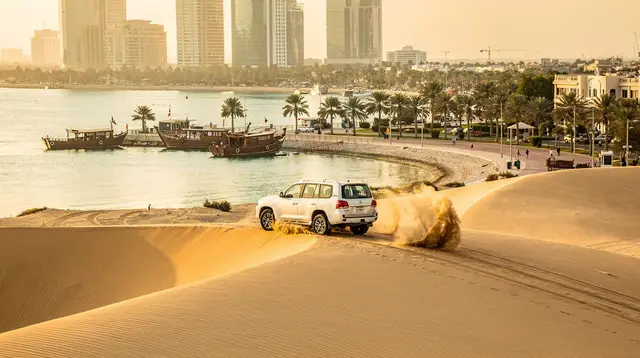
A coastal town south of Doha, not a Doha neighbourhood
Al Wakrah sits on the Gulf coast roughly 15–20 km south of central Doha, close enough for a same-evening visit and far enough to feel like a genuinely different place. It is worth saying plainly, because the confusion comes up often: Al Wakrah is not a district of Doha the way West Bay or The Pearl are. It is its own municipality with its own long history as a pearling and fishing town, predating modern Doha’s growth. What has changed is scale — Al Wakrah has been absorbed into Qatar’s road network and metro-adjacent bus routes as a satellite town, not swallowed into the capital itself.
That distinction matters for planning. A trip to Al Wakrah is a short excursion, not a stroll from one part of the city to another. Most visitors drive, take a taxi, or use a ride-hailing app for the 20–30 minute run down the coastal highway; there is no metro line into the town itself, so anyone relying on the Doha Metro and tram network will need to switch to a taxi or rent a car in Qatar for this leg. It is also a common stop on the way to or from Sealine and the desert safaris based near Mesaieed, since the coastal road effectively runs past it.
The souq: restored, not original — and worth saying so
Al Wakrah’s own souq sits by the old fishing harbour and follows the same low, sand-coloured, wind-tower architecture found across restored markets in this part of the Gulf. It is easy to assume, walking through its shaded lanes, that this is an untouched relic of the pearling era.
It is not, and this guide will not pretend otherwise: like Souq Waqif in central Doha, Al Wakrah’s souq was rebuilt in the 2000s on the footprint of an older market that had fallen into disrepair. The rebuild is faithful to the original layout and materials, and it sits beside a genuinely old working harbour, but the shopfronts, paving and most of the buildings are modern reconstructions rather than structures that survived from the 19th or early 20th century unaltered.
That is not a criticism of the place — restoration is how most of the Gulf’s historic souqs are experienced today, and Al Wakrah’s version is well done. It simply means visitors should come for the atmosphere, the harbour views and the food rather than expecting archaeological authenticity. For a closer look at how the two souqs compare, see the dedicated souq shopping guide and the specific Al Wakrah souq and beach guide, which covers opening patterns and what is actually for sale in more detail than fits here.
Why come here instead of, or in addition to, Souq Waqif
Souq Waqif is the obvious choice for a first evening in Qatar, and it should stay on most itineraries — it is larger, livelier and closer to the main hotel districts. Al Wakrah earns its place as the calmer alternative for a second or third evening, or for anyone who found the Doha souq overwhelming on a Friday night.
The practical differences are straightforward:
| Souq Waqif (Doha) | Al Wakrah souq | |
|---|---|---|
| Distance from West Bay | Central, walkable from the Corniche | 20–30 min drive south |
| Crowd level, evenings | Busy, especially Thu–Sat | Noticeably quieter |
| Size | Large, many lanes and specialty souqs | Compact, one main loop |
| Falcon souq | Yes, dedicated section | No |
| Harbour / fishing boats | Dhows moor on the Corniche nearby | Working fishing harbour on site |
| Best for | First-time visitors, souvenir shopping, the full Doha evening | A quieter walk, sunset photos, seafood dinner |
Neither is a substitute for the other; they are different registers of the same idea. A traveller with only one evening in Qatar should still prioritise Souq Waqif and the Corniche. A traveller with two or three evenings, or one who has already done the central souq once, gets real value from adding Al Wakrah as the quieter counterpart.
What an afternoon or evening actually looks like
Arriving in the mid-to-late afternoon gives the best combination of tolerable heat and enough daylight to see the harbour before the sunset crowd (modest by Doha standards) arrives. The souq itself is compact — a single main loop of shaded lanes lined with textile shops, small cafés, a handful of souvenir stalls and a few outlets selling household goods aimed as much at local residents as at visitors. It does not take more than 45 minutes to walk end to end, which is part of its appeal: there is no pressure to “cover” it the way a first-timer might feel at Souq Waqif.
From the souq, the harbour and corniche are a short walk. Al Wakrah’s waterfront is smaller and far less developed than Doha’s own Corniche, but that is the point — wooden fishing boats still work out of the harbour, and the walkway along the water is genuinely quiet even at peak sunset hours. A public beach sits just beyond the harbour, popular with local families in the cooler months rather than with tourists, and it is a reasonable spot for a short walk even outside swimming hours; the same modest-dress expectations that apply across Qatar’s public beaches apply here.
Dinner is the other main reason to come. Al Wakrah has a cluster of seafood restaurants near the harbour and souq, serving the kind of fresh, simply grilled fish that the harbour’s own boats bring in, alongside the broader Qatari and South Asian menus found across the country. It is a calmer, less touristy dinner setting than the restaurants immediately around Souq Waqif, and prices tend to run a little lower for a comparable meal. For a broader sense of what to order and where, the Doha food tour guide and the blog piece on what to eat in Qatar both cover machboos, karak and grilled hammour, all of which show up on Al Wakrah menus.
How to combine Al Wakrah with the rest of a day
Because it sits directly on the road south toward Mesaieed and Sealine, Al Wakrah works well as a bookend rather than a destination in its own right for most visitors. Two combinations come up repeatedly:
On the way to or from a desert safari. Vehicles heading to Sealine’s dunes, sandboarding runs and the Inland Sea at Khor Al Adaid pass close to Al Wakrah on the coastal highway. A traveller booking a full-day trip that starts early and returns by late afternoon can ask to be dropped in Al Wakrah on the way back rather than straight to a Doha hotel, turning one long outdoor day into a day-plus-evening without adding a separate excursion. Operators running a full-day desert safari with lunch or dinner can sometimes accommodate this kind of routing on request — worth asking when booking rather than assuming.
As a stop on a multi-souq day. Several guided itineraries pair Al Wakrah’s souq with Souq Waqif and sometimes the Falcon Souq in a single day, letting a visitor compare the restored-market experience across two towns without arranging separate transport for each. A guided tour covering Doha’s main souqs with meals and transfers included is the simplest way to do this without self-driving or managing multiple taxi bookings in one afternoon.
Families travelling with children sometimes add a stop at the small zoo near Al Wakrah, reachable via a transfer and entry package to the Al Wakrah mini zoo, which pairs reasonably well with an afternoon at the souq for a lower-key family day than the museums or Lusail’s attractions.
Travellers building a broader north-Qatar day that touches Al Khor, Al Thakira’s mangroves and Al Zubarah’s fort sometimes ask whether Al Wakrah fits into the same route — it does not, geographically, since it lies south of Doha while those sites lie north. A guided tour covering north Qatar’s history and culture is a separate day from an Al Wakrah visit, not an add-on to it; see the day trips from Doha guide for how the various single-day routes divide up geographically.
Getting there and getting around
There is no dedicated metro line to Al Wakrah, so the practical options are a taxi, a ride-hailing app, a self-driven rental car, or a seat on a guided tour that includes transfers. The drive itself is easy — a straight run down the coastal highway with clear signage — and typically takes 20 to 30 minutes from West Bay or the Corniche depending on traffic, closer to the shorter end outside rush hour. Anyone unfamiliar with driving in Qatar, or unsure about parking near the souq, will find a taxi or ride-hailing trip both cheap and simpler; the guides on taxis and ride-hailing in Doha and renting a car in Qatar cover both options in detail.
Within Al Wakrah itself, everything of interest — the souq, the harbour, the corniche walkway and the beach — sits within a 10–15 minute walk of a single central area, so a car is only needed to get in and out of town, not to move between sights once there.
Practical notes for the visit
Modest dress applies here as it does across Qatar’s public spaces: shoulders and knees covered is the safe default for both the souq and the beach promenade, with swimwear reserved for the beach itself. The souq, like Souq Waqif, tends to be quieter in the early afternoon and busier from late afternoon into the evening, and stall hours shift later on Fridays around midday prayers — the same pattern that governs opening times across Doha’s markets. Outside the cooler months (roughly November to March), the midday heat makes an afternoon walk genuinely uncomfortable, and the evening visit described above becomes close to mandatory rather than simply preferable.
There is no significant safety concern specific to Al Wakrah beyond the general, low baseline crime level found across Qatar; the main practical risks are the same as anywhere in the country’s summer heat — dehydration and sun exposure during the hottest hours.
For planning a full trip that fits Al Wakrah alongside the rest of Doha and southern Qatar, the Doha trip planning checklist and the Doha beaches guide are useful companions to this page.
Al Wakrah: frequently asked questions
Is Al Wakrah a neighbourhood of Doha?
No. Al Wakrah is a separate town and municipality roughly 15–20 km south of central Doha, with its own long history as a pearling and fishing settlement. It has been absorbed into Qatar’s wider road and transport network as the capital has grown, but it is administratively and historically distinct from Doha proper.
Is the souq in Al Wakrah an original historic market?
No, and this guide is deliberately clear on that point. Al Wakrah’s souq was rebuilt in the 2000s on the footprint of an older fishing-town market, in the same way Souq Waqif in Doha was restored rather than preserved untouched. The harbour beside it is genuinely working and old in character, but most of the souq’s buildings are faithful modern reconstructions, not original 19th-century structures.
How do I get from Doha to Al Wakrah?
By taxi, ride-hailing app, or self-driven rental car along the coastal highway, a drive of roughly 20 to 30 minutes from West Bay or the Corniche. There is no metro line running directly into Al Wakrah, so the Doha Metro is not a practical option for this trip on its own.
Is Al Wakrah worth visiting if I’ve already seen Souq Waqif?
Yes, if time allows for a second or third evening out. Al Wakrah offers a smaller, quieter version of the same restored-souq-plus-corniche experience, with a working fishing harbour and generally less crowded seafood restaurants. It is not a replacement for Souq Waqif on a first, short visit, but a good addition on a longer stay.
What is the best time of day to visit Al Wakrah?
Late afternoon into early evening, arriving with enough daylight left to see the harbour before sunset and staying on for dinner afterward. Outside the cooler months of November to March, a midday visit is genuinely uncomfortable because of the heat.
Can I combine Al Wakrah with a desert safari to Sealine?
Yes — Al Wakrah sits on the coastal road toward Mesaieed and Sealine, so it works well as a stop on the way back from a full-day desert safari, or as a separate short outing on the same trip. It is not, however, on the route to the north-Qatar sites such as Al Khor or Al Zubarah, which lie in the opposite direction from Doha.
Is there a beach in Al Wakrah?
Yes, a public beach sits just beyond the harbour and souq area, used mainly by local families rather than tourists, particularly in the cooler months. The same modest-dress norms that apply across Qatar’s public beaches apply here.
Do I need a guided tour to visit Al Wakrah, or can I go independently?
Independent visits are straightforward by taxi or rental car, since the souq, harbour and beach all sit within easy walking distance of each other once there. A guided option is mainly useful for visitors who want Al Wakrah bundled with Souq Waqif and other markets in a single day, with transfers and meals arranged for them.