Eid Holidays in Doha: What to Expect
What happens in Doha during Eid?
Eid al-Fitr and Eid al-Adha bring public holidays, family gatherings, and a festive mood to the Corniche, Souq Waqif and Katara, with many venues on adjusted or extended hours. Dates follow the Islamic lunar calendar and move roughly 11 days earlier each year, so they are never fixed to the same Gregorian month.
How Eid changes the rhythm of the city
Twice a year, Doha shifts into holiday mode for a few days. Eid al-Fitr, which marks the end of the Ramadan fasting month, and Eid al-Adha, linked to the annual pilgrimage season, are the two biggest holidays on the Qatari calendar. Government offices close, most residents get several days off work, and the city’s public spaces — the Corniche, Souq Waqif, Katara Cultural Village — fill with families out celebrating together, usually from late afternoon through late evening.
For a visitor, the practical effect is a mix of festive atmosphere and a few scheduling headaches. Nothing about sightseeing itself becomes harder — the Museum of Islamic Art, the National Museum of Qatar and the desert are all still there — but the evenings get busier, some family-run stalls take a day or two off, and the best restaurants and cruises need booking further ahead than usual. This guide walks through what actually changes, and what to plan around, without pinning either holiday to a date it doesn’t have.
Why Eid never falls on the same date twice
Eid al-Fitr and Eid al-Adha are set by the Islamic (Hijri) lunar calendar, which runs about 11 days shorter than the Gregorian solar year most travel planning uses. The practical result is that both holidays drift roughly 11 days earlier every year, working their way backwards through the seasons over a cycle of about 33 years. A holiday that once fell in one month can, a decade later, fall in a completely different one.
This is also why you won’t find a specific month named anywhere on this page. Any date given here would be wrong within a year or two, and worse, it would be wrong in a way that’s easy to miss if you’re planning a trip 6 or 12 months out. The only reliable approach is to check a current Islamic calendar, the official Qatari government calendar, or the Hayya and Ministry of Interior portals close to your travel dates — the exact day is often confirmed only once the relevant moon sighting is announced, sometimes with less than 48 hours’ notice.
If your trip to Doha happens to land during either Eid, treat it as a bonus layer of local culture on top of your normal itinerary, not as something to build the whole trip around — the timing is largely out of anyone’s control that far in advance.
What actually changes during Eid
Public holidays and opening hours
Both Eid al-Fitr and Eid al-Adha come with official public holidays, typically spanning several consecutive days including the eid day itself and the days immediately around it. Government offices, banks and some corporate offices close for the duration. Malls, most restaurants and the major attractions generally stay open and are often busier than usual, since local families use the days off to go out together.
The one exception worth knowing about: some of the smaller, family-run stalls inside Souq Waqif may close for the first day or two of Eid so their owners can spend the holiday with their own relatives. The souq as a whole doesn’t shut down, but don’t be surprised if a specific stall you had in mind isn’t open on day one.
Evening crowds
Eid evenings are when Doha shows its most sociable side. Families dress up, often in new clothes bought specifically for the occasion, and head out to the Corniche for a walk, to Katara for the beach and cultural events, to the malls, and to restaurants for large group dinners. If your visit overlaps with an Eid evening, expect the Corniche promenade and The Pearl-Qatar waterfront to be noticeably livelier than on an ordinary night, with more traffic on the roads leading in and out of these areas.
This isn’t a downside so much as a different kind of experience — a genuinely local celebration rather than a staged tourist event — but it does mean parking, restaurant tables and cruise slots are harder to secure without planning ahead.
Booking pressure on popular activities
Dhow cruises along the Corniche, sunset dinners, and tables at well-known restaurants in Souq Waqif and Msheireb Downtown can sell out during the two or three peak Eid evenings. Desert safari operators running trips out to Sealine also see a jump in local demand, since Eid is a popular time for Qatari and expatriate families to head out to the dunes together.
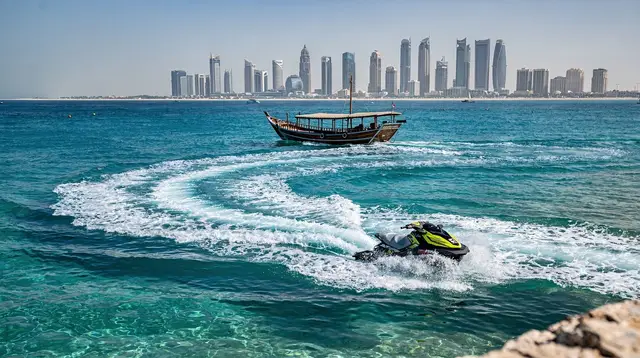
If your dates overlap with Eid, book anything you consider a highlight — a sunset dhow cruise, a heritage walking tour, a night out along the Corniche — a few days ahead rather than assuming you can arrange it on the spot. A relaxed evening on the water is easy to plan around a busy holiday period with a bit of lead time: an evening dhow cruise along the Corniche at sunset is one of the easier ways to see the West Bay skyline without competing for a restaurant table on shore.
What stays the same
It’s worth being clear about what Eid does not change. Museums, the national museum’s galleries, and daytime attractions across the city keep running on close to their normal schedules, sometimes with slightly extended hours rather than closures. Public transport — the Doha Metro, the Lusail Tram and the Karwa bus network — continues operating, and taxis and ride-hailing apps work as usual, if a little busier during peak evening hours. The desert, the north coast and the west of the country don’t observe the holiday any differently from an operational standpoint; guided trips to Al Zubarah or Zekreet run on their usual schedules.
Dress expectations and general etiquette also don’t relax during Eid — if anything, with more local families out in public spaces, it’s a good moment to be a little more careful than usual about modest dress in malls, souqs and cultural sites.
Eid al-Fitr vs Eid al-Adha: what’s different
The two Eid holidays share a similar public rhythm in Doha — holidays, family gatherings, a livelier evening scene — but they mark different things and fall at different points in the lunar year, roughly two lunar months apart.
| Eid al-Fitr | Eid al-Adha | |
|---|---|---|
| Marks | The end of the Ramadan fasting month | The pilgrimage season, roughly two lunar months after Eid al-Fitr |
| Typical mood | Very festive, new clothes, sweets, family visits | Festive, often with a stronger family and charitable focus |
| Effect on Doha | Marked contrast after weeks of adjusted Ramadan hours | Similar holiday atmosphere without the preceding fasting month |
| Travel booking pressure | High on the first 2–3 evenings | High on the first 2–3 evenings |
Both holidays move earlier each year at the same pace, since both are set by the same lunar calendar, so the gap between them in the calendar stays roughly constant even as their position in the Gregorian year shifts.
How Eid relates to Ramadan
Eid al-Fitr comes directly after Ramadan, the month during which observant Muslims fast from dawn to sunset. Ramadan has its own, quite different set of rules for visitors — no eating, drinking or smoking in public during daylight hours, shifted business hours with many places closing during the day and opening late into the night, and a distinctly different evening atmosphere built around the breaking of the fast. None of that applies during Eid itself, which is a celebration rather than a period of fasting.
If your trip falls during the fasting month rather than the holiday that follows it, read our dedicated guide to Ramadan in Qatar before you go — the practical adjustments during Ramadan are more extensive than anything described on this page, and worth planning for separately.
Making the most of an Eid visit
A trip that happens to overlap with Eid can be a genuinely good time to be in Doha, provided you plan around the crowds rather than against them. A few practical suggestions:
- Book evening activities early. A sunset dhow cruise or a heritage walking tour through Msheireb Downtown and Souq Waqif is far easier to lock in a few days ahead than on the evening itself.
- Visit daytime attractions as normal. Museums and indoor attractions see far less of an Eid effect than restaurants and waterfront areas, so mornings and early afternoons are a good window for sightseeing.
- Expect Souq Waqif to feel different for a day or two. Some smaller stalls may be closed on the first day of the holiday even as the souq as a whole stays lively.
- Give yourself extra time for evening transport. Traffic around the Corniche, Katara and The Pearl-Qatar builds up more than usual on the main Eid evenings.
- Check the confirmed date close to your trip. Because the date is set by moon sighting, it can shift by a day even within the same week it’s expected, so a final check a day or two out is worth doing.
A guided introduction to the city’s landmarks works well either side of the busiest Eid evenings: a half-day heritage tour through the old city and its museums covers the ground efficiently during the calmer daytime hours, leaving the evenings free for the festive side of the holiday. For visitors who’d rather see the city lit up after dark once the crowds are part of the appeal rather than an obstacle, a night tour taking in the illuminated Doha skyline pairs naturally with an Eid evening along the Corniche.
Planning your dates around Eid
Because Eid moves through the calendar year over time, whether it lands during your trip is largely a matter of timing rather than something to plan for or against directly. If you’re booking well in advance and want to know whether your dates coincide with either holiday, check a current Hijri-to-Gregorian conversion or the official Qatari public holiday calendar for the relevant year rather than relying on where Eid fell in a previous year.
If you’d rather avoid the busiest evenings altogether, the cooler season from November to March remains the more relevant factor for comfortable outdoor sightseeing generally, and Eid crowds are a secondary consideration layered on top of that. For a broader sense of how Fridays and the weekend rhythm affect opening hours outside of any holiday period, see our guide to Fridays in Doha, and for wider notes on local customs around family gatherings and hospitality, our guide to Qatari etiquette is a useful companion.
For first-time visitors mapping out a short stay that might overlap with a holiday period, our two-day Doha itinerary for first-timers still works as a base plan — Eid simply adds a livelier evening layer to whichever days it falls on. A short guided outing such as a half-day city tour covering West Bay, the Corniche and the old town is flexible enough to slot in before or after the busiest holiday hours, whichever side of the celebration your schedule allows.
Eid Holidays in Doha: Frequently Asked Questions
When is Eid in Doha?
Eid al-Fitr and Eid al-Adha follow the Islamic lunar calendar, which is about 11 days shorter than the Gregorian year, so both holidays drift roughly 11 days earlier each year and cycle through every season over time. There is no fixed month to give, and the exact day is confirmed only close to the date once the relevant moon sighting is announced. Check an official Qatari calendar or the Hayya and Ministry of Interior portals for the confirmed dates before booking.
Is Doha busy during Eid?
Yes, especially in the evenings. Eid is a major family holiday for Qatari and expatriate residents alike, so the Corniche, Souq Waqif, Katara and the malls fill up after sunset, and popular restaurants and dhow cruises can sell out for the peak evenings of the holiday.
Do shops and attractions close for Eid?
Public holidays are declared for both Eid al-Fitr and Eid al-Adha, and many government offices close for several days. Malls, souqs and most tourist attractions stay open and often extend their hours, though some smaller family-run stalls in Souq Waqif may close on the first day or two to allow staff to celebrate with their own families.
Should I book tours and restaurants ahead of Eid?
Yes. Dhow cruises, popular restaurants and desert safari slots fill up around Eid evenings, and last-minute availability is limited compared with an ordinary week. Booking a few days ahead, or the moment your travel dates and the confirmed Eid dates overlap, is the safer approach.
Is Eid the same as Ramadan?
No. Ramadan is the month-long period of daytime fasting that precedes Eid al-Fitr, and it comes with its own rules on eating and drinking in public and its own adjusted hours. Eid al-Fitr marks the end of that fasting month, while Eid al-Adha is a separate holiday linked to the pilgrimage season, roughly two lunar months later. For what changes during the fasting month itself, see our Ramadan guide.
Is it a good time to visit Doha as a tourist?
It can be, if you enjoy a festive, family-oriented atmosphere and don’t mind larger crowds at the main leisure spots in the evening. Daytime sightseeing is largely unaffected away from the busiest family attractions, and the two or three main Eid nights are genuinely lively along the Corniche and at Katara.
What should visitors avoid during Eid?
Avoid assuming every business runs normal hours on the first day of the holiday, and avoid planning a tight schedule that depends on a specific restaurant or dhow slot without a reservation. Public displays of affection and immodest dress are best avoided at any time in Qatar, and this matters more during a period when local families are out in large numbers.
Seasonal Guide
Verified deep-linked GetYourGuide tours. Book through these links and we earn a small commission at no cost to you.
GetYourGuide does not provide a product photo for this activity — the image shows the meeting point, photographed by us.