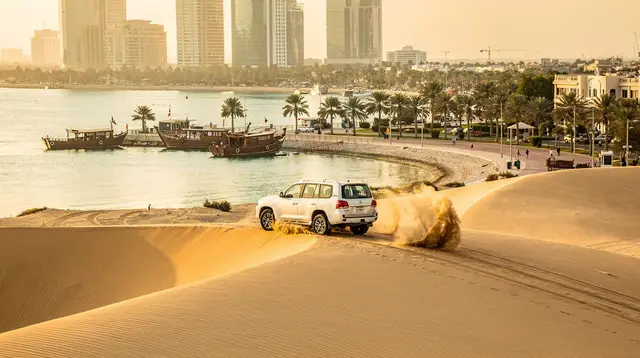
Where the desert meets the sea
Most of Qatar’s coastline is unremarkable flat shore, so the sight that greets visitors at Khor Al Adaid comes as a surprise: a quiet arm of the Persian Gulf pushed inland between walls of pale dunes, some of them tall enough to climb for a view back over the water. Qatari Arabic calls it Khor Al Adaid; English-language guides usually translate that as the Inland Sea, and both names refer to the same tidal inlet sitting on the border with Saudi Arabia, at the southern tip of the southern desert region that also holds Al Wakrah and the dunes of Sealine.
The inlet is part of a protected natural area, and unlike the rest of Qatar’s coast it cannot be reached by any paved road. The final stretch runs entirely across soft sand, over a shifting line of dunes that separates the flat gravel plains around Mesaieed from the water itself. That single fact shapes almost everything about how people actually visit: nobody drives here in an ordinary saloon car, and the trip is built around a guide, a proper 4x4, and a route across the dunes rather than a road with a car park at the end of it.
We are deliberately not printing a number for the inlet’s surface area or its depth here. Figures circulate online for both, but they vary between sources and none of the ones we checked traced back to a citable survey, so rather than repeat an unsourced statistic we simply describe what you will see: a long, branching body of still water, dunes rising directly from its edges in places, and on a clear day the coast of Saudi Arabia visible across the water to the south.
Why it is the most memorable landscape in the country
Doha’s skyline, its museums and its restored souq are all worth a full trip on their own, but they are also the kind of sights a visitor could find, in some form, in half a dozen Gulf cities. Khor Al Adaid is different: nowhere else in Qatar puts open water directly against high dunes, and the drive to get there, bouncing over ridgelines in a convoy of 4x4s, is itself part of what people remember. Guides commonly stop partway across the dunes so passengers can get out, climb a ridge on foot, and look down at the inlet below before the final descent to the shore.
The light matters here more than at almost any other Qatari site. Early morning and the hour before sunset flatten the glare and pick out the ripples on the sand, and most tour operators time the crossing to arrive at the water for one of those two windows. A midday visit in summer is both visually harsher and considerably more dangerous, for reasons covered below.
How people actually get there
There is no public transport option to Khor Al Adaid, no metro line running anywhere near it, and no realistic way to reach it by taxi. The routes to the Doha Metro and tram network simply do not extend this far south, and even Karwa taxis and ride-hailing apps will not take you across the dune crossing itself. In practice, visitors reach the Inland Sea in one of three ways.
The first and by far the most common is a guided desert safari departing from Doha, usually in the morning or early afternoon, which combines dune bashing near Sealine with a run out to the Inland Sea shoreline before returning to the city the same day. Our desert safari guide covers what a typical day looks like, and the dedicated Inland Sea tour guide goes into the route and timing specifically for Khor Al Adaid.
The second option is an overnight stay at a desert camp near the dunes, which lets visitors watch the sunset over the water, spend the night under a genuinely dark sky away from Doha’s light pollution, and see the inlet again at sunrise before the drive back. Our overnight desert camp guide explains what these camps include and how they differ from a day trip.
The third is arranging a private driver and vehicle, which costs more than joining a shared group tour but allows a flexible schedule, a smaller group, and often a longer stop at the water’s edge. None of these options involve renting a car yourself and driving out independently; a two-wheel-drive rental has no chance of crossing the dune line, and even a rented 4x4 without local knowledge of the shifting track is a poor substitute for an experienced desert guide.
Booking a trip
| Style of trip | Typical duration | What is included |
|---|---|---|
| Shared group safari with Inland Sea stop | 6 to 7 hours | Hotel pickup, dune bashing, Inland Sea viewpoint, sandboarding |
| Sunset or overnight desert camp | Afternoon through next morning | Dune drive, camp dinner, stargazing, sunrise at the water |
| Private 4x4 and driver | Half day to full day | Flexible route and pace, smaller group, often more time at the shore |
For a shared safari that stops at the water, an overnight desert safari that includes a night camp near the dunes is the most complete way to see both the sunset and sunrise light over the inlet. Travelers who want the night sky experience without necessarily an early departure can look at a night desert safari built around stargazing and a camel ride, which typically stages from the same dune area.
For a shorter outing that pairs desert time with wildlife and a classic photo, a desert safari combining a camel ride with a falcon photo stop is a popular half-day choice. Riders who prefer a more intimate group can also look at a private horse and camel ride out in the desert as an add-on to a longer day.
What the crossing and the shore are actually like
The drive begins on paved roads heading south from Doha past Al Wakrah and on toward the Sealine dune area near the industrial port of Mesaieed. Vehicles let some air out of their tyres before leaving the gravel plain for the sand, a standard precaution that improves traction on the dunes. What follows is genuine dune bashing: steep drops, sharp crests and stretches where the vehicle leans hard to one side, which is exhilarating for most passengers and uncomfortable for a minority prone to motion sickness.
At the water, the pace slows. Many tours build in time to walk along the shoreline, wade in the shallows, or simply sit and look across toward the Saudi coastline. Camel rides are sometimes offered near the shore as an add-on. Because the site sits inside a protected natural area, operators generally keep to established routes rather than driving directly along the water’s edge, and visitors are expected to take rubbish back out with them.
Practical notes and safety
Dune driving carries real risk if done in the wrong vehicle or without experience, which is precisely why an experienced guide and a proper 4x4 matter here more than at almost any other site in this guide. Rollovers and stuck vehicles are the main hazards, and they happen far more often to inexperienced solo drivers than to guided groups. If you value one safety rule above all others for this destination, it is this: never attempt the dune crossing in a two-wheel-drive rental car, and never attempt it without a driver who does this regularly.
Heat is the second serious risk. Summer temperatures in the southern desert routinely exceed 40 degrees Celsius, and the exposed sand radiates additional heat back at anyone outside a vehicle. Most operators still run tours through summer, but the smart season for this trip is the cooler stretch from November to March, when daytime temperatures are comfortable and evenings by the water are genuinely pleasant rather than punishing. Bring more water than seems necessary, wear closed shoes for walking on hot sand, and expect strong sun even in winter.
Mobile signal is patchy to nonexistent once you are deep among the dunes, another reason not to attempt an independent crossing. Bring sunscreen, sunglasses, a hat, and a light jacket if staying for sunset or overnight, since desert evenings cool down quickly even after a hot day.
Where the Inland Sea fits in a wider Qatar trip
Khor Al Adaid pairs naturally with the rest of the southern desert region. Many day trips combine it with dune bashing and sandboarding closer to Sealine, and some operators add a stop in Al Wakrah to see its restored fishing souq on the way back. Visitors torn between a shorter dune session and the full run to the Inland Sea can compare the two in our Sealine versus Inland Sea safari comparison.
For a full-day plan built specifically around this route, see our desert safari and Inland Sea itinerary, and for travelers deciding how many outdoor days to budget across a longer trip, our three days in Doha and the north coast itinerary shows how a desert day slots in alongside city sightseeing. If your visit is a short layover rather than a full trip, our Doha layover desert safari guide explains realistically how much of this excursion fits into a stopover.
Frequently asked questions about visiting Khor Al Adaid
Can you drive to the Inland Sea yourself in a rental car?
No. The final approach to Khor Al Adaid crosses soft, shifting dunes with no paved road, and a standard two-wheel-drive rental has no realistic chance of making the crossing. Almost all visitors go with a guided desert safari or a private 4x4 driver who knows the current track.
How far is the Inland Sea from Doha?
The drive is roughly one and a half to two hours from central Doha, combining paved roads south past Al Wakrah and Sealine with an off-road dune crossing for the final stretch, so total travel time depends heavily on how much dune driving the tour includes along the way.
Is Khor Al Adaid actually a sea?
Not in the oceanographic sense. It is a tidal inlet of the Persian Gulf that reaches inland among tall dunes near the Saudi Arabian border, which is why it is commonly nicknamed the Inland Sea even though it is connected to the open Gulf.
Do I need to book a tour, or can I join one on the spot?
Book in advance, especially in the cooler months from November to March when demand is highest. Group safaris depart on fixed schedules with hotel pickups, and last-minute space is not guaranteed, particularly for overnight camp options.
Is an overnight stay at the Inland Sea worth it over a day trip?
If your schedule allows it, yes: an overnight camp lets you see both sunset and sunrise light over the water and experience a genuinely dark desert sky, which a same-day return trip cannot offer since most day tours head back to Doha in the afternoon or early evening.
Is the Inland Sea safe to visit?
Qatar has very low crime, and the real risks at Khor Al Adaid are environmental rather than personal safety concerns: dune driving accidents and heat exposure. Both are well managed by choosing an experienced guide, a proper 4x4, and, if possible, avoiding the peak summer months.
What should I pack for a trip to the Inland Sea?
Sunscreen, sunglasses, a hat, closed shoes for hot sand, more water than seems necessary, and a light jacket if staying past sunset or overnight, since desert temperatures drop quickly once the sun goes down.
Can you swim at the Inland Sea?
Some visitors wade or swim in the shallows near the shore, though this is not the main draw of the trip and water conditions vary. Most tours treat it as a scenic and photo stop rather than a swimming excursion, and there are no lifeguards or facilities on site.