Doha's Public Art and Galleries: A Walking Thread Through the City
Where can you see public art in Doha?
Doha's public art is spread across open-air spaces rather than concentrated in one gallery district: sculpture and installations sit along MIA Park, inside Katara Cultural Village, through the rebuilt streets of Msheireb Downtown, and — for anyone willing to drive out to the western desert near Zekreet — in Richard Serra's large-scale steel work East-West/West-East. The two big national museums anchor the whole picture.
Following the thread: how Doha’s public art fits together
Doha doesn’t have a gallery district in the way some cities do — a compact grid of white-cube spaces you can walk between in an afternoon. Instead, its public art is built into the fabric of a handful of purpose-made places: a park beside a museum, the courtyards of a rebuilt downtown, the plazas of a cultural village, and, if you’re willing to drive out into the desert, a pair of steel plates standing alone in the sand. Seeing it well is less about ticking off individual works and more about following a route between these places, letting the two big national museums act as anchors and the open-air spaces as the connective tissue.
This guide sketches that route rather than cataloguing every piece along it. Where a specific artwork or artist isn’t part of the confirmed, checked information for this site, it stays general — better to describe what a space is for than to guess at what’s inside it.
Start at the water: MIA Park and the Corniche
The Museum of Islamic Art sits on its own island just off the Corniche, the 7-kilometre waterfront promenade that curls around Doha Bay. The building itself, designed by I. M. Pei and opened in 2008, is arguably the first piece of public art most visitors encounter in the city — its geometric stone form is meant to be walked around as much as walked into.
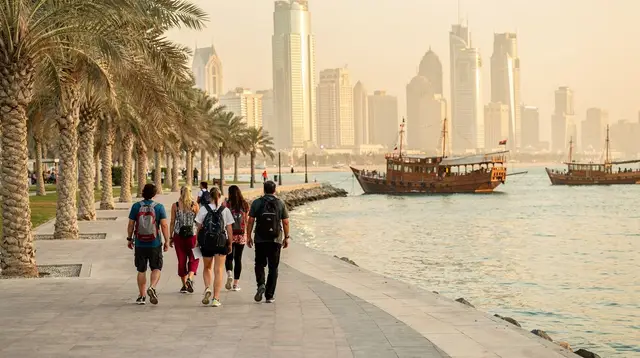
Around it, MIA Park extends along the waterline as green, landscaped public space, with paths, lawns and shaded seating facing back toward the West Bay skyline. It’s the kind of place that rewards an unhurried evening visit: the traditional wooden dhows moored along the Corniche in the foreground, the towers of West Bay behind them, and the museum’s silhouette catching the last light. This combination — historic craft, contemporary skyline, considered architecture — is a useful preview of the contrasts that run through Doha’s public art more broadly.
For visitors who want the collection as well as the setting, a dedicated visit guide to the Museum of Islamic Art covers hours, tickets and what’s inside. The building and the park around it are free to walk at any time; only the galleries require a ticket.
a full-day museum tour that pairs the Museum of Islamic Art with the National Museum of Qatar is the simplest way to see both anchor institutions without working out logistics yourself, and it leaves the outdoor spaces around each one for you to explore at your own pace afterward.
The desert rose: National Museum of Qatar
A short distance along the Corniche, the National Museum of Qatar takes a different approach to the same idea — architecture as the primary artwork. Designed by Jean Nouvel and opened in 2019, its interlocking disc form is modelled on the desert rose mineral formation, built around the preserved old palace of Sheikh Abdullah bin Jassim. Walking its perimeter, especially from across the water, gives a sense of how much Doha’s newer landmarks treat the building envelope itself as sculpture rather than as a neutral container for a collection.
The museum’s public plazas and approach paths are worth building time into, separate from the ticketed galleries inside. A full visit guide to the National Museum of Qatar has the practical detail on entry and layout.
a guided cultural tour focused on Doha’s Islamic heritage and architecture is a good option if you’d rather have context supplied as you go, particularly around the older palace structure the newer building wraps around.
Msheireb Downtown: art built into a rebuilt city
Where MIA Park and the National Museum sit on the waterfront, Msheireb Downtown takes the idea inland. This is Doha’s rebuilt heritage quarter — streets and public squares reconstructed on the footprint of the old commercial centre — and it was designed from the outset with public art and open plazas woven between its buildings, rather than added afterward. Shaded walkways, courtyards and small squares connect its four Msheireb Museums, and the district rewards slow walking more than almost anywhere else in the city centre: it’s compact, largely pedestrianised, and served by its own free tram loop.
The Msheireb Museums guide covers the four house-museums that anchor the district, each set in a restored historic building. Between them, the public spaces function as an open-air extension of the same story — a deliberately walkable, art-considered piece of urban design rather than a conventional downtown grid.
A neighbourhood-by-neighbourhood guide to Doha is useful if you’re trying to work out how Msheireb, West Bay and the Corniche fit together on a map before setting out.
Katara Cultural Village: performance space as art space
West along the coast, Katara Cultural Village takes a broader view of what an arts precinct can be. Built as a dedicated cultural district, it combines exhibition spaces, an amphitheatre, mosques and a public beach, with sculpture and installations placed through its plazas rather than confined to a single building. It functions less like a museum campus and more like a neighbourhood organised entirely around cultural programming — worth an evening visit when the light softens and the plazas fill up.
A detailed evening guide to Katara has the practical layout and timing. Combined with a stop at The Pearl-Qatar next door, it makes a natural half-day loop along the northern waterfront — an itinerary covered in the West Bay and Katara one-day plan.
a walking tour through Katara’s hills park with hotel transfers included covers the district on foot without needing to work out your own way there and back, which matters more here than in the compact city centre since Katara sits some distance from West Bay and the Corniche.
For a shorter, closer walk that covers some of the same idea, a guided walk through Al Bidda Park and along the Corniche links green public space to the waterfront promenade without leaving central Doha, and pairs naturally with the MIA Park stop earlier in this route. a guided walking tour of Al Bidda Park and the Corniche is built specifically around that stretch of shoreline.
Newer edges: Lusail and the 3-2-1 Museum in Al Rayyan
Two further stops extend the same idea of architecture-as-art beyond the older core of the city, though neither is a traditional stop on a public-art trail and both are better thought of as extensions for visitors with extra time.
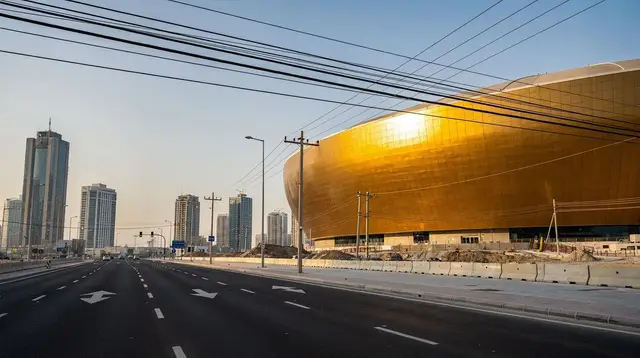
North of the centre, Lusail is Doha’s newest built district, planned from empty desert into a full city with its own marina, waterfront promenade and the retail plazas of Place Vendôme. Lusail Stadium, which hosted the 2022 World Cup final, anchors the skyline from a distance rather than inviting close public access the way MIA Park or Msheireb do, but the marina and its surrounding walkways carry the same purpose-built, considered-from-scratch feel as Msheireb Downtown — just on a larger, more recent scale.
The Lusail city tour guide and the Lusail Marina and Place Vendôme guide cover the practical layout for visitors who want to add it to a longer stay.
West of the centre, in Al Rayyan, the Aspire Zone and Education City sit alongside the 3-2-1 Qatar Olympic and Sports Museum — a purpose-built museum whose building, like the two national museums on the Corniche, is conceived as part of the exhibit rather than a neutral shell around it. It sits apart from the walking route described above, geographically and thematically, but for visitors already tracing Doha’s newer landmark architecture it’s a natural addition. The 3-2-1 Qatar Olympic and Sports Museum guide and the Education City and Aspire Zone guide cover both in more detail.
Out to the desert: Richard Serra’s East-West/West-East
The thread through Doha’s public art eventually leaves the city altogether. In the Brouq Nature Reserve near Zekreet, roughly 80 to 90 kilometres west of Doha, four steel plates by the American sculptor Richard Serra stand across the open desert as the installation East-West/West-East. Unlike the works inside MIA Park or Msheireb, this one has no plaza, no signage in the conventional sense, and no crowd — just scale, distance and the flat gypsum plain around it, which is largely the point.
It sits close to the abandoned “Film City” set and the wind-carved mushroom rock formations that most visitors combine it with on the same trip, since the final stretch of track needs a 4x4. The Zekreet Film City and mushroom rocks guide covers the film set and rock formations, while the dedicated guide to the East-West/West-East sculpture focuses on the installation itself and how tours reach it. For planning a full day out west, the west Qatar one-day itinerary lays out a workable route.
It’s a genuinely different register from the rest of this list — no café, no shade, no other visitors most of the time — and it’s worth going into with that expectation rather than treating it as an extension of the city museums.
Building your own route
None of these places require each other to make sense, but they read better in sequence than at random. A workable order, from easiest to most involved:
| Stop | Type of space | Ticket needed | Approx. time from central Doha |
|---|---|---|---|
| MIA Park & Corniche | Open-air waterfront | No (park); yes (museum interior) | Central |
| National Museum of Qatar plazas | Open-air museum grounds | No (grounds); yes (galleries) | Central |
| Msheireb Downtown | Rebuilt urban district | No (streets); yes (museums) | Central |
| Katara Cultural Village | Cultural precinct | No (plazas); varies (exhibitions) | 15–20 min |
| East-West/West-East, Zekreet | Desert installation | No | 80–90 km, needs a vehicle |
For visitors with limited time, the first three rows form a realistic half-day on foot or by tram, all reachable without a car. Katara adds an easy extension by taxi. The desert sculpture is its own trip and shouldn’t be squeezed in as an afterthought to a city day.
a heritage-focused tour that links the Corniche, Msheireb and the older parts of the city is a practical way to cover the central stops in one guided outing if you’d rather not plan the walking route yourself, and a broader city tour that takes in West Bay, the Corniche and the newer districts gives useful context for how the newer architecture, including the museum buildings, fits against the rest of the skyline.
A note on what this guide doesn’t claim
Doha’s public art scene is still expanding, and individual works move, rotate or get added to the city’s parks and plazas over time. Rather than list specific pieces or attribute particular works to particular artists beyond what’s firmly documented — the Museum of Islamic Art (I. M. Pei), the National Museum of Qatar (Jean Nouvel), and East-West/West-East (Richard Serra) — this guide has stayed general about the smaller installations along the way. If a specific work matters to your visit, the museums themselves and their current exhibition information are the reliable source, not a static guide page.
Public art and galleries in Doha, further questions
Is there a single art district in Doha?
Not really. Public art is scattered across several purpose-built areas — MIA Park, Katara, Msheireb and Lusail among them — rather than gathered into one gallery quarter, so seeing a good cross-section means moving between neighbourhoods rather than staying in one.
Do I need tickets to see the outdoor art?
No. Outdoor sculpture and public installations in places like MIA Park, the Corniche and Msheireb are free and open at all hours. Tickets are only needed for the indoor museum collections, such as the Museum of Islamic Art and the National Museum of Qatar.
How do I get to the Richard Serra sculpture near Zekreet?
East-West/West-East stands in the Brouq Nature Reserve in western Qatar, near Zekreet, roughly 80 to 90 kilometres from Doha. It’s a self-drive or tour destination rather than a city stop, usually combined with the nearby Film City set and the mushroom-shaped rock formations on a west-Qatar day trip.
Is Katara a gallery or a neighbourhood?
Katara Cultural Village is a neighbourhood built around cultural life — it includes exhibition spaces and public sculpture alongside its amphitheatre, mosques and beach, so it functions more like an arts precinct than a single gallery.
Should I visit the museums as well as the outdoor art?
Yes — the outdoor pieces make more sense once you’ve seen the indoor collections. The Museum of Islamic Art and the National Museum of Qatar are the two anchor institutions in the city and are worth building a plan around.
What’s the best time of day to see outdoor art in Doha?
Late afternoon into evening, once the heat has eased, especially for the Corniche and MIA Park. For most of the year the middle of the day is uncomfortable for walking outdoors, and in summer it can be genuinely risky.
Is the art trail suitable for a short stopover?
A short version is: MIA Park and the museum exterior on the Corniche, then a stop in Msheireb Downtown. Both sit close to central Doha and can be covered in half a day without needing a car.
Museums and Culture in Doha
Verified deep-linked GetYourGuide tours. Book through these links and we earn a small commission at no cost to you.
GetYourGuide does not provide a product photo for this activity — the image shows the meeting point, photographed by us.