Doha's Souqs Beyond Souq Waqif: Where to Go Next
Is there a souq in Doha worth visiting after Souq Waqif?
Yes, the restored souq in Al Wakrah, about 15 to 20 km south of central Doha, is the clearest second option. It has the same restored-heritage style as Souq Waqif but on a much smaller, quieter scale, and it sits next to a working fishing harbour and a public beach rather than a dense entertainment district.
Souq Waqif Is Not the Only Souq in Qatar
Most first-time visitors to Doha spend an evening wandering Souq Waqif, and for good reason: it is the country’s best-known restored market, home to the Falcon Souq, a dense run of restaurants, and the kind of lantern-lit alleys that photograph well after dark. If you have already done that, though, the question that naturally follows is whether there is anywhere else in Qatar with a similar feel, and whether it is worth the trip.
The honest answer is that Qatar does not have a second Souq Waqif. What it has is Al Wakrah, a fishing town roughly 15 to 20 km south of central Doha with its own restored souq, built on the same idea of preserving a historic market footprint, but at a much smaller scale and with a very different setting. This guide is about that souq, what it is realistically like compared with Souq Waqif, and how to decide whether it belongs on your trip.
We are deliberately not padding this out with a long list of named local markets, stalls or fixed opening hours across Doha. Those details change often, are not consistently documented, and a wrong hour or a market that has since closed is worse than no information at all. What follows sticks to what is actually confirmed about Al Wakrah and about how souq life works more broadly in Qatar.
Correcting an Assumption: Not Every Souq Sells the Same Things
It is easy to assume that any building or alley in Qatar labelled a souq will sell a similar mix of spices, textiles, falcons and souvenirs, because that is what Souq Waqif has trained visitors to expect. That is not a safe assumption to carry to Al Wakrah, or to any other market in the country.
Souq Waqif’s identity is built around a specific combination: the Falcon Souq and its attached falcon hospital, a concentration of spice and textile stalls, a dense strip of restaurants and cafes, and an evening atmosphere aimed squarely at both residents and tourists in the heart of Doha. That combination exists because of decades of investment in that one site as a heritage and entertainment district.
Al Wakrah’s souq was restored on the same general principle, rebuilding a market on its historic footprint, but it is a much smaller structure serving a much smaller town, and its surroundings are a working harbour and a public beach rather than a dense central entertainment zone. Expecting an equivalent falcon souq, an equivalent restaurant strip or an equivalent evening crowd there sets you up for disappointment. Go for what Al Wakrah actually offers, not for a smaller copy of Souq Waqif.
Al Wakrah’s Souq: What It Actually Is
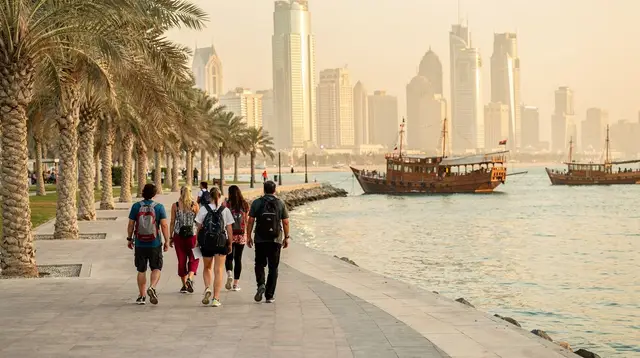
Al Wakrah itself is one of Qatar’s older coastal towns, historically built on fishing and pearling, sitting on the coast south of Doha. Its restored souq sits close to the town’s harbour, where traditional dhows still moor, and near a public beach corniche. The architecture follows the same restored-heritage style used at Souq Waqif: low buildings, wind-tower details and covered walkways, but on a noticeably smaller and quieter footprint.
Because it is smaller, a visit to Al Wakrah’s souq is realistically a shorter stop than an evening at Souq Waqif. Most visitors treat it as one stop on a broader outing rather than as a destination that fills an entire evening on its own. The appeal is less about the density of shops and more about the setting: harbour views, moored dhows, a working fishing town feel, and a beach corniche close enough to combine with the souq in the same visit.
We are not listing specific shop names, exact opening hours or a stall-by-stall breakdown here, because that level of detail for Al Wakrah was not confirmed in the research behind this page, and market hours in Qatar are known to shift, including around Friday prayers and during Ramadan. Confirm current hours locally or with a guide before planning your visit around a specific time of day.
Souq Waqif vs Al Wakrah Souq: A Straight Comparison
| Souq Waqif | Al Wakrah souq | |
|---|---|---|
| Location | Central Doha, on the Corniche | Al Wakrah, roughly 15-20 km south of Doha |
| Scale | Large, dense network of alleys | Small, compact |
| Signature feature | Falcon Souq and falcon hospital | Harbour and dhow-mooring setting |
| Surroundings | Dense restaurant and cafe strip | Working fishing harbour, public beach |
| Best for | A full evening out, first-time visitors | A shorter stop, quieter atmosphere |
| Getting there | Doha Metro accessible area, walkable centre | Not on the metro; taxi, ride-hail or car |
| Typical visit length | Two to three hours or more | Under an hour, often combined with the beach |
The comparison is less about one souq being “better” than the other and more about what each one is for. If you want the full evening market experience, with a falcon souq and a wide choice of places to eat, Souq Waqif is still the answer, and it is worth a guided walking tour of Souq Waqif if you have not already done the souq’s food and karak walk. If what you actually want is a quieter, shorter look at a smaller-scale version of the same restoration idea, in a working-harbour setting, Al Wakrah is the more honest fit.
Doha’s Everyday Local Markets: What We Can and Can’t Tell You
Beyond the two restored heritage souqs, Doha does have ordinary local markets and shopping streets that serve residents rather than tourists, spread across the city’s neighbourhoods. We are choosing not to name specific ones, list their addresses or state their hours here, because that level of detail was not confirmed as part of the research behind this page and would be guesswork dressed up as fact. Markets like these open and close, move, and change character over time in ways that a static guide page cannot track reliably.
If a local, everyday market experience genuinely interests you beyond the two heritage souqs, the more reliable approach is to ask at your hotel or with a local guide once you are in Doha, rather than relying on a name printed months or years in advance. For planning purposes on this site, treat Souq Waqif and Al Wakrah’s souq as the two confirmed heritage-market options, and build any additional local-market exploration around advice you get on the ground.
How to Fit Al Wakrah Into a Doha Trip
Al Wakrah sits south of central Doha on the road toward Mesaieed and the desert areas around Sealine, which makes it a natural stop rather than a dedicated round trip for most visitors. A common approach is to combine a stop at the souq and harbour with time on Al Wakrah’s public beach, then continue south if a desert excursion is already on the itinerary, or head back into Doha afterwards.
Because Al Wakrah is not served by the Doha Metro, you will need a taxi, a ride-hailing app or a car to get there and back. Given the modest distance and the relatively short time most visitors spend at the souq itself, it works well as a half-day outing rather than a full day, and it pairs comfortably with other stops in Doha’s wider neighbourhoods, such as a look at Msheireb Downtown earlier or later the same day.
If you would rather not organise the transport and route yourself, a guided option that covers several of Doha’s souqs in one outing removes that planning step.
a single guided day that links Doha’s best-known souqs together with meals and transfers includedFor travellers who want the harbour town experience with a family-friendly stop attached, Al Wakrah is also the base for a small mini zoo, reachable on the same trip south from Doha.
a return transfer from Doha to Al Wakrah’s mini zooIf You Want More Than a Souq Comparison
Some visitors reach this page not because they want a second souq specifically, but because they have already done the obvious Doha highlights and want something a little further off the main circuit. If that describes you, it is worth widening the frame beyond markets altogether. A private route that mixes The Pearl-Qatar, Katara and some of the city’s quieter luxury shopping alleys gives a different texture from either souq.
a private route through Doha’s quieter souq alleys, Katara and Gewan IslandAnd if your priority is efficient sightseeing rather than markets at all, a half-day city tour with lunch included is a straightforward way to cover West Bay, the Corniche and central Doha before deciding whether a souq detour is worth your remaining time.
a half-day city tour with a buffet lunch stop built inPractical Notes Before You Go
A few points carry over from Souq Waqif and apply just as much at Al Wakrah and anywhere else in Qatar. Modest dress is expected in public places generally, and this applies to souq visits the same as it does to malls and museums. Souq life in Qatar tends to build through the late afternoon and evening and to quiet down in the heat of the day, and hours shift further during Ramadan and around Friday prayers, so it is worth confirming current timing rather than assuming a fixed schedule. None of these are unique to Al Wakrah, but they are easy to forget once you assume a second souq will behave exactly like the first one you visited.
If you are weighing up Al Wakrah against spending that same half-day elsewhere, it can help to look at how the rest of Doha’s neighbourhoods fit together, or to check what a well-paced one-day Doha highlights route already includes before adding a southern detour on top of it. And if food is as much a draw for you as the market itself, comparing what is realistically on offer in each area, alongside a broader look at what to eat in the country, will do more for your planning than a souq-to-souq comparison alone.
Frequently Asked Questions About Doha’s Souqs Beyond Souq Waqif
Is Al Wakrah souq the same as Souq Waqif?
No. Both were restored traditional markets rebuilt on old footprints, but Al Wakrah’s souq is far smaller and quieter, built around a historic harbour and fishing town rather than Doha’s central entertainment district.
Does Al Wakrah souq sell the same things as Souq Waqif?
Not in the same mix. Souq Waqif is built around its Falcon Souq, spices, textiles and a dense concentration of restaurants and cafes. Al Wakrah’s souq is smaller and leans on its waterfront setting and harbour views rather than a comparable retail density.
How far is Al Wakrah from central Doha?
Roughly 15 to 20 km, generally a short drive south of the city centre. It does not sit on the Doha Metro network, so a taxi, ride-hailing app or car is the practical way to reach it.
Are there other traditional markets in Doha itself, away from Souq Waqif?
Doha has everyday local markets and shopping streets serving residents rather than visitors, but this guide does not list specific names, stalls or opening hours for them, since those details were not confirmed in our research and change often.
When is the best time of day to visit Al Wakrah souq?
As with Souq Waqif, souq life in Qatar generally builds through the late afternoon and evening, and slows in the heat of the middle of the day. Confirm current opening times before you go, since they are not fixed year-round.
Can I combine Al Wakrah with other places in one outing?
Yes. Al Wakrah sits on the way south toward Mesaieed and Sealine, so it works well as a stop on a half-day that also takes in the coast, or paired with a broader look at Doha’s souqs on a guided tour.
Is Al Wakrah souq walkable, or do I need transport to get around once there?
The souq area itself is walkable on foot, similar in scale and layout to a small restored old town. You will need a taxi, ride-hailing app or car to get there from Doha and back, since it is not served by the metro.
Souq Waqif and Doha's Markets
Verified deep-linked GetYourGuide tours. Book through these links and we earn a small commission at no cost to you.
GetYourGuide does not provide a product photo for this activity — the image shows the meeting point, photographed by us.