Al Wakrah Souq and Beach: A Quieter Side of Qatar
Is Al Wakrah part of Doha, and is its souq an original old market?
No to both. Al Wakrah is a separate town roughly 15 to 20 kilometres south of central Doha, with its own municipality and its own waterfront. Its souq is a restoration of a historic pearling and fishing market, rebuilt in the 2000s rather than an intact original, and it draws a fraction of the crowds of Souq Waqif.
A fishing town, not a Doha neighbourhood
Al Wakrah gets filed, wrongly, as one more corner of greater Doha. It isn’t. It is its own town, with its own municipality, sitting on the Gulf coast roughly 15 to 20 kilometres south of central Doha — closer to Al Wakrah as a place in its own right than to any Doha district. Long before Doha grew into the skyline visible from West Bay, Al Wakrah was already a working pearling and fishing settlement, and fishing boats still put out from its harbour today. Treating it as a suburb misses the point of visiting: the appeal here is precisely that it is a separate, smaller, slower place.
For visitors staying in central Doha, that separateness is also the practical draw. Al Wakrah offers a restored souq, a waterfront promenade and a public beach, all on a scale that never feels crowded, and all reachable as a half-day trip that pairs naturally with an evening back in the city or a morning heading further south toward the desert.
The souq: restored, not ancient
The single most common misconception about the Al Wakrah souq — and about Souq Waqif in central Doha, for that matter — is that visitors are walking through an untouched historic market. Neither is. Al Wakrah’s souq sits on the footprint of a genuine 19th- and early 20th-century pearling and trading market, but the buildings standing today, with their coral-stone-style walls, wind towers and wooden lintels, were reconstructed in the 2000s as part of Qatar’s wider programme of heritage restoration. The layout and materials gesture toward the original town; the fabric of the buildings is largely new.
That distinction matters for expectations rather than for enjoyment. A restored souq can still be a genuinely pleasant place to wander, and Al Wakrah’s version has an advantage over its more famous Doha counterpart: far fewer visitors. Where Souq Waqif fills with tour groups, shisha cafes and a dense run of shops from late afternoon onward, Al Wakrah’s souq stays low-key even at its busiest hour. Expect a modest run of alleys, a handful of cafes, some clothing and household shops aimed as much at local residents as at tourists, and none of the falcon-souq spectacle that defines its Doha equivalent.
As with Souq Waqif, the souq comes alive later in the day. Many stalls stay shuttered through the hottest hours and open from the late afternoon into the evening, so a visit timed for sunset or after gets the most out of it. Midday visits in summer, when temperatures routinely pass 40°C, are best avoided altogether.
The waterfront and the harbour
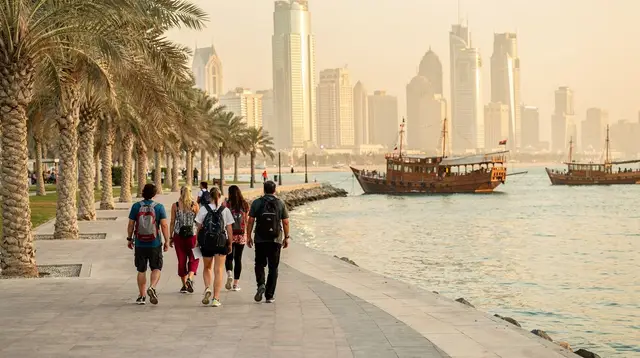
Al Wakrah’s corniche is a smaller, plainer cousin of Doha’s famous waterfront, and that is its charm. A paved promenade runs along the shore near the souq, with views out over a working harbour where wooden fishing boats — not the tourist dhows of the Doha Corniche, but boats still used for actual fishing — come and go. There is a modest fish market nearby that operates on local hours rather than tourist ones, worth a look for anyone interested in seeing an economic activity that predates Qatar’s oil and gas wealth by more than a century.
This is not the place for the sunset dhow cruises and restaurant strip that define the Doha waterfront; there is no equivalent evening promenade of the scale found near Katara or The Pearl. What Al Wakrah offers instead is a much quieter version of the same coastal-town atmosphere, useful for anyone who has already spent an evening on the Doha Corniche and wants a contrast rather than a repeat.
The beach
Al Wakrah’s public beach sits along the same stretch of coast, a shallow, calm strip of sand and water suited to wading, a short swim and sitting out the late afternoon rather than a resort beach day. There are no major beach clubs or water-sports operators based here in the way there are around central Doha or Sealine; it functions as a local, low-facility beach rather than a curated tourist attraction. Basic modesty norms apply, as they do at any public beach in Qatar — swimwear belongs at the beach and pool, and a cover-up is sensible once away from the sand itself.
Combined with the souq and the waterfront, the beach rounds out Al Wakrah into a workable half-day outing: souq in the late afternoon, a walk along the corniche, a short stop at the beach, and dinner back in Doha or at one of the simple local cafes near the souq.
How Al Wakrah compares to Souq Waqif
| Al Wakrah souq | Souq Waqif (Doha) | |
|---|---|---|
| Distance from central Doha | ~15–20 km south | Central |
| Crowds | Light, mostly local | Heavy, tourist-dense |
| Scale | Small, a handful of alleys | Large, sprawling |
| Falcon souq | No | Yes |
| Restaurant density | Low, a few cafes | High, dozens of options |
| Access by metro | No | Yes, nearby stations |
| Best for | A quiet, easy contrast | A full evening out |
Neither is more “authentic” than the other in the sense of being untouched — both are restorations. The real difference is atmosphere: one is built for volume, the other is not.
Getting to Al Wakrah
The Doha Metro’s lines do not extend to Al Wakrah, so the practical options are a taxi, a ride-hailing app such as Uber or Careem, or a rental car. All three are straightforward: Qatar’s roads are well maintained, traffic drives on the right, and the route south from Doha runs largely along the coastal highway. The drive takes roughly 20 to 30 minutes from central Doha depending on traffic and starting point, similar to or slightly longer than the drive to Hamad International Airport on the opposite side of the city.
Because there is no public transport link, Al Wakrah is not a walk-in stop the way souqs closer to a metro station can be; it needs a deliberate decision to drive or book a ride. A private guided visit removes that friction, and pairing Al Wakrah with a wider souqs tour or a Doha city itinerary is a common way to see it without arranging transport independently.
When to go
The same seasonal logic that applies across Qatar applies here. The cooler months, roughly November through March, make an outdoor walk along the corniche and a stroll through the souq genuinely pleasant, day or evening. From May to September, the heat and humidity make midday visits uncomfortable and mildly risky; plan for the late afternoon or evening instead, when the souq is opening up anyway. During Ramadan — which shifts roughly 11 days earlier each year on the lunar calendar — expect quieter daytime hours and a livelier atmosphere after sunset, in keeping with the rest of the country.
Combining Al Wakrah with other plans
Al Wakrah’s position south of Doha, on the route toward Sealine and the port of Mesaieed, makes it a natural stop rather than a dedicated round trip. Travellers heading out for a desert safari can build in a short detour to the souq and waterfront on the way down or back, and several operators cover both Al Wakrah and the desert on a single day. For a private full-day route, a guide can plan a stop here alongside a longer desert programme:
a full-day desert safari with lunch or dinnerFor visitors who prefer to see Al Wakrah as part of a broader souqs comparison rather than a solo trip, a guided tour that covers several of Qatar’s markets in one outing puts the restored Al Wakrah souq side by side with Souq Waqif and others, with transfers and meals handled:
a guided tour covering all of Doha’s famous souqs, with meals and transfers includedFamilies travelling with children sometimes add a stop at Al Wakrah’s small mini zoo as part of the same outing, a low-key add-on that works well alongside the souq and waterfront:
an Al Wakrah mini zoo visit with transfer from DohaAnyone who would rather see Al Wakrah folded into a broader city sightseeing day, with a driver and a proper lunch stop, can instead build the day around a wider Doha city tour and treat Al Wakrah as an early or late addition on the same route:
a Doha city tour that includes a buffet lunch stopPractical notes
A few points worth keeping in mind before heading south:
- No metro access. Budget for a taxi, ride-hailing fare or rental car both ways; there is no train or tram option.
- Cash is not essential. Cards are accepted at most cafes and shops in the souq, in line with the rest of Qatar, though small vendors may prefer cash.
- Dress expectations are the same as central Doha. Shoulders and knees covered in the souq area; swimwear stays at the beach.
- Facilities are basic. Do not expect the density of restrooms, cafes or shaded seating found in central Doha’s tourist areas; plan a short visit rather than a full day unless combining it with the desert route further south.
- Fishing harbour activity is unpredictable. Boats come and go on their own schedule; there is no fixed viewing time, but early morning and late afternoon tend to be busiest.
Where Al Wakrah fits in a wider Qatar trip
For a first visit to Qatar, Al Wakrah is not usually a headline stop — that role belongs to central Doha’s museums, Souq Waqif and the Corniche. It earns its place on a second look: for visitors staying more than a couple of days, for anyone who wants a genuine contrast to the density of central Doha, or for those already routing south toward the Inland Sea and the dunes. Seen that way, a stop in Al Wakrah costs little extra time and adds a side of Qatar that the capital’s showcase districts, by design, do not show.
Al Wakrah: frequently asked questions
Is Al Wakrah part of Doha?
No. Al Wakrah is a separate coastal town with its own municipality, roughly 15 to 20 kilometres south of central Doha. It has always been a distinct fishing and pearling settlement, older in some respects than modern Doha’s built-up core.
Is Souq Waqif Al Wakrah an old, untouched market?
No. Like Souq Waqif in central Doha, the Al Wakrah souq is a restoration built on the footprint of an older pearling and fishing market. The stonework, wind towers and wooden beams you see today were rebuilt in the 2000s, not preserved unchanged since the 19th century.
How do I get from Doha to Al Wakrah?
The Doha Metro does not reach Al Wakrah, so a taxi, ride-hailing app such as Uber or Careem, or a rental car is the practical option. The drive takes roughly 20 to 30 minutes from central Doha depending on traffic, mostly along the coastal highway.
Is Al Wakrah beach good for swimming?
It is a calm, shallow stretch of coastline suited to wading and relaxing rather than a resort-style swimming beach. There are no major beach clubs here; it works best as a quiet stop rather than a full beach day, and modest swimwear etiquette applies as it does elsewhere in Qatar.
When is the best time to visit Al Wakrah souq?
Late afternoon into the evening, as with Souq Waqif in Doha. Many stalls open later in the day and the waterfront is at its most pleasant once the heat has eased, particularly from November to March.
Can I combine Al Wakrah with other places in one day?
Yes. Al Wakrah sits on the road toward Sealine and Mesaieed, so it works well as a stop on the way to or from a desert safari, or as a standalone half-day trip paired with an evening back in central Doha.
Is Al Wakrah worth visiting if I’ve already seen Souq Waqif?
Yes, precisely because it offers a contrast: a smaller, quieter souq, a genuine working fishing harbour, and a waterfront without the density of restaurants and shisha cafes that fill the Corniche and Souq Waqif areas.
Souq Waqif and Doha's Markets
Verified deep-linked GetYourGuide tours. Book through these links and we earn a small commission at no cost to you.
GetYourGuide does not provide a product photo for this activity — the image shows the meeting point, photographed by us.