Doha for Wheelchair Users and Limited Mobility
Is Doha accessible for wheelchair users?
Doha's newest infrastructure - the Metro, the trams, the flagship museums and the Corniche promenade - was built after 2010 with lifts, ramps and step-free routes as standard. Older areas such as Souq Waqif, desert excursions and dhow boarding are much harder or impossible in a standard wheelchair, so every activity needs a direct check with the operator before booking.
What Doha actually gets right for reduced mobility
Doha is a young capital by the standards of most world cities, and that matters for accessibility. Much of what visitors see - the Doha Metro, the Museum of Islamic Art, the National Museum of Qatar, Msheireb Downtown and the Corniche promenade - was built or rebuilt from around 2008 onward, well after step-free access became a standard design requirement rather than an afterthought.
That gives Doha a genuinely strong core for wheelchair users and anyone with limited mobility, concentrated in West Bay, along the Corniche, in Msheireb and out at Lusail and The Pearl.
The flip side is that Doha is not a single, uniformly accessible destination. Older commercial areas, the traditional souqs, boat boarding, and above all the desert excursions that fill most visitors’ itineraries were never designed with wheelchairs in mind, and in some cases cannot realistically be adapted. This guide sets out what tends to work, what tends not to, and - the point that matters most - what you need to verify directly with each venue or tour operator rather than take on faith from any single source, including this one.
Nothing here should be read as a guarantee. Lifts break down, renovation work moves around a museum floor, and a boat operator’s boarding ramp on one visit may not be there the next. Treat every claim below as “generally true as of the last check” and confirm it yourself before you rely on it for a trip.
Getting into and around Doha
Hamad International Airport is a modern, single-terminal airport with lifts, wide corridors and accessible restrooms throughout, and airlines and the airport’s own ground-handling teams can arrange wheelchair assistance from the gate to arrivals - this should be booked with your airline in advance rather than requested on arrival.
From the airport, a private transfer in an ordinary car is the simplest way into the city for most travellers, but a standard sedan or minivan is not wheelchair-accessible on its own; if you need a vehicle with a ramp or the space for a non-folding wheelchair, say so explicitly when booking rather than assuming a “private transfer” listing includes it. The general route from the airport into the centre is covered in our guide to getting from Hamad Airport to the city centre.
Inside the city, the Doha Metro is the single most useful piece of accessible infrastructure in the country. All three lines - Red, Green and Gold - opened from 2019 with lifts at every station and level boarding onto the trains, and each train has a marked wheelchair space, usually in the family or Gold Club carriage depending on the line. In practice this means a wheelchair user can move between West Bay, Msheireb, Souq Waqif, Lusail and Al Rayyan without needing a car at all.
The caveat is ordinary and worth repeating: lifts are mechanical, they occasionally go out of service for maintenance, and a station that is fully accessible on one day may have a lift down on another. Our Doha Metro and tram guide covers the network in detail, and it is worth checking Qatar Rail’s own service updates or asking staff on the day if a specific lift matters to your route.
Doha’s newer trams - the free Msheireb loop and the Lusail tram - run on flat, purpose-built tracks with low-floor vehicles and are generally straightforward to board. Taxis and ride-hailing apps such as Uber and Careem are the default way to reach places the metro does not serve, but the vehicles that show up are ordinary sedans: they are not fitted with ramps and will not take a wheelchair that cannot be folded and stowed in a boot.
If you need a wheelchair-accessible vehicle, this has to be requested specifically in advance; do not assume one will be available on demand, and build in extra time. See taxis and ride-hailing in Doha for how this normally works. Renting a self-drive car is an option for some travellers and is covered in our guide to renting a car in Qatar, though adapted rental vehicles are not standard stock and would need to be arranged with a specialist agency well ahead of the trip.
The Corniche, West Bay and the newer districts
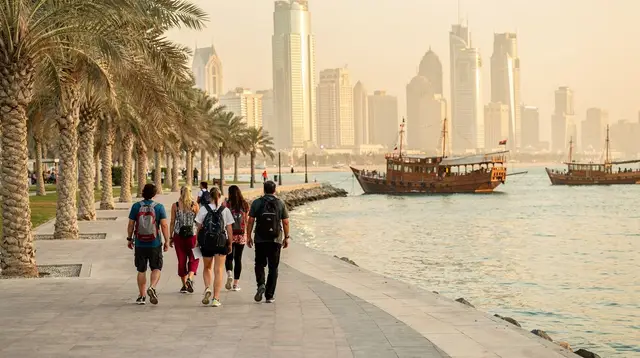
The Corniche is a 7 km waterfront promenade that runs the length of Doha Bay, and as a piece of public infrastructure it is one of the more comfortable places in the city for a wheelchair or a mobility scooter: wide, flat, paved, and largely free of steps along its main length, with views back onto the West Bay skyline and the dhows moored along the water. It is a genuinely pleasant place to spend an evening regardless of mobility, and several dhow cruise operators depart from jetties along it - though, as covered below, boarding the boat itself is a separate question from reaching the jetty.
The newer districts built around the Corniche and further out generally continue this pattern. West Bay’s towers, malls and hotel lobbies are modern commercial buildings with lifts and ramps as a matter of course. Msheireb Downtown, rebuilt as a heritage-inspired but entirely new district, was designed with wide, shaded, largely level streets and houses the four Msheireb Museums, which - being purpose-built cultural buildings from the 2010s - are step-free between galleries.
Katara Cultural Village, The Pearl-Qatar and Lusail, including its Marina and Place Vendôme, are similarly modern developments with paved walkways, though Katara’s beach area and some of the older-style architectural details in its amphitheatre precinct have uneven surfaces that are worth checking case by case. None of this amounts to a certified accessibility standard - Qatar does not publish one universal rating that covers every site - so where a specific feature matters to you, the reliable move is to check that venue’s own accessibility information or call ahead, not to extrapolate from a neighbouring building.
a private guided city tour straight from the airport can be a practical option for a traveller who wants to see West Bay, the Corniche and Msheireb without managing public transport connections on the day of arrival - confirm the vehicle type and any assistance you need directly with the operator when booking.
The flagship museums
The Museum of Islamic Art, designed by I. M. Pei and sitting on its own island off the Corniche with the surrounding MIA Park, and the National Museum of Qatar, designed by Jean Nouvel around the old palace of Sheikh Abdullah bin Jassim and built in the shape of a desert rose, are Doha’s two headline cultural attractions, and both are recent, purpose-built museum buildings run by Qatar Museums.
Both have step-free entrances, lifts connecting their floor levels, and accessible restrooms, and both are generally visitable by wheelchair users without special arrangement. Our Museum of Islamic Art visit guide and National Museum of Qatar visit guide cover ticketing, opening days and what to expect inside.
That said, “generally accessible” is not the same as “accessible in every gallery on every day.” Museums periodically close sections for reinstallation, temporary exhibitions sometimes use different circulation routes than the permanent collection, and the desert-rose geometry of the National Museum in particular creates some sloped and curved surfaces that are worth asking about if you use a wheelchair with limited manoeuvrability.
If a specific gallery or feature matters to your visit, contact Qatar Museums or the museum directly before you go rather than relying on a general description. The same applies to the Msheireb Museums, which occupy four restored historic houses reworked as modern museum spaces - each building is a little different, and it is worth checking which of the four best suits your needs.
Booking ahead also smooths the day regardless of mobility: our guide to buying Doha attraction tickets covers how reservations work for the main museums and sights.
Souq Waqif and the older commercial areas
Souq Waqif is where accessibility gets genuinely mixed, and it is worth being direct about that rather than papering over it. The souq was rebuilt in the 2000s on the footprint of the old market, so its main thoroughfares are wider and better paved than a historic bazaar would be, and a wheelchair user can navigate a good part of it, especially earlier in the day before the evening crowds build up.
But it is still a working market: lanes narrow unpredictably, some stretches retain older, uneven paving, individual shops and restaurants very often have a step or a raised threshold at the door, and in the evening - when the souq is at its liveliest, with the Falcon Souq and its falcon hospital next door - the pedestrian density itself becomes an obstacle independent of the surface underfoot. If a specific restaurant or shop matters to you, it is worth checking or calling ahead rather than assuming step-free entry.
A guided visit can help here simply by routing around the harder sections and pacing the visit sensibly. a guided walking tour of Souq Waqif is worth discussing with the operator in advance if mobility is a concern, so the route can be adjusted rather than fixed to a standard path. Our Souq Waqif shopping guide has more on how the market is laid out.
Similar caveats apply to Doha’s other traditional souqs and to older neighbourhoods generally: newer is more likely to be accessible, older is more likely to have steps, uneven surfaces or narrow doorways, and there is no shortcut past checking the specific place you plan to visit.
Where accessibility runs into hard limits
Some of Qatar’s best-known experiences are, realistically, not accessible to a standard wheelchair, and no amount of research will change the physical facts involved.
Desert safaris - to Sealine, the Inland Sea at Khor Al Adaid, or the west-Qatar sites around Zekreet - are built entirely around 4x4 vehicles crossing loose sand. There is no paved surface at any point once the vehicle leaves the road, dune bashing itself involves the vehicle tilting and bouncing over soft sand, and there is no standard ramp or accessible seating arrangement for boarding a 4x4 in the desert.
A wheelchair user or anyone with significant mobility restrictions who wants any version of a desert experience should raise this directly with a specialised tour operator well before booking, to discuss what - if anything - could realistically be arranged, rather than book a standard safari and hope it can be adapted on the day. This is a case where the honest answer is “check first, and expect the answer may be no,” not a workaround.
Dhow cruises along the Corniche are a gentler case but still uncertain. The dhows themselves are traditional wooden boats, and boarding usually means a step down from the jetty or a narrow gangway, with no universal ramp system across operators. Some boats and jetties may be easier than others, but this varies by vessel and even by tide and day, so the only reliable approach is to ask the specific cruise operator how boarding works for their boat before you reserve. Our dhow cruise guide covers how these trips generally run, but it cannot tell you whether a particular boat will suit your needs - that question goes to the operator.
Camel racing at Al Shahaniya, kayaking through the mangroves at Al Thakira, and the walled ruins at Al Zubarah involve, respectively, an open racetrack with limited paved viewing areas, water-based activity requiring transfer into a kayak, and an archaeological site with natural, uneven ground - none of these are built environments in the way a museum or a metro station is, and each needs a direct conversation with the relevant operator or site if accessibility is a requirement.
Hotels and day-to-day practicalities
International hotel brands in West Bay, The Pearl and Lusail generally offer at least a small number of accessible rooms with wider doorways, roll-in showers and grab rails, but the exact specification varies by property and by room category, and availability is limited, so this should be confirmed directly with the hotel at the time of booking rather than assumed from the brand name alone. If a specific bathroom feature or bed height matters to you, ask for that detail explicitly; “accessible room” as a category can mean different things at different properties.
Doha’s malls, restaurants and the government and commercial buildings that most visitors pass through day to day are, on the whole, modern buildings with lifts and ramps as standard, and dress-code and prayer-time norms - covered elsewhere on this site - do not add extra mobility barriers beyond what applies to any visitor. Restrooms in newer developments, including the flagship museums, the malls and the metro stations, typically include accessible stalls, though as with everything above, a specific facility on a specific day is best confirmed rather than assumed.
For city sightseeing generally, a guided city tour of Doha that sticks to West Bay, the Corniche, Msheireb and the museums plays to the city’s accessible strengths, and discussing your needs with the operator before booking lets them route around anywhere that would otherwise cause problems. It is worth pairing this kind of trip with the general orientation in how to plan a trip to Doha and the safety overview in is Doha safe, neither of which is specific to accessibility but both of which help with the wider logistics of a first visit.
The one rule that matters more than any single fact here
Every claim in this guide describes what is generally true of Doha’s infrastructure as of late 2026, not a guarantee for any specific building, boat, vehicle or day. Lifts fail, exhibitions rearrange gallery routes, jetties change with the tide, and a hotel’s “accessible” room stock is limited and can sell out.
There is no single, current, comprehensive accessibility certification covering every attraction in Qatar, so the only dependable method is the plain one: before you book anything - a museum ticket, a hotel room, a tour, a transfer - ask the venue or operator directly how their specific accessibility works for your specific needs, and get the answer in writing where you can. Nothing in this guide should be treated as a substitute for that direct check.
Accessibility Guide
Verified deep-linked GetYourGuide tours. Book through these links and we earn a small commission at no cost to you.
GetYourGuide does not provide a product photo for this activity — the image shows the meeting point, photographed by us.