How I Plan a Trip to Doha, Step by Step
What is the right order to plan a trip to Doha?
Check your entry requirements first, then pick your season, book your hotel by neighbourhood, reserve your desert safari and museum tickets ahead, and only then think about how you will get around, since the metro covers the city but not the desert or the north.
I’ve now put together several Doha itineraries for friends and family, and every time I start the same way: not with a map, but with a short list of things to confirm before anything gets booked. Doha rewards preparation more than most cities I’ve planned for, mostly because a few practical details — entry rules, the season, and the fact that the desert isn’t reachable by metro — change what the rest of the trip should look like. Here’s the order I actually work through.
Step 1: Confirm your entry requirements, don’t assume them
This is the one step I refuse to shortcut, and I’m going to be blunt about why I won’t give you a simple answer here. Entry rules for Qatar depend on your passport and on regulations that shift over time, and plenty of nationalities get a visa waiver on arrival while others don’t. I’ve seen too many outdated blog posts state a rule confidently and get it wrong a year later. So instead of quoting a rule that might already be stale by the time you read this, I check the official Qatari entry portals or my own government’s travel advisory a few weeks before booking flights, and I’d genuinely encourage you to do the same rather than trust a fixed answer from any single article.
If you’re only passing through on a Qatar Airways connection, the question is slightly different: whether you can leave the airport during a layover also depends on your nationality and the rules at the time. If that’s your situation, I’d point you to a Doha stopover guide before you plan anything else, since a short layover changes almost every other decision below.
Step 2: Pick your season before you pick your dates
Once entry is sorted, season comes next, and in Doha this isn’t a minor preference. I plan around the cool season, roughly November through March, when daytime temperatures are comfortable and evenings on the Corniche are genuinely pleasant. Summer, from around May to September, is extremely hot and humid, routinely above 40°C, and I treat midday outdoor sightseeing as something to avoid rather than push through. If summer is your only option, I’d read Doha in summer indoor activities before building an itinerary, because it changes what’s realistic each day.
I also keep Ramadan in mind, since it follows the Islamic lunar calendar and shifts roughly eleven days earlier every year — I never plan around a fixed month. If your dates land during Ramadan, opening hours shift, daytime eating and drinking in public aren’t allowed, and evenings become livelier than usual, which I actually enjoy once I know to expect it.
Step 3: Choose where to base yourself
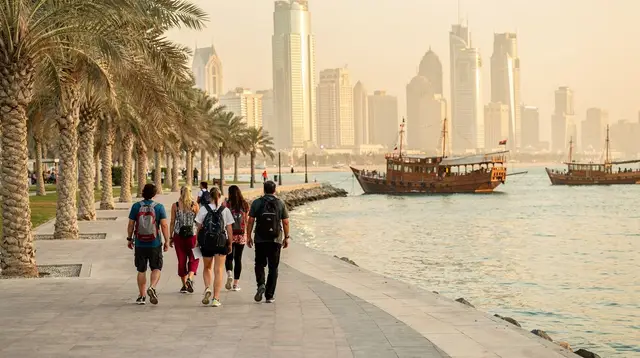
I decide on a neighbourhood before I look at specific hotels. West Bay puts you among the skyscrapers and an easy walk or short taxi from the Corniche and its dhow moorings. The Pearl feels quieter and more marina-facing. Basing near Souq Waqif keeps you close to the evening market atmosphere and a short ride from the Museum of Islamic Art. None of these is objectively “best” — it depends on whether you want energy in the evenings or a calmer base to return to, which is a question worth answering honestly before you compare hotel listings.
Step 4: Book the things that need booking ahead
Most of a Doha trip can be planned loosely day by day, but two categories I always lock in early. The first is a desert experience: Sealine and the Inland Sea are the main draw outside the city, and I’d rather have a half-day desert trip with dune bashing arranged than try to organise a 4x4 and driver myself, since the Inland Sea genuinely cannot be reached by ordinary car. If I want the desert at a quieter hour, I’ll instead look at an evening safari that combines dune driving with a visit to the Inland Sea after dark.
The second is museum timing. Both the Museum of Islamic Art and the National Museum of Qatar close one day a week and can have limited entry slots, so I check current hours and book ahead rather than turning up and hoping.
For a first full day in the city, I’ve also booked a guided overview covering the Corniche, Souq Waqif and the main landmarks to get oriented quickly, and on trips where I want to see Education City properly, a full day covering the university district and Al Rayyan has saved me from figuring out the logistics myself.
Everything else — Souq Waqif shopping, a walk through Msheireb Downtown, an evening at Katara — I leave unbooked and decide day to day.
Step 5: Plan your transport by zone, not as one system
This is where I see people overcomplicate things. The Doha Metro and its Red, Green and Gold lines, plus the Lusail Tram and the free Msheireb loop, comfortably cover West Bay, Msheireb, Lusail and the museum district. For anything outside that zone — Al Wakrah, Sealine, Al Khor and the north, or Zekreet in the west — I switch to taxis, a ride-hailing app, or a tour, since the metro simply doesn’t reach there. I plan my days around this split rather than trying to force one mode of transport to do everything.
Step 6: Decide how many days you actually need
I plan a minimum of three days: one centred on the city and Corniche, one for the desert, and one flexible day for either the north coast around Al Zubarah or a slower museum and souq day. If you have five days, adding a day trip toward Zekreet and the mushroom rocks in the west rounds things out nicely without feeling rushed. For a tighter trip, I’d start from Doha with limited time priorities rather than trying to compress a five-day plan into two.
Putting it together
None of these six steps is complicated on its own, but doing them in this order — entry rules, season, base, advance bookings, transport zones, then day count — is what’s kept my own trips from unravelling halfway through. It also means the fun part, actually wandering Souq Waqif in the evening or watching the sun set over West Bay from a dhow, doesn’t get eaten up by logistics you could have settled from home. If you want the condensed version of all this in checklist form, I keep an updated one at my Doha trip planning checklist, and if you’re still deciding what to actually book once you land, how to book tours in Doha picks up exactly where this leaves off.
Frequently Asked Questions About Planning a Trip to Doha
Do I need a visa to visit Qatar?
It depends entirely on your passport and on the rules in force when you travel, so I never give a blanket answer. Check the official Qatari entry portals or your own government’s travel advisory shortly before you book, not months in advance.
When should I go to Doha?
I plan around November to March, when days are warm and evenings are pleasant. Summer, roughly May to September, is extremely hot and humid, and walking around the Corniche or Souq Waqif at midday becomes a genuine health risk rather than an inconvenience.
Where should I stay in Doha?
I choose a base first and a hotel second. West Bay puts you among the skyscrapers and close to the Corniche, The Pearl feels more residential and marina-facing, and a hotel near Souq Waqif keeps you close to the evening atmosphere and an easy taxi ride from the Museum of Islamic Art.
What should I book before I arrive?
I reserve a desert safari and, separately, timed tickets for the Museum of Islamic Art and the National Museum of Qatar, since both close one day a week and can sell out slots. Everything else in the city I leave flexible.
Can I get around Doha without a car?
Yes, for the city itself. The Doha Metro’s Red, Green and Gold lines plus the Lusail Tram and the free Msheireb loop cover West Bay, Msheireb, Lusail and the museums well. The desert, the north and the west are not served by rail, so those legs go by taxi, ride-hailing app or an organised tour.
How many days do I need in Doha?
I plan a minimum of three days: one for the city and Corniche, one for a desert half or full day, and one for either the north coast or a slower museum and souq day. Five days lets you add the west, Zekreet and the mushroom rocks, without rushing.
Is Doha expensive to visit?
I don’t put figures on this because prices move and currencies differ, but I plan my spending around three fixed costs I book ahead: hotel, one or two desert or dhow experiences, and museum tickets, then treat food and transport as flexible.
Is it easy to be a first-time visitor in Doha?
Yes. English is widely used on signage and in shops, the metro is simple to use, and the main sights sit within a fairly compact area. The main adjustment for first-timers is the dress code and the rhythm of the week, both of which are easy to plan around once you know they exist.
tours.Planning
Verified deep-linked GetYourGuide tours. Book through these links and we earn a small commission at no cost to you.
GetYourGuide does not provide a product photo for this activity — the image shows the meeting point, photographed by us.