Scuba Diving and Pearl Diving in Qatar: What to Expect
Can you go scuba diving or pearl diving in Qatar?
Yes. Licensed operators run guided scuba dives and introductory try-dives from Doha, and separate cultural pearl-diving demonstrations recall the country's pearling past. The Gulf here is calm and warm but shallow and often turbid, so operators do not promise dramatic reef scenery, and no outing guarantees a pearl.
Two very different things called “diving” in Qatar
Doha sits on the edge of the Persian Gulf, and two activities on offer here both get called “diving,” which causes some confusion when people book. The first is genuine scuba diving: an equipment-based sport, run by licensed operators, aimed at either certified divers or complete beginners on a supervised try-dive. The second is a cultural pearl-diving demonstration, usually staged on a traditional wooden dhow, that recreates the free-diving technique Qatari pearl divers used for centuries before the pearling industry collapsed in the 1930s.
They are sold by different operators, they cost different amounts, and they deliver completely different experiences. This guide keeps the two apart on purpose, because most of the disappointment visitors report comes from expecting one and getting the other, or from expecting either to deliver something it was never designed to.
Before either activity, it’s worth understanding why Qatar’s coastal past is built around the sea rather than the desert most visitors picture. Long before oil and gas, the towns along this coast, including Al Zubarah in the north, lived on pearling, fishing and trade with India and East Africa. Al Zubarah’s fort and walled town, Qatar’s only UNESCO World Heritage Site, is the clearest physical trace of that pearling economy still standing. A pearl-diving demonstration in Doha is a small, staged echo of that history, not a re-creation of an ancient bazaar frozen in amber; treat it as living-history theatre with a genuine technical basis, not as an archaeological experience.
Certified diving versus a guided try-dive
If you already hold a diving certification, most operators will take you on an open dive built around your card level, adjusting the plan to what you’re qualified for. You bring or rent equipment, complete a check-in and briefing, and dive with a guide who knows the local sites. This is the more flexible and less supervised option, and it suits divers who want to log time in a different body of water rather than see something extraordinary.
If you have never dived before, the standard option is a guided introductory dive, sometimes called a discover dive or try-dive. This does not require certification. An instructor stays with you throughout, in shallow, controlled conditions, and the session is built around comfort and safety rather than distance or duration. It is a taster, not a qualification: it does not certify you to dive independently afterwards, and it is not the moment to expect the kind of dive a certified diver would do. Several Doha operators run exactly this format, combining pick-up, a full safety briefing, guided time in the water and refreshments afterwards into a single half-day outing.
a scuba diving outing from Doha with hotel pick-up and drop-off included is built for this beginner-to-mixed-level audience, with guides on hand throughout. For a version with a stronger guiding and refreshment component, a fully guided scuba session that includes refreshments afterwards follows the same shape with a bit more structure around the day.
A third option, a guided dive focused on exploring the local seabed with a guide, plus refreshments, is pitched similarly but framed around a slower, exploratory pace rather than a fixed route.
None of these three should be booked on the promise of a spectacular reef. Read that sentence twice if a colourful brochure photo is what convinced you to book: Gulf waters off Doha are generally calm and warm, which makes them workable for beginners, but visibility and reef cover here vary with season, tide and location, and operators are not marketing a Red Sea or Maldives-style reef experience. What you should expect is a low-stress, well-supervised outing in mild water, with a competent guide managing the pace, and a legitimate first taste of breathing underwater if you have never done it before. That is a real and worthwhile thing to do; it is a different thing from a reef showcase, and no reputable listing will promise the latter.
What a pearl-diving demonstration actually is
A separate category of trip, usually run on a dhow out of the Corniche or a nearby marina, recreates the historical technique of Qatari pearl diving: free-diving (no scuba gear) using a nose clip and a weighted rope, the way divers worked before compressed air was available. These are staged for visitors as cultural demonstrations, sometimes paired with a short talk on the pearling economy, traditional songs, or a stop to open oyster shells collected in advance for the show.
Be clear-eyed about what this is not. It is not a scuba dive, it does not use tanks, and it is not sold as a sporting activity in the way the scuba trips above are. It is also not, whatever a hopeful brochure line might imply, a chance to find and keep a valuable natural pearl. Reputable Qatari tourism operators do not promise a pearl find, because natural pearls are rare and the shells used in these demonstrations are typically prepared rather than fished blind on the day. Treat any operator who promises you will “find your own pearl” as overselling the experience, and book the demonstration for what it honestly is: a hands-on, historically grounded window into the trade that built Qatar’s coastal towns before oil, not a treasure hunt.
If the pearling history is the part that interests you most, pairing the demonstration with a visit to Al Zubarah or the north-Qatar day trips that combine it with Al Khor and the mangroves of Al Thakira gives the history far more depth than the boat demonstration alone. Qatar Museums’ heritage sites, including the Msheireb Museums in the rebuilt heritage quarter, also cover the pearling economy in more historical depth than a half-hour boat demonstration can.
Choosing between the two
| Scuba diving | Pearl-diving demonstration | |
|---|---|---|
| Equipment | Tank, regulator, mask, fins | Nose clip, weighted rope, no tank |
| Certification needed | No, for a guided try-dive; yes for a full open dive | No |
| Setting | Boat out to a dive spot, in the water | Usually on or beside a traditional dhow |
| What you’re shown | The underwater environment, at your own pace with a guide | A historical technique and the pearling trade |
| Realistic expectation | A calm, supervised dive; reef scenery not guaranteed | A cultural demonstration; no pearl to keep |
| Typical duration | Half a day, including briefing and travel | Usually part of a longer dhow outing |
Neither is inherently “better” than the other; they answer different interests. Someone who wants to try breathing underwater for the first time, or a certified diver who wants a change of location, should look at the scuba options. Someone whose interest is Qatar’s pre-oil history and the culture that pearling built along this coast is better served by the demonstration, ideally combined with a museum visit or a trip north to Al Zubarah.
Practical planning notes
Diving and pearl-diving trips both depart from Doha’s marinas rather than from a location the Doha Metro or tram network reaches, so almost every operator includes hotel or city-centre pick-up as part of the package; confirm your pick-up point and time when you book rather than assuming a fixed departure spot. Bring a swimsuit under light, easily removed clothing, sun protection, and a change of clothes for afterwards; hats and loose cover-ups are worth having on the boat between activities, since shade is often limited.
Season matters more than most visitors expect. The cooler months, roughly November through March, make the whole day around the water genuinely pleasant, with mild air temperatures on the boat and comfortable conditions before and after time in the sea.
Trips run through the hotter months too, but the heat and humidity of a Doha summer, described in more detail in the guide to visiting Doha in summer, make the waiting time on deck considerably more taxing than the time actually in the water. If you’re planning your trip dates around comfort generally, the best time to visit Doha overview and the season-by-season cool-season guide are useful companions to this page.
If a scuba trip is your only water activity of the day, it pairs naturally with an evening back on land rather than another boat outing, since the diving trips already occupy a half-day. an evening city tour through Souq Waqif, the Pearl-Qatar and Lusail is a common way to close the day, taking in the lit-up skyline and the old market’s evening trade after a morning spent on the water. For visitors who prefer to stay on the water a while longer, a separate sunset dhow cruise along the Corniche is a gentler, non-diving way to see Doha from the sea afterwards.
Neither scuba diving nor a pearl-diving demonstration requires strong swimming ability for the introductory versions, but both involve time in open water, so anyone uneasy in the sea should say so when booking; most operators can adjust the format for nervous beginners. As with any water activity here, treat heat and hydration as the real risk rather than the water itself: Qatar’s coastal water sports are generally low-risk when booked through a licensed operator, but the midday sun on an open boat deck is not to be underestimated, in keeping with the same heat precautions that apply to desert safaris and other outdoor activities across the country.
Other water activities nearby
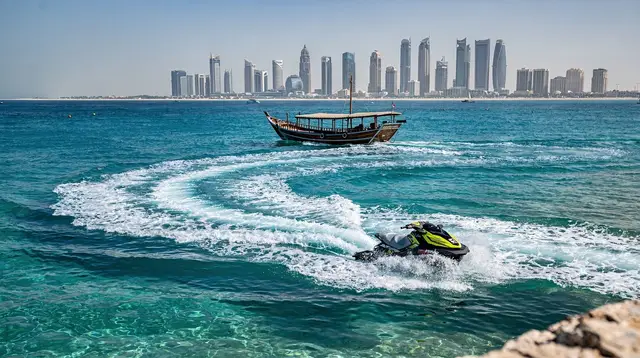
Diving and pearl-diving are not the only things on the water in Doha. If you’d rather stay closer to shore, jet-skiing along the Corniche and parasailing and flyboard sessions are shorter, higher-adrenaline alternatives that need no prior experience.
Anglers can book a half-day fishing trip out of Doha’s marinas, and families looking for a lower-key water day sometimes prefer Doha’s beaches or the water parks around the city instead of a boat-based activity altogether. All of these, like the scuba and pearling trips above, depart from or near Doha’s coastline rather than the inland desert sites south and west of the city.
Scuba diving and pearl diving in Qatar: frequently asked questions
Do I need a diving certification to go scuba diving in Qatar?
No. Operators offer both certified dives for divers who already hold a PADI or SSI card and guided introductory sessions for complete beginners, run in shallow water under close supervision. A certification opens up longer, less supervised dives; a try-dive is a short, closely managed first taste.
Is pearl diving in Qatar the same as scuba diving?
No, and the two are usually sold as separate experiences. Pearl diving here is a cultural demonstration on a traditional dhow, recreating the free-diving techniques Qatari pearl divers used before the 1930s pearling collapse, not a scuba activity and not a way to search for a real pearl to keep.
Will I see coral reefs or colourful marine life while diving?
Manage your expectations. The Gulf off Doha is warm and generally calm, but visibility and reef cover vary a great deal with season and location, and operators do not promise a spectacular reef. Expect a low-key, sheltered dive rather than a showcase site.
Can I find or keep a real pearl on a pearl-diving trip?
No reputable operator promises this, and you should treat any such promise as a red flag. The pearl-diving demonstrations sold to visitors are about the technique and history of Qatari pearling, not a chance at a valuable find.
What’s included in a typical scuba diving trip from Doha?
Most trips include hotel or city pick-up, all diving equipment, a briefing, one or two dives with a certified guide, and light refreshments afterwards. Exact inclusions vary by operator, so check the specific listing before booking.
Is scuba diving in Qatar suitable for children?
Introductory try-dives usually set a minimum age, commonly around 10 to 12, and require the child to be a confident swimmer; certified dives follow the minimum age of the certifying agency. Confirm the age policy directly with the operator before booking for a child.
When is the best time of year to dive or take a pearl-diving trip in Qatar?
The cooler months, roughly November to March, are the most comfortable for any time on or in the water, with milder air and sea temperatures. Summer trips run too, but the heat and humidity make the boat time before and after the dive far less pleasant.
How do I get from central Doha to the dive or pearling boat departure point?
Most operators include pick-up from hotels in West Bay, the Pearl-Qatar or central Doha as part of the package, since the metro and tram network does not reach the marinas used for these trips. Confirm your pick-up point when you book.
Water Sports in Doha
Verified deep-linked GetYourGuide tours. Book through these links and we earn a small commission at no cost to you.
GetYourGuide does not provide a product photo for this activity — the image shows the meeting point, photographed by us.