Falconry Experiences in Doha: Shows, Glove Holds and the Falcon Souq
What does a falconry experience in Doha actually involve?
Most visitor falconry experiences in Doha are a short handling session or show, where a trained falcon is placed on your gloved arm for photos and a handler explains the bird's role in Gulf hunting tradition. They are not free flights: the bird stays tethered or works with its own handler, and any claim of an untethered flight for visitors should be treated with caution.
A falcon on the glove: what visitors actually see in Doha
Of all the images used to sell Qatar to outsiders — the shining towers of West Bay, the dhows on the Corniche, the desert dunes south of the city — the hooded falcon on a leather glove is the one that reaches back furthest into the country’s own history. For a visitor, that image is also one of the easiest cultural experiences to book: a short, guided session in or around Souq Waqif where a trained bird is placed on your arm, a handler talks you through what you are looking at, and you leave with photographs and, usually, a clearer sense of why this bird matters here.
It is worth being precise from the start about what this kind of experience is, and what it is not. A visitor falconry session is a controlled, short interaction: a bird that already has months or years of training behind it is presented calmly, often hooded to keep it settled, and handled by someone who works with it daily.
It is not a demonstration of a wild hunt, and a responsible operator will not promise you an untethered free flight as part of a one-off tourist booking — that kind of flying is the product of a long relationship between one bird and one trainer, not something built around a rotating stream of visitors. If a listing promises a free-flying spectacle as a guaranteed centrepiece, read the description carefully and treat firm claims about the flight itself with some scepticism; ask the operator directly what the session includes before you pay.
Falconry’s place in Gulf culture, briefly
To understand why falconry occupies the place it does in Qatar, it helps to go back before oil, before the skyline, before the World Cup stadiums at Lusail. The Bedouin communities who lived across this peninsula and the wider Arabian interior used trained falcons — mainly saker and peregrine falcons — to hunt houbara bustard and other small desert prey. A falcon that could be trusted to catch food and return to its handler was a genuine asset in a difficult environment, and the skill of training one was passed down as practical knowledge, not decoration.
That practical root is exactly what gives the modern symbol its weight. As Qatar’s economy and cities transformed in the space of a few decades, falconry stayed as one of the clearest living threads back to the desert life that came before.
It shows up constantly in how the country presents itself: falcons feature in national emblems and on Qatar Airways branding, falconry displays are a fixture at cultural festivals, and owning and flying a well-trained falcon still carries real social standing among Qataris, in much the same way that a fine horse or a prized camel does. None of this is staged nostalgia — falconry is UNESCO-recognised as an intangible cultural heritage practice across several countries including Qatar, and it continues as an active pastime, not only a tourist backdrop.
One detail says more about how seriously it is taken than almost anything else: Qatar issues official passports for registered falcons. These documents track a bird’s identity and origin and are part of a wider effort, shared across the Gulf, to control the trade in wild-caught birds and protect falcon populations rather than deplete them for the market. When you meet a falcon at a visitor experience or in the Falcon Souq, there is a real chance the bird carries this kind of paperwork, even if nobody points it out to you.
What a bookable falconry experience typically covers
Formats vary between operators, but a typical visitor falconry experience in Doha combines some or all of the following:
- A handling session on the glove. You wear a thick leather gauntlet, the handler transfers a calm, usually hooded falcon onto your forearm, and you hold the pose for photographs while the bird’s weight, grip and posture are explained.
- A short talk on training and species. Handlers commonly cover which species are used (saker and peregrine falcons are the most typical in the Gulf), roughly how long training takes, and what a falcon eats and needs day to day.
- Context on hunting history. Expect an explanation of how falconry was used historically to hunt houbara bustard and other prey across the desert interior, and how that practical skill became a cultural marker.
- A stop at or near the Falcon Souq. Many souq-based experiences are paired with a walk past the market stalls that sell falcons, hoods, jesses, gloves and other equipment, sometimes including a look at the falcon hospital next door.
- Combination with other activities. Some tours bundle the falconry element with a wider Souq Waqif walk, an Arabic coffee stop, a desert picnic, or even horseback riding, rather than offering falconry as a completely standalone booking.
What almost none of these sessions include is an actual hunting demonstration or a long free flight performed purely for visitors. Handlers are protecting valuable, carefully trained animals, and a controlled glove session is simply the safer, more repeatable format for a rotating stream of tourists.
The Falcon Souq versus a falconry experience: two different things
It is easy to conflate these, so it is worth separating them clearly. The Falcon Souq is a physical market — a row of shopfronts next to the main Souq Waqif complex where falcons are bought, sold, groomed and treated, alongside shops selling hoods, gloves, scales and other equipment. Walking through it costs nothing and does not require a booking; you can simply visit, look, and talk to shopkeepers if they are open to it. Our dedicated guide to the Falcon Souq covers that visit on its own, including where it sits relative to the main souq and what the falcon hospital does.
A falconry experience, by contrast, is a paid, bookable activity built around handling a bird yourself, usually away from the working stalls of the market itself, in a setting arranged for visitor photographs and explanation. You can do one without the other — plenty of visitors walk the Falcon Souq for free as part of a general Souq Waqif visit and never book a handling session, and some falconry experiences take place away from the souq entirely, closer to the desert.
If your main interest is seeing falcons in a working commercial setting and understanding how the trade and the hospital operate, start with the Falcon Souq guide. If your main interest is holding a falcon yourself and hearing a handler talk you through it, that is the falconry experience covered on this page.
Booking a falconry experience in Doha
Falconry sessions in Doha are usually sold either as a standalone show, bundled into a broader Souq Waqif cultural tour, or paired with a desert outing. A guided tour that combines the souq walk, Arabic coffee and a falconry stop suits visitors who want cultural context alongside the photo opportunity.
a guided Souq Waqif walk that folds in a falconry encounter and traditional Arabic coffeeFor a version built more around the falcon itself, with a show format and a countryside setting, an operator running a dedicated display alongside a desert picnic is worth comparing.
a falconry show combined with a desert picnic, with hotel pickup includedSome visitors prefer to pair falconry with other Gulf animal traditions in a single outing — a souq walk followed by a spell in the saddle further south.
a Souq Waqif tour that continues on to a horse riding session near SealineWhichever format you pick, check the listing for the session length, whether it is indoor or outdoor, and whether transport is included, since none of that is standardised across operators and prices are not fixed enough to quote reliably here — confirm the current rate on the booking page itself.
A fourth route worth comparing is a broader cultural loop that treats falconry as one stop among several rather than the centrepiece — a single tour touching the Corniche, The Pearl-Qatar, Souq Waqif and Katara Cultural Village in one outing, useful if you would rather see a falcon on the glove as part of a wider morning or afternoon than book it as a dedicated activity.
a combined Corniche, Pearl, Souq Waqif and Katara tourPractical points before you go
Dress and behaviour. Souq Waqif and its surrounding streets call for the same modest dress expected across Doha’s public spaces — shoulders and knees covered is a safe baseline, particularly if your session includes time walking through the souq itself. See our dress code guide if you are unsure what to pack.
Around the bird. Follow the handler’s instructions exactly: keep your arm steady, do not reach for the falcon’s head or hood unprompted, and move slowly. These are working animals, not props, and a startled bird can injure itself or a handler.
Photography. Most experiences are built around photo opportunities and will allow your own camera or phone; some operators also offer professional photos as an add-on. Ask before the session starts so you know what is included.
Timing and heat. Outdoor falconry sessions are far more comfortable in Doha’s cooler months, roughly November through March. In peak summer, an outdoor show in the middle of the day is uncomfortable for visitors and stressful for the bird alike, so look for shaded, indoor, or evening formats if you are visiting between May and September.
Combine it sensibly. A falconry stop pairs naturally with an evening in Souq Waqif for food and karak, or with a wider look at Qatari etiquette if you want to understand the hospitality customs — coffee service, the majlis — that often accompany a cultural demonstration like this one.
Booking ahead versus walking in. Because falconry sessions run in fairly small groups around a limited number of trained birds, slots can fill for the cooler-season evenings when demand for any Souq Waqif activity is highest. Booking a day or two in advance removes the risk of arriving to find the session full, whereas a Falcon Souq visit itself needs no booking at all — you can simply walk past the shopfronts whenever the market is open.
Fitting a falconry session into your Doha days
Where falconry lands in your schedule depends mostly on how much time you have in the city. On a single tight day built around the highlights, it slots naturally alongside the Corniche and Souq Waqif rather than as a separate outing — our one-day Doha highlights itinerary shows how that fits together. Visitors with two days, following a plan like two days in Doha for first-timers, often leave falconry for the evening of the souq-focused day, once the midday heat has passed and the market itself is fuller and livelier.
With three days or more, following the shape of three days in Doha essentials, there is enough slack to treat falconry as a standalone booking on its own afternoon or evening rather than squeezing it between other stops, and to combine it more comfortably with a desert day trip if that is also on your list.
Falconry alongside Qatar’s other animal traditions
Falconry is one of three animal-based traditions visitors regularly encounter in Qatar, alongside camels and horses, and it is worth knowing how they relate rather than treating each as an isolated activity.
| Tradition | Where to see it | Typical visitor format |
|---|---|---|
| Falconry | Souq Waqif area, some desert-based operators | Glove handling session or show, market visit to the Falcon Souq |
| Camel riding and racing | Al Shahaniya, desert camps | Short ride, or watching robot-jockey races in season |
| Horse riding | Sealine area, equestrian centres | Guided ride, sometimes combined with a souq tour |
If you want to go deeper on the other two, our guides to camel riding in Qatar, camel racing at Al Shahaniya, and horse riding in Qatar cover each in detail, including how racing season and etiquette work if you plan to watch rather than ride — see our note on camel racing season and etiquette for that.
For visitors weighing up which of these traditions to prioritise on a short trip, falconry has the advantage of being the most centrally located, sitting right by Souq Waqif rather than requiring a drive out to Al Shahaniya or Sealine — useful to know if you are trying to build an efficient day around the Corniche and the old town without long transfers.
Falconry experiences and other Souq Waqif plans, in one place
A falconry booking rarely stands alone in most itineraries — it tends to sit inside a broader Souq Waqif evening or a half-day cultural loop. If you are still building out that day, it is worth reading how the souq itself works before you commit to a time slot, since many stalls, including falconry operators working nearby, keep later afternoon and evening hours rather than opening early. Our shopping-focused Souq Waqif guide lays out that rhythm, and a wider food tour of the area is a natural way to fill the hours either side of a falconry session.
Whatever combination you choose, the core of the experience stays the same wherever you book it: a few minutes with a bird whose training and status run far deeper than the photograph you take of it, and a small, direct link to a way of life that predates every tower on the Doha skyline.
Camel Rides, Horse Riding and Falconry
Verified deep-linked GetYourGuide tours. Book through these links and we earn a small commission at no cost to you.
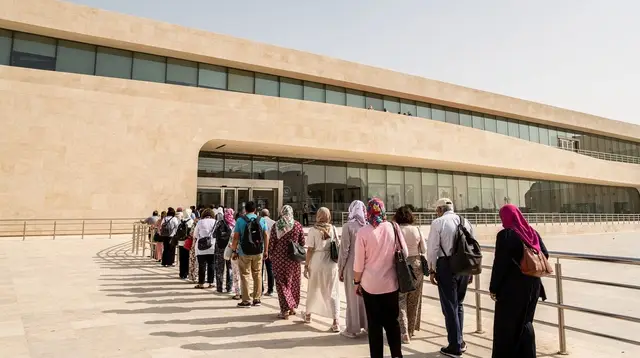
GetYourGuide does not provide a product photo for this activity — the image shows the meeting point, photographed by us.