Al Shahaniya Camel Racing: Robot Jockeys West of Doha
Can visitors watch camel racing at Al Shahaniya near Doha?
Yes. Al Shahaniya, about 40km west of Doha, has Qatar's main camel racetrack, where camels ridden by robot jockeys are followed along the track by their owners in SUVs. Races run in the cooler months, but exact days and times vary and should always be checked locally before driving out.
A racetrack unlike any other, 40km west of Doha
Camel racing is one of the more unusual sights on the road out of Doha, and it happens at a single main venue: Al Shahaniya, a small town roughly 40km west of the capital on the highway toward Dukhan and Zekreet. Camel racing is a genuinely old sport on the Arabian Peninsula, but the way it is run today is thoroughly modern. Instead of a human rider, each racing camel carries a small robot jockey — a lightweight mechanical device strapped to the saddle that whips gently and can be steered by remote control. The camel’s owner, trainer or handler drives alongside the track in an SUV, radio in hand, guiding the robot jockey and pacing the animal for the length of the race.
For visitors basing themselves in West Bay or around Souq Waqif, Al Shahaniya is not a place you stumble onto by accident. It sits well outside the city, past Al Rayyan, and most people who see it do so as part of a longer west-Qatar day out that also takes in the film set and mushroom rocks at Zekreet and, sometimes, the abandoned town near Dukhan. This page focuses specifically on the racetrack itself, how the sport works, and the practical side of getting there — including the one thing this guide deliberately will not give you: a fixed race calendar.
How robot-jockey camel racing actually works
Traditional camel racing across the Gulf used to be ridden by small children, chosen for their light weight. That practice was banned in the early 2000s across Qatar and its neighbours on child-welfare grounds, and it was replaced within a few years by remote-controlled robot jockeys — a solution that turned out to suit the sport well, since a machine can be made lighter than any child and does not tire.
A race at Al Shahaniya looks like this: a line of camels, each ridden by a small robot rig instead of a person, sets off down a long straight track. Alongside the track, a convoy of SUVs keeps pace, one per camel, each with an owner or trainer leaning out of the window operating the robot’s arm by remote control to encourage their animal. It is loud, fast and slightly surreal to watch for the first time — a line of camels sprinting flat out with a parallel line of 4x4s matching their speed a few metres away.
The camels themselves are purebred racing dromedaries, bred and trained specifically for speed rather than for milk, meat or transport, and camel ownership and racing carry real prestige in Qatar and the wider Gulf. Race meets can include heats for different age classes of camel, and serious money and reputation ride on the results, even though the crowd on any given day may be small.
When racing happens — and why we will not give you a calendar
Camel racing at Al Shahaniya runs during Qatar’s cooler months, broadly across autumn, winter and into spring, when temperatures make training and racing the animals sensible; it effectively pauses through the punishing heat of summer. Within that cooler season, though, specific race days and start times vary from week to week and are not organised around a tourist audience. Meets can be scheduled early in the morning to beat the heat, and the calendar can shift at short notice for reasons that have nothing to do with visitors.
Because of that, this guide will not print a table of race dates or a “camel racing season calendar” — any such list would be out of date within weeks and could send you on a wasted drive. If seeing an actual race is important to your trip, the reliable approach is to ask locally close to your date: your hotel concierge, a Qatar Tourism contact, or a west-Qatar tour operator who tracks the current schedule. A guided day trip that includes Al Shahaniya will usually already know whether a race is likely on the day you are travelling, which is one good reason to book the stop as part of a tour rather than trying to time it yourself with a rental car.
What you can see even without a live race
The good news is that Al Shahaniya rewards a visit even on a day with no race scheduled. The track and the surrounding training grounds are active most mornings with camels being exercised, and the sheer scale of the facility — long straight tracks, rows of camel enclosures, a steady traffic of SUVs and trailers — is worth seeing on its own. Photographers in particular tend to find the early-morning training sessions, with low light and dust kicked up along the track, more visually interesting than a formal race day with a bigger crowd.
a full-day tour that pairs the camel race track with the Richard Serra desert sculpture is the most direct way to combine Al Shahaniya with the rest of west Qatar in a single outing, without needing to plan the logistics yourself.
The Sheikh Faisal Museum, next door
A short drive from the racetrack sits the Sheikh Faisal Bin Qassim Al Thani Museum, a large private collection housed in a purpose-built complex near Al Shahaniya. It is one of the most-visited stops in this part of the country and is very often combined with the camel racetrack on the same half-day or full-day out, since the two sit only minutes apart. This guide is focused on the racetrack rather than the museum, so it won’t attempt to describe the collection here — treat it as a worthwhile add-on to confirm separately, with opening days and access arrangements checked ahead of your visit rather than assumed.
Combining Al Shahaniya with the rest of west Qatar
Because Al Shahaniya sits on the main road toward Dukhan, it slots naturally into a broader west-Qatar itinerary rather than standing as a destination by itself. The usual pairing is with Zekreet, roughly another 40–50km further west, where the abandoned “Film City” set and the wind-carved mushroom rock formations sit close to Richard Serra’s four-part steel sculpture East-West/West-East inside the Brouq Nature Reserve. A day that starts with a morning at the racetrack, moves on to the mushroom rocks and finishes at the sculpture as the light softens in the late afternoon is a common and sensible way to use a single day of a Doha trip on the western side of the peninsula.
a tour covering west Qatar’s art, rock formations and camel racing together is built around exactly that combination, and saves you working out the driving order and timings yourself.
For visitors with more time, some operators fold Al Shahaniya into a longer loop that also covers the north Qatar sites — Al Khor, the Al Thakira mangroves and Al Zubarah — across two or more days, since both regions lie outside the reach of the Doha Metro and are realistically only covered by road.
a multi-day tour spanning the city, north and west Qatar plus a desert safari is one option built for travellers who want the full spread of the country rather than a single day trip.
Camels beyond the racetrack: riding and desert experiences
If watching camels race is interesting but you would rather be closer to one, Al Shahaniya is also a starting point for some camel- and horse-riding experiences that use the same desert terrain west of Doha. These are separate from the competitive racing itself — slower-paced rides aimed at visitors, usually on quieter tracks or open desert rather than the official racetrack.
a horseback ride through the dunes west of Doha is a good alternative for anyone who wants a hands-on animal experience rather than a spectator one, and it can be booked as a stand-alone activity or paired with a broader west-Qatar day.
For a closer look at riding, handling and the wider culture around these animals in Qatar, see the dedicated camel riding guide, and for etiquette specifically around watching a race — where to stand, how close is appropriate, and what not to photograph without asking — see the camel racing season and etiquette guide.
Getting to Al Shahaniya
There is no metro, tram or scheduled bus service that reaches Al Shahaniya; like the rest of west Qatar and north Qatar, it is reached by road. Three practical options:
| Option | Best for | Notes |
|---|---|---|
| Self-drive rental car | Independent travellers comfortable navigating | Paved highway the whole way; no 4x4 needed for the racetrack itself |
| Taxi or ride-hailing (Uber, Careem) | A one-way trip without a return booked in advance | Return pickup from a rural site can be slow; agree a return plan before you go |
| Guided day tour | Anyone wanting help timing a possible race, plus onward stops | Combines naturally with Zekreet, the Serra sculpture and the Sheikh Faisal Museum |
A rented saloon car is entirely adequate for the racetrack and museum, since both sit just off the main highway; a 4x4 only becomes necessary once you push further west to the sand tracks around Zekreet’s mushroom rocks and the Serra sculpture site. For anyone continuing that far in the same day, review the notes in the Zekreet guide before setting off.
Practical tips for visiting
- Go early if you can. Training activity at the track is often livelier in the cool of the morning, before the heat builds through the day.
- Bring water and sun protection. There is little shade around the track itself, and this stands outside the city with fewer amenities nearby than central Doha.
- Dress modestly, as you would anywhere outside a beach or hotel pool in Qatar — this is a working rural site, not a tourist attraction with a visitor centre.
- Don’t assume a race is on. Treat any sighting of an actual race as a bonus rather than the reason for the trip, and confirm current scheduling with a local source close to your date if seeing one matters to you.
- Combine it with something else. Given the drive involved, pairing Al Shahaniya with Zekreet, the Serra sculpture, or the Sheikh Faisal Museum makes far better use of the trip out west than visiting it alone.
Al Shahaniya camel racing: frequently asked questions
Where is Al Shahaniya and how far is it from Doha?
Al Shahaniya sits roughly 40km west of central Doha, on the road toward Dukhan and Zekreet, about a 30 to 40 minute drive depending on traffic.
What makes Qatari camel racing different from horse racing?
The camels are ridden by lightweight robot jockeys strapped to their backs, operated by remote control. Owners and trainers drive alongside the track in SUVs, steering and pacing their camel by radio rather than by a human rider on the animal.
When do camel races take place at Al Shahaniya?
Racing happens during Qatar’s cooler months, broadly from autumn through spring, when the heat is manageable for the animals. Specific race days and start times vary through the season, so check current listings before travelling out.
Is there a published camel racing calendar for tourists?
Not a reliable one. Race scheduling at Al Shahaniya changes from week to week and is aimed at owners and the racing community rather than tourism, so this guide does not publish a fixed calendar. Confirm with a local operator, your hotel or Qatar Tourism close to your travel date before making the trip.
Can I visit Al Shahaniya without watching an actual race?
Yes. The racetrack and training areas are worth a stop even without a live race, and the site is usually combined with the nearby Sheikh Faisal Bin Qassim Al Thani Museum and other west-Qatar attractions such as Zekreet and the Richard Serra sculptures.
What is the Sheikh Faisal Bin Qassim Al Thani Museum?
It is a large private museum near Al Shahaniya holding a wide-ranging personal collection, commonly visited on the same day as the camel racetrack. This guide does not detail its exhibits, but it is a well-known stop on west-Qatar itineraries.
Do I need a tour or a 4x4 to visit Al Shahaniya?
A regular rental car can reach the racetrack itself on paved roads, since it sits directly off the main west-Qatar highway. A guided tour is useful mainly for timing a race correctly, for context on the sport, and for combining the stop with Zekreet or the desert sculptures further west.
Is camel racing humane and safe to watch as a visitor?
The switch to robot jockeys, mandated across the Gulf in the early 2000s, was specifically introduced to replace child riders and reduce risk to human jockeys. As a spectator you stay along the track or in viewing areas away from the running lane, and there is no direct safety concern for visitors.
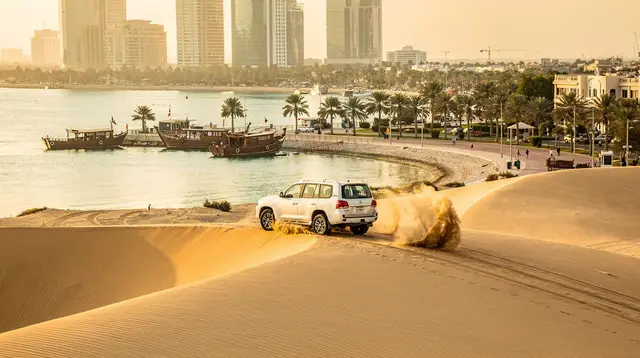
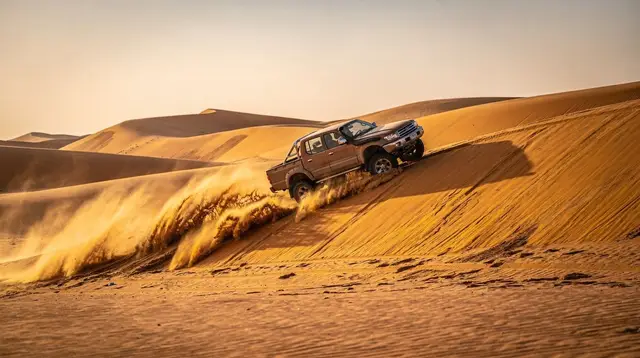
Desert Safari and Dune Bashing Excursions
Verified deep-linked GetYourGuide tours. Book through these links and we earn a small commission at no cost to you.
GetYourGuide does not provide a product photo for this activity — the image shows the meeting point, photographed by us.