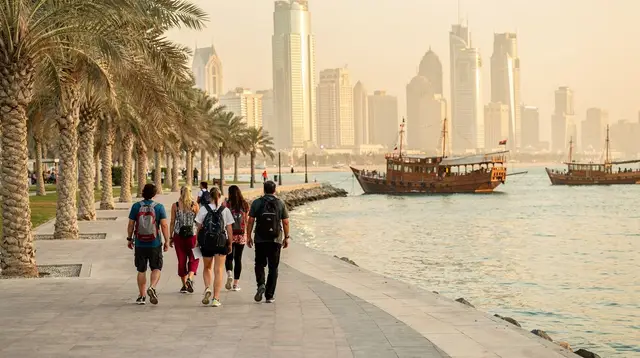
Souq Waqif Guided Tour: What a Guide Actually Adds
Is a guided tour of Souq Waqif worth it compared to walking it yourself?
A guide adds context a self-guided stroll skips over: why the souq looks the way it does, how to read what each row of stalls actually sells, and a proper stop at the Falcon Souq and its falcon hospital. It suits first-time visitors and anyone short on time more than it suits a slow, repeat evening wander.
What A Guide Sees That A Solo Walk Misses
Souq Waqif rewards a wander on its own — that much is true whichever way you visit. But a market this dense, rebuilt on the footprint of an older one and threaded with trades that look similar from the outside, hands over a different amount of information depending on whether someone is reading it for you.
Walking through alone, most visitors see stalls of spices, textiles, and souvenirs, a strip of restaurant terraces, and a corner with birds in cages, and move on having enjoyed the atmosphere without much sense of what they actually passed. A guide’s job in Souq Waqif is to close that gap: to explain what is old and what was rebuilt, what each row of shopfronts is actually for, and to walk you specifically into the Falcon Souq rather than past it.
This page is about that difference — what a guided visit adds, who it suits, and where it stops short of promises that cannot honestly be made about duration or price without checking a specific listing.
a guided walk through Souq Waqif’s lanes is the most direct way to get that context, usually scheduled for the part of the day when the market is actually alive.
The Souq Is Restored, Not Preserved In Amber
The single fact that reframes a Souq Waqif visit most is also the one a solo walk is least likely to surface: the market as it stands today is a restoration, carried out in the 2000s on the footprint of the older souq, using traditional building materials and the old layout rather than a modern shopping-centre plan. It is not an ancient bazaar that has simply been left alone for centuries, and it is not a fabricated tourist set either — it is a working market rebuilt to keep working.
That single fact changes how several things read once you are standing in the lanes. The mud-render walls and wind-tower silhouettes are a deliberate choice to keep the old aesthetic, not survivals from before restoration. Some sections were more heavily rebuilt than others, and a guide who knows the market will usually be able to point out where the newer construction sits next to older frontages, something that is invisible to someone walking through without that background. None of this makes the souq less worth visiting; it just means the story of the place is “restored heritage market”, and a guide is the fastest way to hear that story rather than assume the opposite.
What A Guide Actually Adds, Stall By Stall
A self-guided walk through Souq Waqif tends to flatten the market into one long strip of similar-looking stalls: spices, textiles, souvenirs, more spices. What a guide adds is the ability to read the rows rather than just look at them — which section historically sold what, why the gold souq sits where it does, why certain lanes cluster around textiles and others around spices and incense, and which shops are aimed mostly at residents doing everyday shopping rather than at visitors. That reading is the main value of paying for a guide here rather than the walking itself, which anyone can do for free.
A second, more concrete addition is time management. Souq Waqif is large enough, and repetitive enough in appearance, that first-time visitors often miss entire sections — the animal market at the edges, the row of traditional coffee and tea houses, or quieter courtyards away from the main promenade — simply because nothing marks them out from the street. A guide who knows the layout will usually route a visit to cover more of the market’s variety in less time than an unguided wander manages, though the exact route and pace depend entirely on the specific tour and guide.
The Falcon Souq: Why It Needs Pointing Out
The Falcon Souq sits beside the main market and is easy to walk straight past if nobody tells you it is there — it looks, from the main promenade, like an unremarkable side street of shopfronts. It is where falcons are bought, sold, fitted with hoods and jesses, and treated at an attached falcon hospital, and it is one of the more distinctive things Souq Waqif has that most souqs elsewhere in the region do not.
A guide will typically walk a group directly into this row and explain what falconry means in the Gulf, why the birds are valued the way they are, and what the hospital actually does, rather than leaving visitors to guess from shopfront displays. Not every guided walk includes this stop, so it is worth checking the specific tour description if the Falcon Souq is the main reason for booking one.
a route that pairs the souq with a museum stop and an activity in Lusail is one way operators build a fuller day around the market rather than treating Souq Waqif as a single isolated stop.
Evening Timing Is Not A Marketing Line
Souq Waqif genuinely changes character between early afternoon and evening. A meaningful share of stalls close in the early afternoon and reopen later, and the market’s atmosphere — lit lanes, full restaurant terraces, families and groups out walking, incense and shisha smoke drifting between stalls — is a late-afternoon and evening phenomenon, not an all-day one. This is why most guided walks are scheduled for that window rather than the middle of the day, and it is worth checking the start time on any tour listing to make sure it lands after the souq has properly woken up rather than during its quiet stretch.
An evening slot also tends to suit visitors combining the souq with the Corniche just afterwards, since the promenade and the view back toward West Bay are also best after sunset.
Guided Tour Vs Self-Guided: A Straight Comparison
| Self-guided walk | Guided walk | |
|---|---|---|
| Cost | Free (aside from anything bought or eaten) | Paid; varies by operator and inclusions |
| Context on restoration history | Minimal, unless researched beforehand | Explained on the spot |
| Falcon Souq | Easy to miss entirely | Usually a deliberate stop |
| Pace | Fully flexible, can linger anywhere | Set by the guide and group |
| Best for | Repeat visitors, slow evenings, people who prefer to browse alone | First-time visitors, short stays, anyone who wants the “why” behind what they see |
| Combining with other sites | Requires planning your own route | Often bundled with Katara, the Corniche, or a night tour |
Neither column is objectively better — the choice mostly comes down to how much time is available and whether context or unstructured wandering matters more on a given evening.
Who Actually Benefits From A Guide Here
A guided visit to Souq Waqif suits a fairly specific set of visitors more than others. First-time visitors to Doha, who have no baseline for what a “normal” Gulf souq looks like, get the most out of having someone explain what they are seeing as they see it. Visitors on a tight schedule — a stopover or a short layover with only an evening free — benefit from a guide’s ability to cover the market’s highlights efficiently rather than discovering the Falcon Souq by accident twenty minutes before needing to leave. Travellers combining the souq with other sights in one outing, rather than treating it as a standalone destination, also tend to prefer a guided format because it is built to link stops together.
By contrast, visitors staying in Doha for several days, or those who simply enjoy unstructured browsing and are happy to look things up themselves, often get just as much satisfaction from a free evening walk. There is no universally correct answer, only a better fit for a particular kind of trip.
a wider city tour that folds Souq Waqif into a stop alongside Katara Cultural Village suits travellers who want the souq’s context without dedicating an entire evening to the market alone.
What A Guide Cannot Promise You
It’s worth being direct about what this page will not claim. Tour durations for Souq Waqif guided walks are not standardised across operators — some are built as a stand-alone hour or two, others are folded into a longer city or night tour lasting considerably longer. Prices likewise vary by operator, group size, season, and whether meals, transfers, or extra activities such as a dhow cruise or jet-ski stop are bundled in. Rather than quote a duration or a price that would be wrong by the time it is read, the right way to check either is on the specific tour listing at the time of booking.
The same caution applies to what is or is not included on any given tour: some guided walks fold in a tasting or a stop at a restaurant within the souq, others end at the market gates and leave dinner up to you. None of that should be assumed from a general description — it is worth reading the inclusions on the exact listing before booking.
Combining Souq Waqif With A Bigger Evening
Because Souq Waqif sits close to the Corniche and within reach of Doha’s newer districts, several guided tours use it as an anchor for a wider evening rather than the whole itinerary. A night-focused route, for instance, can carry a visit from the souq’s lanes out toward Lusail and The Pearl-Qatar, giving a contrast between the restored old market and the newest parts of the city within a single evening.
an evening route that moves from the souq out to Lusail and The Pearl is built exactly around that contrast, for visitors who want both sides of Doha in one outing rather than splitting them across two evenings.
For visitors who want to see Souq Waqif alongside the country’s other markets rather than in isolation, some operators also run tours that link it with Doha’s other souqs in a single day, usually paired with meals along the way.
a day that visits several of Doha’s souqs together with meals and transfers included is worth considering for visitors who want breadth across the city’s markets rather than depth in just one.
Practical Notes Before Booking
A few things are worth checking regardless of which guided option looks appealing. First, confirm the exact meeting point and start time, since Souq Waqif has multiple entrances and a mismatched meeting point is a common source of missed tours. Second, dress with the same modesty expected across Doha’s public spaces — shoulders and knees covered — since a guided group moving through a working market is not the place to test the limits of the dress code.
Third, if the tour is scheduled around Friday, remember that many stalls open later in the day after midday prayers, which can shift a guide’s usual route and timing. Finally, if visiting during Ramadan, expect the souq’s rhythm to shift toward the evening even more than usual, with longer opening hours after sunset.
Booking ahead is generally worth it for evening slots, since Souq Waqif’s guided walks are popular at exactly the hours the market is at its best, and last-minute availability can be limited on weekend evenings.
Souq Waqif Guided Tours: Frequently Asked Questions
Is a guided tour of Souq Waqif worth it compared to walking it yourself?
A guide adds context a self-guided stroll skips over: why the souq looks the way it does, how to read what each row of stalls actually sells, and a proper stop at the Falcon Souq and its falcon hospital. It suits first-time visitors and anyone short on time more than it suits a slow, repeat evening wander.
How long does a Souq Waqif guided tour last?
Durations vary by operator and by whether the souq visit is combined with other stops such as Katara or the Corniche. Check the exact duration on the specific tour listing before booking rather than assuming a fixed length.
How much does a guided tour of Souq Waqif cost?
Pricing depends on the operator, group size, and whether meals or transfers are included. There is no single fixed rate, so compare current prices on the tour listings themselves.
Is Souq Waqif rebuilt or original?
The souq standing today was restored in the 2000s on the footprint of the older market, using traditional materials and layout rather than being an untouched historic structure. A guide will usually point out which sections were rebuilt and why.
What is the Falcon Souq and is it included?
The Falcon Souq is the row of shops and the falcon hospital next to the main market, where falcons are bought, sold and treated. Many but not all guided walks include a stop there, so check the specific tour description.
Do guided tours run in the evening?
Most guided walks of Souq Waqif are timed for late afternoon or evening, when the souq is at its busiest and coolest, rather than the early afternoon when many stalls are shut.
Does a guided tour include food tastings?
Some tours build in tastings or a stop at a café or restaurant within the souq, others do not. This varies by listing, so confirm what is and is not included before booking.
How is this different from a shopping guide to Souq Waqif?
A shopping guide focuses on what to buy, where, and for roughly how much. This page focuses on what a guided walk adds in terms of history and context, and who benefits from having a guide rather than exploring alone.
Souq Waqif and Doha's Markets
Verified deep-linked GetYourGuide tours. Book through these links and we earn a small commission at no cost to you.
GetYourGuide does not provide a product photo for this activity — the image shows the meeting point, photographed by us.