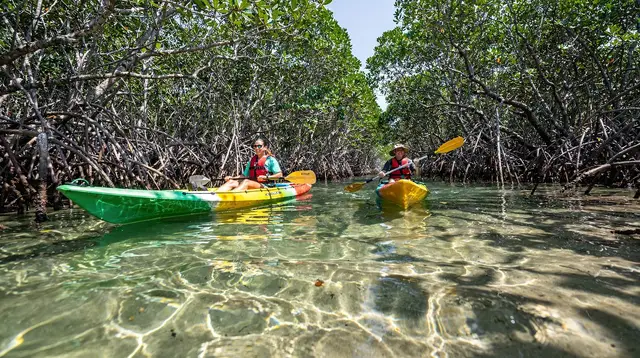
Al Thakira Mangrove Kayaking: The Complete Guide
What is Al Thakira mangrove kayaking like?
It is a low-effort paddle through calm, shallow channels lined with grey mangroves near Al Khor, about 50 km north of Doha. No experience is needed, and most outings run one to two hours with a guide.
Paddling through Qatar’s grey mangroves
Most first-time visitors to Qatar picture desert dunes, not mangroves. Yet on the coast near Al Khor, roughly 50 km north of central Doha, a network of grey mangrove creeks fringes the shoreline at Al Thakira, and kayaking through it has become one of the more relaxed, family-friendly outings in the country. It is not an adrenaline sport. The water is shallow, the channels are sheltered, and the pace is set by the tide rather than by fitness or experience.
This guide explains what a typical trip involves, why the tide is the single most important variable, what wildlife you might realistically see, and how to prepare — without inventing tide tables or promising animals that may or may not show up on your particular day.
Where Al Thakira is and how to get there
Al Thakira sits just north of the town of Al Khor, on Qatar’s northern coast. By road it is around 45 to 60 minutes from central Doha, depending on traffic and exactly where you start from — West Bay, Souq Waqif or The Pearl are all roughly comparable. The Doha Metro does not reach this far north, so getting there independently means a rental car or a taxi/ride-hailing app; almost everyone else goes as part of a guided tour with hotel pickup included, which removes the need to find the launch point yourself.
Because the site is a working tidal mangrove system rather than a fixed attraction with a ticket booth, there is no single “entrance.” Kayaking operators use one or more designated launch points along the creek edge, and the exact spot can shift slightly depending on which channels are paddleable that day.
For a first look at how this fits into a wider itinerary, see north Qatar day trips and the things to do near Al Thakira overview.
Why the tide controls everything
Grey mangroves grow in the intertidal zone, meaning the ground around their roots is submerged at high tide and partly exposed at low tide. The creeks at Al Thakira are shallow to begin with, so the difference between a comfortable paddle and a channel that is simply too shallow to move through can come down to a matter of tide timing on a given day.
This is why departure times for mangrove kayaking tours are not fixed the way a museum’s opening hours are. Operators schedule sessions around the tide window that gives enough water depth to paddle the creeks comfortably, and that window shifts from week to week. We are not going to state a specific tide schedule here, because tide times change constantly and any number printed on a webpage will eventually be wrong — check the exact time with your operator when you book, and expect it to differ from what a friend was told a month earlier.
Practically, this has a few consequences for planning:
- Book a couple of days ahead where possible, since good tide windows can mean a tour is only offered at certain times on certain days.
- Confirm the meeting time close to your date, rather than relying on a time quoted weeks in advance.
- Morning and late-afternoon slots are common, partly because these avoid the harshest midday heat as much as because of the tide, so expect some flexibility in scheduling either way.
Is it actually difficult? No — here is why
It is worth correcting a common assumption directly: Al Thakira mangrove kayaking is not a sporting or strenuous activity, and treating it as one puts people off who would otherwise enjoy it. The creeks are shallow — often only knee to waist deep in places — and largely sheltered from wind and swell by the mangroves themselves and by the layout of the inlets. There are no rapids, no significant current to fight, and no need for advanced paddling technique.
Kayaks used for these tours are typically stable sit-on-top or double (tandem) kayaks, which are much harder to tip than a narrow touring kayak and forgiving of an uneven stroke. Guides give a short briefing and basic paddling instruction on the water before the group sets off, and they generally stay close to less confident paddlers. Life jackets are standard equipment.
In short: reasonable fitness helps, as it does for any activity involving an hour or two of light physical movement, but you do not need to be a strong swimmer, an athlete, or an experienced paddler. Families with children old enough to sit still in a kayak, and travelers who would never consider whitewater kayaking or open-sea paddling, are the typical audience here — see family desert safari Qatar and Doha with kids for how this fits into a family itinerary.
What a typical outing looks like
While details vary by operator, most Al Thakira kayaking trips follow a similar shape:
- Pickup and transfer from your Doha hotel, roughly 45–60 minutes each way to the north coast.
- Arrival and briefing at the launch point, including a life jacket fitting and basic paddling instructions.
- Paddling session, typically one to two hours, moving through the creek system at a gentle pace with stops to look at the surroundings.
- Return transfer to Doha, sometimes combined with a stop elsewhere in north Qatar.
| Element | Typical range |
|---|---|
| Distance from Doha | ~50 km / 45–60 min drive |
| Paddling time | 1–2 hours |
| Total tour length (with transfers) | 3–5 hours |
| Kayak type | Sit-on-top or double kayak |
| Experience needed | None |
| Best avoided | Midday heat in summer |
What wildlife you might see (and what we won’t promise)
Al Thakira’s mangroves support a genuine, if modest, coastal ecosystem, and part of the appeal is the contrast with Doha’s skyline just up the coast. That said, this is a wild tidal habitat, not a managed wildlife park, so nothing here is guaranteed and any operator who promises specific sightings is overstating things.
What visitors commonly report, without any guarantee on a given day:
- Wading birds such as herons and egrets, often seen standing along the muddy banks or in shallow water.
- Crabs, particularly visible in exposed mud at lower tide, scuttling among the mangrove roots.
- Other coastal birdlife, which varies with season and time of day.
- Occasional sightings of other small marine life in the channels, though these are incidental rather than a planned part of the route.
If seeing specific species is your main goal, treat kayaking as a pleasant way to experience the mangrove environment rather than as a wildlife-spotting guarantee. Early morning and late afternoon sessions tend to be quieter and slightly more likely to catch birds active and feeding, but again, this is a tendency, not a rule.
What to wear and bring
- Quick-drying clothing — splashing from paddles and shallow water is normal.
- A hat and reef-safe sunscreen — there is little shade over open water. a combined mangrove paddle and Purple Island stop is a good way to make the most of sun exposure by breaking up the time on the water with a landing.
- Water shoes or sandals with a back strap — the launch area is often muddy.
- A dry bag or waterproof phone pouch — many tours do not supply one.
- A full change of clothes left in the vehicle for the drive back.
- Drinking water, especially outside the cooler months.
Choosing a kayaking tour
Several operators run Al Thakira mangrove kayaking, and the main choices are group size and whether the trip is combined with other north Qatar sights.
A standard small-group mangrove kayaking tour is the simplest option for travelers who just want the paddling experience with hotel transfers included. Those who prefer a more flexible pace or a private group can look at a private kayaking tour to Al Thakira, which typically allows more control over timing within the tide window and a guide’s full attention.
Travelers who want to understand the ecology alongside the paddling might prefer a guided eco and wildlife-focused mangrove kayaking tour, where guides tend to spend more time explaining the mangrove environment rather than simply covering distance.
For a broader look at how these compare, see mangrove kayaking tides and timing and north Qatar kayak and Zubarah combo.
Combining Al Thakira with the rest of north Qatar
Because Al Thakira sits close to Al Khor and is not far from Al Zubarah — Qatar’s only UNESCO World Heritage Site — many visitors combine the kayaking with other north-coast stops rather than making a single-purpose trip. Popular pairings include:
- A visit to Al Zubarah Fort, roughly an hour further along the coast.
- A stop at Purple Island (Jazirat Bin Ghanim), a tidal island near the same mangrove system.
- A wider north Qatar tour that also touches Al Khor town itself.
If you would rather have this planned for you, a north Qatar tour combining Al Zubarah Fort with mangrove kayaking covers both in a single day, and travelers who also want to see Purple Island up close can look at a route like the mangrove kayaking and Purple Island itinerary described above. See Al Khor day trip for how a self-planned version of this route looks.
When to go
Qatar’s climate is the deciding factor as much as the tide. Summer, roughly May to September, brings extreme heat and humidity, and paddling in direct midday sun during these months is genuinely uncomfortable and can be risky if you are not careful with hydration. The cooler months, roughly November to March, are far more pleasant for any outdoor activity, kayaking included. See Qatar cool season outdoor activities and Doha in summer indoor activities for how this affects planning across the year.
Whatever the season, mornings and late afternoons keep you out of the harshest sun, which is a separate consideration from — but often overlaps with — the tide window your operator selects.
Planning your trip
For the wider practicalities of visiting Doha and Qatar, including entry requirements, currency and getting around, see the Doha trip planning checklist and how to book tours in Doha. If you are short on time and trying to prioritize, Doha with limited time priorities explains where a half-day mangrove trip fits against museums, the Corniche and the desert.
Frequently asked questions about Al Thakira mangrove kayaking
Is Al Thakira mangrove kayaking hard or dangerous?
No. The channels are shallow and sheltered from open-sea swell, the current is gentle, and kayaks used here are stable sit-on-top or double kayaks. Guides brief beginners before setting off, and most visitors paddle comfortably with no prior kayaking experience.
Why does the tide matter so much at Al Thakira?
The mangrove creeks are shallow, so water depth changes noticeably between low and high tide. At low tide some channels can become too shallow to paddle through, while a healthy water level opens up more of the creek system. Operators plan departure times around the tide, which is why exact start times shift from booking to booking rather than staying fixed.
What animals might I see while kayaking at Al Thakira?
Sightings vary by day, tide and season and are never guaranteed. Visitors commonly report wading birds such as herons and egrets along the banks, along with crabs in the exposed mud at lower tide. Larger birdlife and other marine life are possible but occasional, not a scheduled part of the trip.
Do I need to know how to swim or kayak before booking?
Swimming ability is not required for most guided tours, since the water is shallow and life jackets are provided. Basic kayaking instruction is given on the water before departure, and guides paddle alongside the group.
What should I wear and bring for mangrove kayaking?
Quick-drying clothes, a hat, reef-safe sunscreen and a change of clothes are the practical basics, since splashing is common. Closed-toe water shoes or sandals with a back strap help on the muddy launch point. A dry bag or waterproof phone pouch is worth bringing if the tour does not supply one.
Can I combine Al Thakira kayaking with other north Qatar sights?
Yes. Al Thakira sits close to Al Khor and roughly an hour from Al Zubarah, so several tours pair the kayaking with a stop at Al Zubarah Fort, Purple Island (Jazirat Bin Ghanim) or the town of Al Jumail on the same half-day or full-day outing.
How long does a mangrove kayaking tour take, including transport?
The paddling itself typically runs one to two hours. Counting hotel pickup from Doha, the drive to Al Khor (around 50 km, roughly 45–60 minutes each way), and time to gear up, a half-day tour usually takes three to five hours door to door.
Is Al Thakira the same as Purple Island?
No, though they are close together and often visited on the same trip. Al Thakira refers to the mangrove area and its kayaking channels near Al Khor, while Purple Island (Jazirat Bin Ghanim) is a nearby tidal island with its own mangrove-fringed shoreline, reached by boat or kayak from the same general area.
Kayaking in the Al Thakira Mangroves
Verified deep-linked GetYourGuide tours. Book through these links and we earn a small commission at no cost to you.
GetYourGuide does not provide a product photo for this activity — the image shows the meeting point, photographed by us.