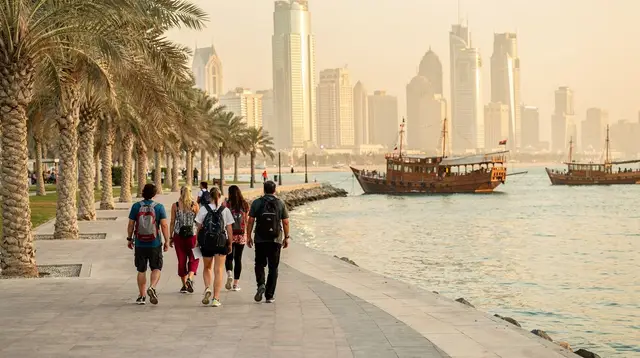
A different Qatar: still water instead of sand
Most first-time visitors picture Qatar as two things: the West Bay skyline and the dunes south of Mesaieed. Al Thakira is neither. It’s a belt of grey mangroves — one of the very few naturally occurring mangrove stands in the Gulf — growing along tidal creeks a short drive north of Doha, next to the fishing town of Al Khor. Instead of engines and dust, the experience here is a kayak paddle, flat water, and the quiet rustle of birds moving through the branches.
It’s a small landscape by area, but it does something none of Doha’s other attractions do: it slows the pace down. There’s no dune bashing, no queue for a museum ticket, no souq crowd. You paddle in, drift along channels between the mangrove roots, and paddle back out. That simplicity is the appeal, and it’s also why timing matters more here than almost anywhere else on this list.
Why the tide and the time of day actually change the trip
Al Thakira sits on a tidal creek system, and mangroves live in the zone the tide covers and uncovers twice a day. At low tide, some channels narrow or expose mud banks, which can make paddling harder or block a route entirely; at higher tide, the same channels open up and boats can move further into the mangrove stand. Operators who run kayak trips here plan around the tide table for that specific day, not around a fixed clock time — which is exactly why this guide won’t give you a tide schedule. Tide times shift daily and change through the year, so the only reliable source is the tour operator’s own booking confirmation or a current tide chart for Al Khor, checked close to your date.
Time of day matters for a second, simpler reason: heat and light. Outside the cooler months, midday sun on open water is intense and there’s little shade among the mangroves. Early morning and the couple of hours before sunset are calmer, cooler, and better for photography — the light sits low and flat across the water, and that’s also when birds are most active, feeding along the exposed mud at the tide’s edge. A guided trip booked for early morning or late afternoon during the cooler season gets you the best version of Al Thakira; the same trip at 1pm in July is a different, much harder experience.
What you’ll actually see on the water
The mangroves at Al Thakira are grey mangroves (locally known as qurm), a hardy, salt-tolerant species that copes with the Gulf’s heat and salinity better than almost anything else that grows here. Paddling among them, you move through narrow channels with the mangrove canopy close on both sides, opening out occasionally into wider lagoon-like stretches.
Birdlife is the other draw, and it’s worth being honest about what that means in practice: this coastline sits on a migratory flyway, and the mix of resident and visiting waterbirds changes with the season, so no guide can honestly promise you’ll see a specific species on a specific day.
What’s fair to say is that herons, egrets and various wading birds are commonly reported around the tidal mudflats and mangrove edges, especially at low tide when feeding grounds are exposed, and that quieter, early-morning paddling gives you the best chance of a close sighting before boat traffic picks up. If birdwatching is your main reason for coming, bring binoculars and treat any list of “guaranteed” species with suspicion — reputable operators will do the same.
Kayaking Al Thakira: what to expect
Kayak trips here are typically guided, in single or tandem sit-on-top kayaks, launching from a jetty or beach access point near Al Thakira or Al Khor. A standard session runs somewhere in the region of one to two hours on the water, though longer or sunset-timed trips are also offered. No previous kayaking experience is usually required — the water inside the mangrove channels is sheltered and flat, nothing like open-sea paddling — but a guide will brief you on paddling technique and where the boat can and can’t go on that day’s tide.
Practically, that means:
- Wear quick-dry clothing; you will get splashed and possibly wet getting in and out.
- Reef-safe sun protection, a hat, and sunglasses — there’s little shade on the water.
- Closed-toe water shoes or sandals with a strap, for the launch point and any muddy sections.
- A dry bag or waterproof phone case if you want photos; conventional phones and cameras don’t mix well with kayak splash.
- Water to drink — even in the cooler season, paddling is more exertion than it looks.
For the full route breakdown, launch points and gear checklist, see our dedicated Al Thakira mangrove kayaking guide, which also covers what changes if you book independently versus through a tour.
Purple Island, next door
A short distance from the main mangrove channels sits Jazirat Bin Ghanim, better known by its English name, Purple Island — a small island with its own mangrove fringe and a low-key historical footnote as a site of ancient dye production, which is where the name comes from. It’s often paired with an Al Thakira kayak trip rather than visited as a separate excursion, since the access point and the tidal considerations are much the same. We’ve written a separate page on what’s actually there and how to combine the two: Purple Island, Qatar.
Combining Al Thakira with the rest of North Qatar
Al Thakira and Al Khor sit roughly halfway along the coast road toward Al Zubarah, Qatar’s only UNESCO World Heritage Site, about a further 50 minutes’ drive north-west. Because a mangrove kayak session only takes a couple of hours and Al Zubarah is a half-day destination in its own right, most visitors treat this as a single long day out from Doha rather than two separate trips. A typical sequence looks like: leave Doha early, kayak Al Thakira in the cooler morning hours, have lunch in Al Khor, then continue to Al Zubarah’s fort and archaeological site in the afternoon.
For that combined route, see our North Qatar tour: Al Zubarah and Al Khor guide, the more focused Al Khor day trip page, or the dedicated Al Zubarah fort visit write-up if the fort and old pearling town are your priority. There’s also a ready-made single-day plan in our one-day North Qatar: Al Zubarah and mangroves itinerary, and a version that adds a second kayak stop at Purple Island in our North Qatar kayak and Al Zubarah combo guide.
Nearby: Al Khor town and the Panda House
Al Khor itself is a working fishing town with its own small waterfront and dhow harbour, worth a short stop before or after the mangroves. It’s also home to the Al Khor Panda House, a modest attraction some visitors combine with the coastal side of a north-Qatar day — a lower-key stop that works well if you’re travelling with children who’ve had enough of open water for one morning.
an Al Khor Panda House visit with return transport from DohaAn aerial view: Purple Island and the coast from above
If you’d rather see the shape of the mangrove channels and the coastline from the air before or after paddling through them at water level, a short helicopter flight over the north coast gives a genuinely different perspective on how the tidal creeks and Purple Island sit against the open Gulf.
a VIP gyrocopter flight that passes over Purple Island and the north coastWhere Al Thakira fits if you’re short on time
Al Thakira is not a must-do in the way the Museum of Islamic Art or a Sealine desert safari are; it’s a strong add-on for travellers who have more than a couple of days in Doha, or who specifically want kayaking and birdwatching on their trip. If you’re planning a first, short visit and weighing up priorities across the whole country, our Doha with limited time: priorities page and general Doha city guide are better starting points than this one. For travellers who do have the time, Al Thakira is one of the best ways to see a side of Qatar that neither the skyline nor the dunes show you.
If you’d rather build a wider Doha day around a guided overview first, a general city or country tour is a reasonable way to get oriented before adding a specialised stop like this one.
a full-day guided tour covering Doha’s main sightsAnd if the desert side of Qatar is still on your list for the same trip, our southern desert coverage sits alongside this north-coast guide rather than replacing it — the two halves of the country feel almost unrelated on the ground.
a desert safari with dune bashing, sandboarding and other activitiesPractical notes before you book
A few points worth flagging before you commit to a kayak slot:
| Consideration | What to know |
|---|---|
| Tide | Channels open and close with the tide; operators choose the time slot, not you |
| Heat | Cooler months (roughly November–March) are far more comfortable on open water |
| Skill level | Sheltered water, suitable for first-time kayakers with a guide |
| Wildlife | Sightings vary by season and tide; never treated as guaranteed |
| Combine with | Al Khor town, Purple Island, or a full North Qatar day to Al Zubarah |
Bookings for mangrove kayaking are usually confirmed with a specific pickup or launch time rather than an open window, precisely because of the tide dependency described above — expect the operator to fix your slot, not the other way round.
Al Thakira mangroves: frequently asked questions
Do I need kayaking experience to visit Al Thakira?
No. Trips run in sheltered tidal channels with a guide, and most operators accept complete beginners in single or tandem sit-on-top kayaks. The water inside the mangroves is calm; it’s nothing like paddling in open sea.
What time of day is best for the mangroves?
Early morning or the couple of hours before sunset, especially outside the hottest months. Light is softer for photography, temperatures are more comfortable, and birds tend to be more active around those times.
Will I definitely see flamingos or other specific birds?
There’s no guarantee. Al Thakira sits on a migratory route and the mix of resident and visiting waterbirds changes with the season and the tide. Treat any promise of a specific species as marketing, not fact, and bring binoculars to make the most of whatever is around on the day.
How does the tide affect a kayak trip?
Mangrove channels are only navigable within certain tide windows; at low tide some routes narrow or expose mud banks. Operators schedule trips around the day’s tide table, which is why kayak sessions are booked with a fixed departure time rather than a flexible one.
How far is Al Thakira from Doha?
Roughly 50–60 minutes’ drive, similar to the town of Al Khor next to it. There’s no metro or tram service this far north, so a car, taxi, ride-hailing app or organised tour is the way to get there.
Can I combine Al Thakira with Al Zubarah in one day?
Yes, and it’s the most common way to see both. Al Zubarah is a further 45–50 minutes past Al Khor, and a kayak session only takes a couple of hours, so many visitors do mangroves in the morning and the fort and archaeological site in the afternoon.
What should I bring on a mangrove kayak trip?
Quick-dry clothing, reef-safe sun protection, a hat, secure water shoes or sandals, drinking water, and a dry bag or waterproof case for a phone or camera. Expect to get splashed.
Is Al Thakira suitable for children?
Sheltered, flat water makes it reasonably approachable for older children with a guide, though most operators set a minimum age or require an accompanying adult in the kayak. Check the specific tour’s age policy before booking, since it varies by operator.