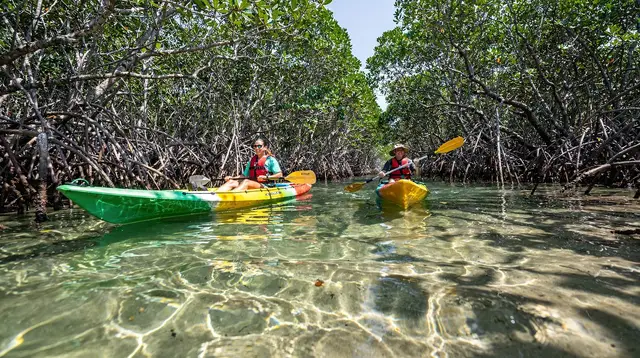
Mangrove Kayaking in Qatar: Tides and Timing Explained
What time of day is best for mangrove kayaking in Qatar?
The best window is usually the first couple of hours after sunrise, when the water is calmer and the heat hasn't built up yet. The exact time within any given week also depends on the tide, since a low tide can leave the mangrove channels too shallow to paddle. Book a guided departure rather than fixing a time yourself, since operators check the tide and adjust the slot.
Why the mangroves run on their own clock
Most activities in and around Doha can be booked for whatever hour suits you. Mangrove kayaking is one of the few that cannot, because the water you paddle on is not a lake or a marina — it is a tidal system. The grey mangroves of Al Thakira, on the coast near Al Khor, and the channels around Purple Island sit inside a shallow inlet where the sea rises and falls twice a day. That single fact, more than anything else, decides when a kayaking trip can actually happen.
This page does not give you a tide table or a temperature chart. Those numbers change by the day and by the season, and a printed figure goes stale within a week. What matters more, and stays true year-round, is understanding the two forces at work — tide and heat — well enough to know why your booked departure time might shift, and why that is normal rather than a problem with the operator.
Tide: the reason the channel is sometimes just mud
The mangrove creeks at Al Thakira and around Purple Island are not permanently full of water. They are tidal channels cut through flat coastal ground, and their depth changes constantly through the day as the Gulf tide moves in and out. At high tide, water pushes back up into the channels, floods around the base of the mangrove stands, and gives a kayak enough depth to glide through comfortably. At low tide, a lot of that same channel network drains away, leaving exposed mudflats, thin trickles of water and stretches too shallow for a loaded kayak to pass.
This is why a guide sometimes has to ask a group to step out and walk the kayak a short distance across soft mud before the water deepens again further along the channel. It is slow, it is messy, and it is not what most people picture when they imagine a scenic paddle through mangroves. Reputable operators try hard to avoid putting guests in that position, which is exactly why the departure time you are quoted when you first look at a tour is often provisional rather than fixed.
None of this means you need to become an amateur tide-watcher before your trip. Tide levels in this part of the Gulf shift in a broadly predictable daily pattern, and tracking that pattern is squarely the guide’s job, not yours. What is worth understanding is simply that the “best” time to go changes from week to week, which is a structural feature of paddling a tidal mangrove system, not an inconvenience specific to Qatar.
Heat: why summer forces an extremely early start
Layered on top of the tide is Qatar’s climate. Roughly from May to September, Doha and the coast run extremely hot and humid, routinely well above 40°C in the shade by the middle of the day. The mangrove channels sit low, sheltered and close to still water, which is a setting that traps heat rather than dissipating it — there is often little breeze down inside the channels even when it is windier out on open water.
Paddling under a summer midday sun in that kind of enclosed, humid pocket is not simply unpleasant, it carries real heat-stress and dehydration risk, particularly for anyone unused to Gulf summer conditions. Operators respond by pushing the entire activity to the coolest part of the day, which in summer means departures at or before sunrise, often finishing before the heat has properly built. A summer trip booked for mid-morning, let alone midday, is not something reputable kayaking operators offer.
In the cooler months, roughly November to March, this pressure eases considerably. Mornings and evenings are comfortable, and even midday paddling, while still warm, is far more manageable. This is when you start to see later morning slots and genuine sunset departures on offer, because the heat constraint that dominates summer scheduling has largely lifted.
How tide and heat combine to set your actual departure
Put the two factors together and the logic of mangrove kayoking scheduling becomes clear:
| Season | Main constraint | Typical departure pattern |
|---|---|---|
| Summer (roughly May–September) | Heat, overwhelmingly | Very early morning only, adjusted slightly earlier or later within that window by the tide |
| Cool season (roughly November–March) | Tide, primarily | Morning or late-afternoon/sunset slots, whichever aligns with a workable tide that day |
| Shoulder months (April, October) | Both, in balance | Morning strongly preferred; exact slot set by the tide |
Notice that heat sets the outer boundary — it rules certain hours out entirely during summer — while the tide fine-tunes the exact time within whatever window the season allows. That is why two people booking what looks like the same tour, one in July and one in January, can end up with a departure time hours apart, and why even two people booking a week apart in the same month can be given slightly different times.
Purple Island and Al Thakira: same rules, slightly different logistics
Al Thakira’s mangrove forest and the channels around Purple Island (Jazirat Bin Ghanim) sit right next to each other on the same stretch of coast near Al Khor, and they share the same tidal system, so the tide-and-heat logic above applies equally to both. Most guided routes actually combine the two in a single outing, paddling out through the Al Thakira mangroves before crossing open channel toward Purple Island and back, rather than treating them as two separate trips with two separate timings.
Because they are one connected system, there is no version of “Purple Island is fine at low tide even if Al Thakira isn’t.” A guide planning a Purple Island stop checks the same tide window that governs the mangrove paddle itself, and builds the whole route, including any short landing on Purple Island, around that single window. If your main interest is Purple Island specifically rather than the mangroves themselves, it is still worth booking a mangrove-and-Purple-Island combination rather than trying to find a Purple-Island-only slot, since in practice the two are reached by the same channels and the same tide-dependent access.
Group departures versus private timing flexibility
The FAQ above touches on this, but it is worth spelling out because it affects how much control you actually have over your slot. A fixed-departure group tour publishes a small number of daily windows and assigns you to whichever one fits that day’s tide and season; you can request a preference, but the operator ultimately sets the time close to the date. A private booking works the same way in principle, since the same tide and heat constraints still apply, but there is more room to shift the exact hour within the workable window, or to start slightly earlier or later than a group would, since the operator is not also coordinating other guests’ schedules.
a private kayaking tour to the Al Thakira mangrove forest and a private Purple Island mangroves kayaking outing both work this way: still governed by the tide, but with more say over exactly when within that window you go out. If your schedule is tight, for instance on a short stopover, this extra flexibility can matter more than it first appears, since a group slot that lands mid-afternoon on a hot-season day may simply not exist, while a private booking can sometimes be nudged into an earlier or later hour that a fixed group departure could not accommodate.
What happens if you ignore the timing advice anyway
It is worth being direct about what goes wrong if you try to book mangrove kayaking exactly when it suits your itinerary rather than when the tide and season allow it. In summer, requesting a late-morning or midday slot either gets turned down outright by a well-run operator, or, worse, gets accepted by one that is less careful about heat safety, in which case you are the one paddling through a sheltered, humid channel in the hottest part of a Gulf summer day. In the cooler months, ignoring the tide window is less about safety and more about wasted time: arriving to find the channel too shallow to paddle, or spending part of the outing walking a kayak across mud instead of gliding through mangroves.
Neither outcome is necessary, since every reputable operator already builds their schedule around these two constraints. The only real cost of respecting the timing is a small loss of control over your exact hour, which is a minor trade-off against either a genuinely unsafe summer paddle or a disappointing low-tide mudflat crawl.
Why light also plays a role, but a smaller one
Beyond tide and heat, the quality of light shapes the experience rather than deciding whether the trip can run at all. Early morning light, low and soft, tends to bring out the grey-green colour of the mangroves and works well for photos of Purple Island and the surrounding channels before the haze of the day sets in. Sunset paddles, where the season allows them, give warmer light and often calmer water as the wind drops toward evening, at the cost of less time before dusk to finish the route.
Neither option is objectively better. A photographer or an early riser may prefer the crisp morning light; someone on a relaxed cool-season itinerary who is not an early riser may prefer a late-afternoon slot instead. What both share is that they are secondary to tide and heat — a beautiful sunset slot is not offered in the middle of summer no matter how good the light would be, because the heat rules it out first.
What this means when you book
The practical takeaway is straightforward: do not try to lock in an exact hour yourself weeks in advance, and do not be surprised if the confirmed time differs slightly from what a listing first suggested. A well-run Al Thakira mangrove kayaking trip typically works like this:
- You book a date, sometimes with a rough morning or afternoon preference.
- Closer to the day, once the operator knows that date’s tide, they confirm an exact pickup or meeting time.
- On the day itself, in summer, that time is early — often before or right around sunrise.
- In cooler months, the confirmed time may be a later morning slot, or a sunset departure, depending on how the tide lines up.
This is also the strongest argument for booking a guided trip rather than trying to arrange independent kayak access to the mangroves. A guide holds the local knowledge of how that week’s tides are running and reworks the schedule accordingly, which is far more reliable than guessing from general seasonal rules.
a guided kayaking route through the mangroves and around Purple Island, with the departure time set once the tide for your date is knownWhat to expect on the day, whatever the hour
Regardless of whether your slot ends up being a summer sunrise or a cool-season sunset, a few things stay constant. You will get a short safety and paddling briefing before setting out, life jackets are provided and required, and the guide leads the group at a pace that suits the slowest paddler, since the channels are narrow enough that the group generally has to move together. Most outings run one to two hours of actual paddling.
Bring water, since there is nowhere to buy any once you are on the channels, and reef-safe sunscreen applied before you leave rather than once you are already on the water. For an early start, a light layer is worth having, since the air before sunrise on the coast can feel noticeably cool despite the daytime heat to come. Footwear that can get wet is sensible even on days when the tide keeps you afloat the entire time, since getting in and out at the launch point often means a few steps through shallow water or soft ground either way.
a small-group mangrove forest kayaking tour out of Al Thakira and a private one-hour kayaking session in the Al Thakira reserve both fall into this same pattern: a confirmed date, and a time finalised once the operator has checked that day’s tide.
Combining the timing with a wider north Qatar day
Because the mangroves sit up on the north coast, an early finish to a summer kayaking trip, or a late-afternoon cool-season one, fits naturally into a longer day exploring north Qatar. A common pattern is an early paddle followed by a relaxed late morning and early afternoon visiting Al Khor town and the Al Zubarah fort and archaeological site, before heading back to Doha in the cooler part of the late afternoon.
In the cool season, the order can flip, with a fort visit in the morning and a sunset kayak to close the day. Either way, treating the kayaking slot as the fixed point that everything else is arranged around, rather than the other way round, tends to produce a smoother itinerary — this is broadly how a north Qatar and Zubarah combo route is usually structured, and it maps onto a standalone one-day north Qatar and mangroves itinerary just as well.
a guided north Qatar day that pairs mangrove kayaking with other coastal stops is one way to let a single operator handle both the tide-dependent timing and the rest of the day’s logistics.
Choosing your season with timing in mind
If your travel dates are flexible and mangrove kayaking is a priority rather than an add-on, the cool season, roughly November to March, gives you more freedom over when in the day you go, including a genuine sunset option. Travelling in the hotter months does not rule the activity out, but it does mean accepting a very early start as the only realistic way to do it safely and comfortably.
For a broader read on when to schedule a Qatar trip around weather generally, the best time to visit Doha overview and the seasonal planning tool cover the wider picture beyond kayaking alone. Whatever the season, pack with the early or late hours in mind — the Doha packing guide covers the layers worth having for a pre-dawn departure.
For a look at the full range of ways to get out on Qatar’s water, including options beyond the mangroves, the kayaking and mangroves category and the things to do in Al Thakira pages list the current guided options side by side.
Kayaking in the Al Thakira Mangroves
Verified deep-linked GetYourGuide tours. Book through these links and we earn a small commission at no cost to you.
GetYourGuide does not provide a product photo for this activity — the image shows the meeting point, photographed by us.